
Just Add Water to Your Photos (Part I)
A pictorial of shallow underwater photography


I have never considered myself to be much of a photographer. Before I started scuba diving, my photography was simple. I would point and shoot, hoping for good family portraits or holiday snaps.
In the old days, you’d take your film to the chemist or camera shop. Then, you’d wait about seven days. After that, you’d pick up your printed photos. Sad to say, most of these are still sitting in a box waiting for that fearful day when I finally dare to throw them away.
When I started going on tropical holidays, that all changed. I started to take it a bit more seriously.
This is the first of two stories about my underwater photography. It focuses on shallow diving/snorkelling at depths of less than 5 meters (15 feet).
The second story is about my time in deep water. You can only reach it with scuba gear. It’s more than 10 meters, or 30 feet, deep. Both are great environments. Both stories are pictorials rather than detailed dialogue.
I started diving about thirty years ago. I was spurred on to dive after my first trip to the Maldives. I had bought a lightweight housing for an existing Canon camera and done a lot of snorkelling. The waters were so clear, and the coral reefs teemed with life.
I spent hours shooting. Storage on SD cards has changed photography. Now, there are no limits on how many photos you can take.
There are two essential variables to appreciate in underwater photography. First, you usually don't have much time to sort out your shots. You deal with constant movement as fish move with the swell and the currents. You also move with the swell and the currents, so it is a double whammy.
You can capture amazing shots by shooting across a reef edge. This technique highlights movement and depth of field, just like in this image.

The second factor with underwater photography is the light penetration and water clarity. Underwater, it can be tough to adjust for cloudy or dull conditions above. This is even harder when the water itself is cloudy. This is more of a problem, as we will see in the second story, when shooting in deeper water.
Even in poor conditions, focusing on sedentary creatures can be rewarding. These giant clams were photographed at Lizard Island in far north Queensland, Australia.
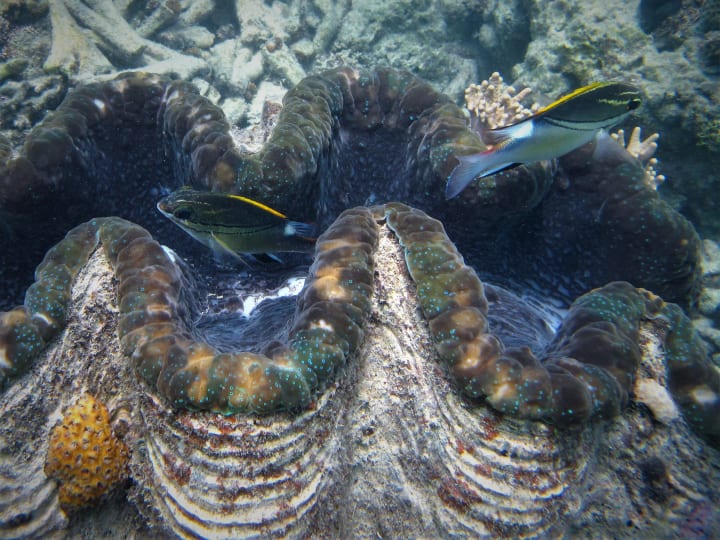
Finding subjects that stand out against a dark background helps beginners take great photos, such as this scorpionfish and the pair of Pipefish.


There is a perception that underwater photography in shallow water is a waste of time. I disagree. If you are sure not to dive and nobody else is, there are still many hours to spend in shallow water. On the right day, it can be more rewarding than photography in deeper water.
I remember several days at a resort in the Maldives. In only waist-high water, alongside schools of fish near the pier. I observed schools of trevally hunting for bait fish. Meanwhile, reef sharks chased their meals around the pylons. It kept me entertained for hours. At these depths, you can play around and even get split shots, half above and half underwater.

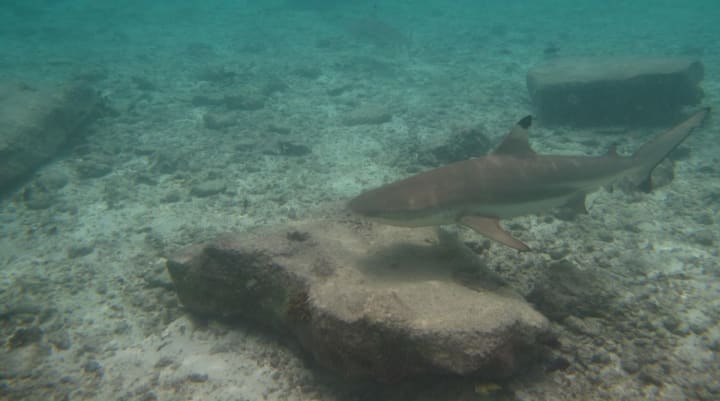
On a bright, sunny day, you can see vibrant colours in shallow water. For example, look at this bannerfish school.
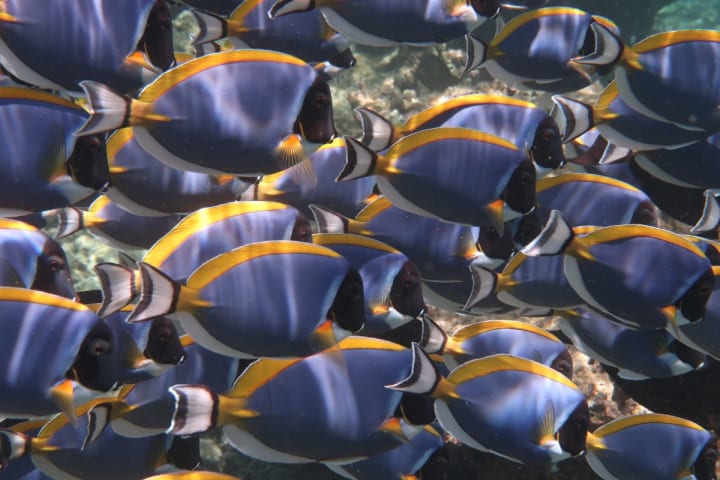
Don’t listen to anyone who says photographing underwater at shallow depths is boring. Even an unskilled photographer can achieve excellent colour differentiation. Natural light improves colour and clarity. It also gives you more flexibility with your camera settings, even in automatic mode.
In the right spot, you could be lucky enough to see a turtle travelling across a reef looking for sea lettuce.

Till next time,
Calvin
[Author’s note: This story is part of a personal challenge to contribute to each of the communities on Vocal. I have now contributed to 29 of the 48 communities.]
About the Creator
Calvin London
I write fiction, non-fiction and poetry about all things weird and wonderful, past and present. Life is full of different things to spark your imagination. All you have to do is embrace it - join me on my journey.
Keep reading
More stories from Calvin London and writers in Photography and other communities.
My Year, in Prattling and Photos
It's been a year since... last year. Ironically, it seems I've found myself a new tradition of getting sick during the New Year holidays. At least, this year (that is, this inter-year period remarkable for its shiny decorations in the streets and houses, and closed supermarkets and pretty much everything), I'm doubtlessly doing better: I've managed to come visit my friends in Germany for Christmas (which I failed to do last year) and—after having some good quality time eating machanka, playing Munchkin and swinging machetes (the last one obviously crept into this checklist only for the sake of the phonological form)—I came back home via proverbial Deutche Bahn and probably less known Schweizerische Bundesbahnen, my body hosting a family of viruses, virions and who knows what other tiny critters somewhere inside my chest.
By Andrei Z.9 days ago in Photography
Debunking False Claims About the Minneapolis ICE Shooting
In the days following the fatal shooting of a woman in Minneapolis involving a US immigration enforcement agent, social media has been flooded with claims, counterclaims, and speculation. As protests spread and emotions run high, misinformation has traveled faster than verified facts, deepening confusion and mistrust.
By Aarif Lashari2 days ago in Photography


Comments (3)
Wow you are so interesting. I love the photographs this is a Top Story It amazing🏆🏆🏆🏆
Thanks for sharing these amazing shots, we don't see many in this community
Nice going, Calvin. Great photos. I admire all those who scuba as I don’t want to. I don’t even like walking the beach or hot sun for more than ten minutes any longer. So many amazing things we cannot see up top, huh?