
A Common Everyday Habit That Severely Impacts Mental Health
How Short Videos Are Quietly Rewiring Young Minds—The Hidden Mental Health Crisis Fueled by Endless Scrolling

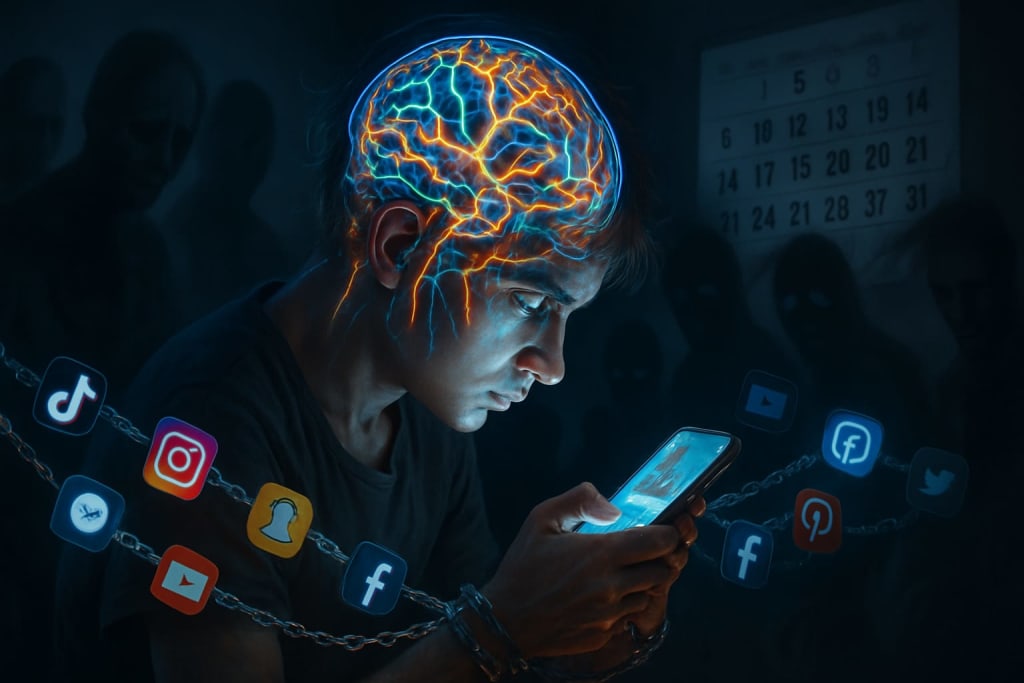
A new study conducted in China has revealed that short videos shared on social media platforms can become so addictive that they significantly damage mental health. According to research published in the medical journals Nature and NeuroImage, these short videos are emerging as a dangerous habit leading to various brain-related disorders.
The researchers found that watching short videos weakens a person’s decision-making ability and keeps them in a constant state of mental stress. During the study, health data from more than 2,500 young people were analyzed. The participants were divided into three groups: one group was exposed to frequent short videos, the second group was kept completely away from them, and the third group was given only limited access.
The results were striking. In the group allowed to watch short videos, more than 500 university students developed a compulsive habit that changed their mental health over time. MRI brain scans and neurocognitive tests showed changes in areas of the brain responsible for emotional regulation, impulse control, and reward sensitivity.
Experts explained that this compulsive use of short videos is very similar to the way gambling or drug addiction affects the brain. These platforms are designed to constantly trigger the release of dopamine—a neurotransmitter linked to pleasure and reward. Each time a person scrolls to the next video, the brain experiences a mini-reward. Over time, this loop makes it increasingly difficult for the brain to function normally without constant stimulation.
One of the alarming discoveries of the study was how rapidly these changes occur. Even young, otherwise healthy individuals showed signs of depression, increased anxiety, and reduced self-control after just a few weeks of heavy short-video consumption. In fact, the researchers noted that these brain changes can persist even after reducing screen time, indicating a long-lasting impact.
If we look at the statistics from China alone, the scale of the problem becomes clear. Approximately 95.5% of internet users in China spend an average of 151 minutes per day watching short videos. This translates to millions of young people unintentionally harming their mental well-being. The research also highlighted that the most affected were adolescents and university students, whose brains are still developing and are more susceptible to addictive patterns.
Researchers also warned about the phenomenon of “endless scrolling.” Unlike traditional television or movies with a clear beginning and end, short-video platforms are specifically engineered to keep people engaged for as long as possible. The algorithm tailors content to match the user’s preferences, making it difficult to stop watching. This habit can easily consume hours without the viewer realizing how much time has passed.
Another critical point emphasized by the study is the decline in executive functioning. This includes the ability to plan, resist impulses, and judge risks accurately. Participants who spent more time on short videos were more likely to make rash decisions and struggled to concentrate on tasks requiring sustained attention. Many described feeling mentally “foggy” or emotionally drained after long periods of scrolling.
The researchers also explored the social consequences. Excessive engagement with short videos often replaces time that could be spent on physical activity, face-to-face social interaction, and hobbies—all of which are crucial for a balanced and fulfilling life. Over time, this isolation can exacerbate feelings of loneliness and depression.
Based on their findings, the experts offered several recommendations to protect mental health:
1. Limit the daily duration of short-video consumption. Setting specific time boundaries (e.g., no more than 30–45 minutes per day) can help prevent the formation of addictive patterns.
2. Engage in regular physical exercise. Even moderate activity, such as walking or stretching, can help restore healthy dopamine levels and reduce anxiety.
3. Increase offline activities and hobbies. Reading, creative pursuits, and socializing in person provide a more balanced and enriching environment.
4. Practice mindful technology use. Turn off notifications, avoid watching videos before bed, and consider using apps that track and limit screen time.
5. Seek professional support if needed. If you notice persistent feelings of sadness, lack of motivation, or difficulty controlling screen time, it may be helpful to consult a mental health professional.
The researchers concluded that although short videos can be entertaining and educational in moderation, their addictive potential should not be underestimated. Like any technology, they should be used mindfully, with awareness of how they impact the brain and behavior.
Ultimately, protecting your mental health requires conscious effort in today’s digital world. While technology has brought unprecedented access to information and connection, it has also introduced new risks. By understanding these challenges and taking proactive steps, individuals can enjoy the benefits of technology without sacrificing their well-being.
About the Creator
THE SPHERICAL SPACETIME - ALEXIS KARPOUZOS
I. The Question of a Spacetime without Centre From Aristotle to Kant, Western philosophy approached space and time primarily as conditions of the possibility of experience or as properties of reality. In the Aristotelian tradition, space is defined topologically — as the place of bodies — and time arithmetically — as 'the number of motions with respect to before and after'. In Kantian critical philosophy, space and time become a priori forms of intuition, transcendental conditions of all phenomenal experience. Yet in both traditions a common assumption is preserved: space and time are structures that organise phenomena from a — however implicit — centre of reference. Alexis Karpouzos radically challenges this assumption. The Spherical Spacetime he introduces is neither place nor intuition; it is a dynamic ontological structure that refuses every privileged point of reference, every external centre, every principle that precedes the very movement of the world. The question posed from the outset is this: what does it mean to think a spacetime that does not 'contain' beings but is the very manner in which beings are? And what ontological consequences does this displacement carry for the understanding of existence, consciousness, and truth?
By alexis karpouzosabout 11 hours ago in Education
Natural Ways to Clear Blackheads and Whiteheads
Blackheads and whiteheads are very common skin problems that affect people of all ages. They usually appear on the nose, chin, forehead, and sometimes on the cheeks. These small bumps form when the pores of the skin become clogged with oil, dead skin cells, and dirt. Blackheads appear dark because the clogged material inside the pore reacts with air and becomes oxidized, while whiteheads remain covered by skin, giving them a white or flesh-colored appearance.
By DigitalAddi7 days ago in Education
My First Time Skiing and I Got Lost, Alone, in the French Alps
Looking back, I can trace some of my life’s biggest adventures to a simple action from my sister. She’d introduced me to Tommy (a very long time ago), a colleague of hers, who had overshared his penchant for Italian-looking women, and I ticked that box.
By Chantal Christie Weissa day ago in Humans



Comments
There are no comments for this story
Be the first to respond and start the conversation.