
A Child's School Fear is a worrying mental health problem....
School Phobia

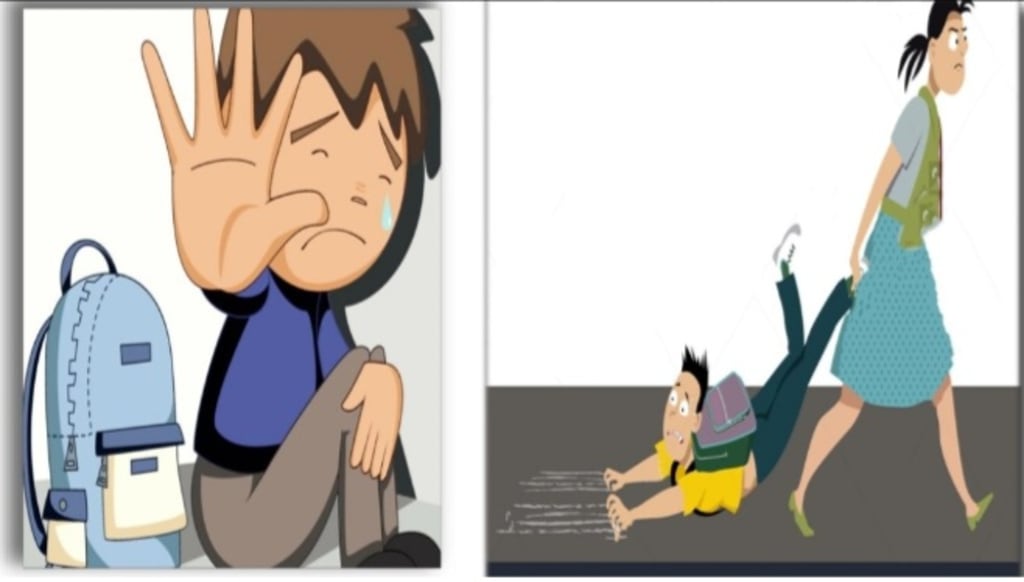
It was nine o'clock in the morning. Suddenly Sneha's chest began to throb. Also she was feeling nauseatic. She began to stroll from one room to another. The time was also running out. With all these things in her head, she went to take a bath. Everything seemed to be moving slowly that day, it would be wrong to say 'Everything', all her work was going on at a slow pace. She tried to vomit but failed. As she sat down to eat, her father asked her, "What? Feeling nervous?"
Actually that day was the first day of Sneha's new school. She has been admitted in class five in that school. Before that, she went to another school(class 1 to 4), where she was brilliant and everyone's favorite student. But today she has to go to a completely unknown place, where she does not know anyone, she knows nothing. Everything seems to be beyond imagination. Thinking about all these, her tension reached peak and the restless mind was accompanying her. Before proceeding further, let me say something about her –––>>> *She is the only child of her parents. Her parents both work. Most of the time since childhood she has grown up under housemaids. All her relatives lived far away, as a result, she only met them once or twice a year. There was no one nearby of her age to talk to. The school she attended earlier had no or very less English speaking habits, so she did not have the fluency to speak English. Her nature— shy, less expressive, calm, little timid, very sensitive and simple. Later on, she had gone through many problem in that school with not being able to speak fluently in English. Many times she has been the victim of misunderstandings among the teachers but she couldn't explain. Also the above-mentioned character of her has caused more or less problems. As a result, she began to fear the teachers, couldn't concentrate on studies, had difficulties in making friends and all. After one year she began to develop some kind of OCDs. All these resulted in "SCHOOL PHOBIA". *
Such children with school phobia are usually very sensitive, shy, dreamy, anxious and emotionally immature. They lack self-confidence and have a pervasive sense of imperfection. They usually become overly dependent on their parents to cope with their fears. These children suffer from insecurity and do not know how to cope with these emotions. Their anxiety increases when they leave their family and home and go somewhere. At first the child complains about a minor matter. For example, the teacher of the school did not like him, this school is not good, his classmates do not want to play with him, etc. Later the child does not want to go to school, cries and goes to school late. At one point he would stop going to school. Even when thinking about going to school, the child becomes anxious and feels physically ill. 1% to 5% of school going children have school phobia or school refusal. This problem is more common in children between the ages of five and six or seven to eleven. However, school phobia is also seen in other children and among adults. This problem is more common in the only child of the family, the youngest child or the child who often suffers from diseases.
Children with school phobia almost always complain of illness. They may have headaches, abdominal pain, sore throats, a feeling that something is stuck in the throat, they often cry. The feeling of sickness usually goes away when he makes sure that he don't have to go to school. While at school, the child becomes extra anxious about his parents. Sometimes he gets very angry. Often goes to school late, becomes absent from school especially on important days, such as during exams or any special class. Even after going to school, he often asks permission to leave home due to illness. At one point he stops going to school.
The causes of school phobia :
1) School phobia occurs for various reasons. This can happen when there is a change in the child's life. For example, at the beginning of the first school, at the beginning of primary to secondary school, after the death of one of the parents or after the divorce of the parents. School phobia can start even after the death of a pet. It can happen before going to a class, after a holiday or even after his class has started after a long illness.
2) Problems adapting to new environments and new classmates can create school phobias. For example, the child may not have had proper toilet training. He has to take the help of the parents to go to the toilet. Now he may feel uncomfortable going to the school toilet. Or maybe the school staff scolded him for going to the bathroom again and again. Or there is not enough light and air in the classroom etc.
3) The child may want to avoid an exam, a specific class, or a group presentation. This may be the beginning of his school phobia.
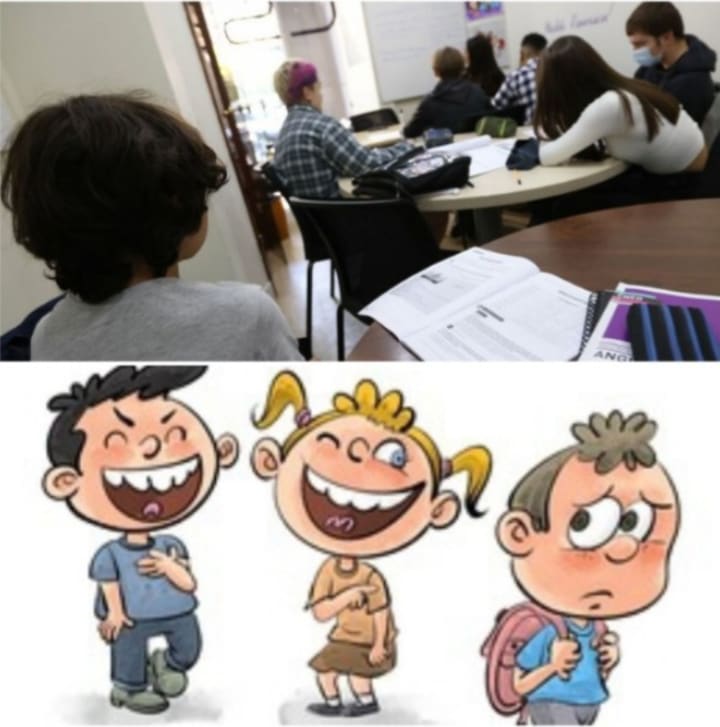
4) The child may want to avoid interacting with other children. He may be very shy or may have social phobia or social fear. As a result, he is afraid of the presence of other classmates and teachers and wants to avoid these and avoid school. He is afraid to live in a new environment, with new people. As a result, he does not want to go to school.
5) He may be seeking the attention of someone significant outside of school. This may happen if he gets the full attention and company of one of his parents, then school phobia can occur. If one of the parents says that the child may be in danger while going away from them, then the child will feel insecure in the school environment and will want to drop out of school.
6) If the child does not go to school due to the computer games, watching television or engaging in such fun and exciting activities and does not have to study at that particular time, then the issue of not going to school becomes more mature.
7) Sometimes parents and teachers have high expectations from the child and even the child himself begins to think that he will do well in the test. But if he has a lack of ability or lack of self-confidence to do well, then the child becomes anxious. Fear of doing badly in tests or evaluations overwhelms him. The result leads to school phobia.
8) If a child continues to do poorly in exams, if he has an intellectual disability or a specific learning disability (as a result he will continue to do badly in studies), he may lose interest in school, studies and refuse to go to school out of fear.
9) If other children in the school or class beat, abuse, or intimidate the child, then the child does not want to go to school. The child may be bullied because of the features that are not as good as others, such as being fat, thinner, taller, or more black. If for some reason the teacher or any other school-employee beats or abuses the child in the same way, the child will not want to go to school.
10) When a school teacher always makes negative criticisms or punishes the child physically or emotionally, the child loses interest in going to school.
11) The child may be anxious about his own family, parents and siblings and may want to stay at home without coming to school. Anxiety about family can increase in a child if there is family unrest, quarrels at home or too much trouble with neighbors.
12) School phobia can be a manifestation of various mental illnesses. The child may be suffering from anxiety, depression, psychosis, conduct disorder, separation anxiety disorder, generalized anxiety disorder, learning disability etc. As a result, he became afraid of school and started skipping school. The child may have sleep disorders. For example, due to delayed sleep phase syndrome (DSPS), children cannot sleep easily. As a result, he cannot wake up in the morning and go to school.
Some steps to solve school phobia :
• Parents and guardians will have to encourage the child to go to school. If the child cannot do it at once, let him do it gradually to return school with courage. The child should not be forced to go to school in the first place, it can be counterproductive. Both the family and the school have to work in close coordination. They need to help each other with information and advice.
• A counselor or a teacher at the school may pay special attention to the child. After talking to the school phobic child, if he finds any problem with his research, he can take immediate action and give the child emotional support to make the environment conducive to him while he is at school. Teachers can also add one or two children to the child's class to provide emotional support to the child. As a result, the child will get interest in going to school.
• If the child does not want to go to school, the parents can talk to the child, to the child's classmates or their parents, to the child's teachers, to the school staff and authorities, to the psychologist in the school. It has to be solved. If another child beats or intimidates this child, appropriate steps must be taken to ensure the child's safety. If a teacher does this for any reason, it should be stopped by conversation. In this case, the school authorities, teachers and staff must work together to ensure that such incidents do not happen again.
• Parents and teachers need to be proactive in giving children the opportunity to play with other children of the same age. As a result, the frightened child will get emotional support in school. He will be interested in coming to school through play.
• The school authorities should help the child to develop an environment in which he can develop the good qualities that he has, the things that he can do well. As a result, the child's self-confidence will increase. He will feel better at school.
• If a child is constantly failing in tests, the cause must be investigated. If the child's intelligence is tested and his intelligence is found to be much less, he should be given to follow a special syllabus according to his mental ability, his school should evaluate him accordingly, give him homework in that way. This is why it is beneficial for these children to have special education teachers (who are specially trained to teach children with intellectual disabilities) in general schools and to have some special classes under the supervision of special education teachers. The school authorities and the government should take such an initiative.
• Parents should be regularly present with the school phobic child at various school events, such as class party, functions, parents day etc.
• Parents will encourage the child, telling him that his family will be fine even if he goes to school. After returning home, he will find his parents in good condition. If there is a family quarrel, it should be settled. If anyone in the family has anger or drug addiction or any other mental problem, they should be given proper treatment. Parents need to stop saying some kind of words in front of the child to weaken him emotionally. For example, "I will go away, I will die, and you will never see me again" - such harmful words must be stopped. Rather, he should be assured that everything will be fine. If the family problem is excessive, then if necessary, the whole family can solve the problem with a kind of psychotherapy called family therapy. Parents should also stop saying that – 'In the absence of their parents, their child may be in danger at school, or there is no problem even if they do not take classes and only study at home'.
• The child needs to do relaxation exercises, through which he will learn to reduce his anxiety. The child should be allowed to read or listen to books that increase his courage and self-confidence. Similar movies can be shown to him. The child can be trained for the situation of feeling bad at school and how to adapt to it. As a result, he will be brave to go to school.
• Parents and teachers should occasionally commend the child for such desirable behavior in going to school and studying. He can be encouraged with small prizes, such as food of choice, small toys, taking him on a trip...... as a result, the child will be encouraged in these activities.
• Parents need to make sure that, at the time of his school the child does not have any fun activities at home or that particular time does not turn out to be a good time for him.
• Among the parents who can best encourage the child to go to school, sometimes it is better to do the work of bringing the child to and from school by one of them.
• Parents and guardians can take skill training on various aspects of child rearing methods and child issues. They can learn about this from the internet or from psychologists.
Even if all these fails, then get ideas from psychiatrists or psychologists who can solve such problems with the help of a type of psychotherapy called Cognitive Behavior Therapy. In many cases good results are obtained by providing alternative education for school phobic children. If school phobia is a manifestation of a mental illness, it is important to ensure proper treatment for the underlying mental illness. Psychiatric medications can be used to help with very severe school phobias of the worst kind. Schools in the developed world employ school counselors or school psychologists. These counselors identify the problem at the very beginning and take initiative to solve it.
If the school does not take the initiative to solve the phobia properly, the result will be bad. In addition to ruining the education of this child, the routine of life can also get ruined. He will get out of the habit of waking up at the right time, eating on time, taking care of himself, brushing his teeth, bathing and sleeping on time. He will not be able to play and make friends with children of his age. As a result, he will be deprived of physical and mental pleasure and proper mental, social and physical development. Such children are more likely to develop death fears, anxiety disorders, and other mental illnesses at an older age. Therefore, it is especially necessary to eradicate school phobia through the joint efforts of parents, schools and experts.
About the Creator
Keep reading
More stories from Dr. Tulika Sarkar and writers in Education and other communities.
There was time but it didn't work
Due to the corona outbreak, the movement of students in the campus was stopped overnight last year. The assessment season was underway under various Central and State Boards of Education across the country. Unscientific assessments at the higher secondary level had to be accepted despite reluctance. Even today, at the upper primary level, study is stagnant, everyone has passed the class without evaluation. Although the situation was not normal before the second wave came, everything was started for the sake of the economy, only education was outcast. Excuse protection. Although in rural and suburban schools most of the time students come for mid-day meal every month.
By Dr. Tulika Sarkar3 years ago in Education
What Should Be Your Main Focus During an Online Limited Radiology Tech Program
Well, the short answer is that there is not a single module that you should strictly focus on. If you want to become a X-ray technician, you need to develop both technical and soft skills.
By Meaghan Howe3 days ago in Education
Precision in Motion: The Rise of Sport Shooting and Firearms in Modern Competition
Sport shooting has grown from a simple test of aim into a structured sport that demands discipline, patience, and technical skill. Today, sport shooting and firearms play a major role in global competitions, training programs, and recreational events. Athletes train for years to improve accuracy and control. They study equipment, posture, breathing, and focus. Because of this dedication, sport shooting has become a respected sport that rewards precision and calm thinking.
By Matthew Pothoff2 days ago in Education
Hottest in the Office
Dear Rafi, You’re very distracting to work around. For the first second I saw you the other day, I thought you were some type of executive. It took a moment to realize no, you were just the new guy, dressed up for the job he wants. Be still, my heart.
By Gabriel Shames5 days ago in Pride



Comments
There are no comments for this story
Be the first to respond and start the conversation.