
5-Step Process for Newbies to Draft a Balance Sheet in Their Accounting Assignment
New to accounting? Learn the 5-step process to draft a balance sheet for your assignment with ease. Perfect for beginners aiming to master the basics quickly.

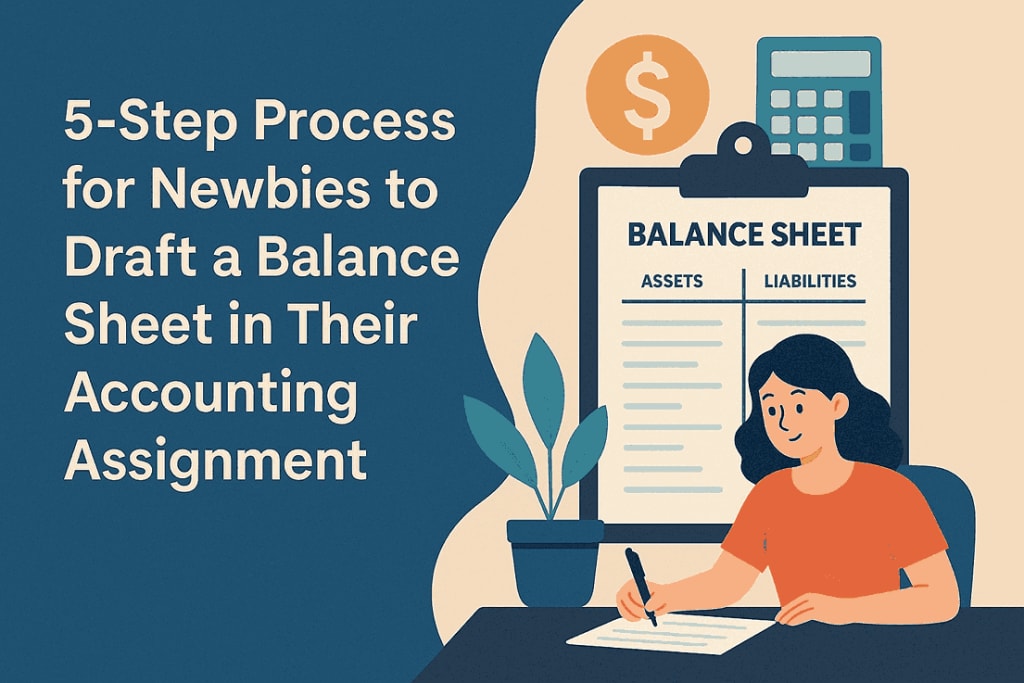
If you are a fresh student and have to prepare a balance sheet as your homework, don’t worry! A balance sheet may seem technical, but it is very easy if you understand the steps. But if you are new to this subject, you can get accounting assignment help from seasoned experts online.
This article will instruct you through the 5 simple steps to prepare a balance sheet. If you are looking for b, this article can be a great starting point. By the end of it, you will be able to prepare your own balance sheet and impress your teacher!
What Is a Balance Sheet?
Let's begin, let us know what a balance sheet is all about. A balance sheet is like a report card for a company. It shows what a company owns, what it owes, and what value remains to the owner on a particular date.
The balance sheet is categorised into two sides. It puts the assets (what the company has) on one side. It puts the liabilities (what the company owes others) and the owner's equity (the owner's stake in the company) on the other side. One of the fundamental principles of accounting is:
Assets = Liabilities + Owner's Equity
This is a mathematical principle which states that everything the company possesses should equal the amount it owes plus what the owner possesses.
Steps to Prepare a Balance Sheet
Now that we have a clue about what a balance sheet is, let us step by step go through the 5 steps to prepare it in a simple manner.
Step 1: Obtain All Your Financial Information
You are required to first gather all the relevant information about the business. This comprises of what the business owns, what the business owes somebody, and how much investment the owner has made in the business. These are generally held within the records of the company or stated in your assignment question.
For instance, if an enterprise owns cash, a bank account, machines, and money owed by a bank or suppliers, then all of them need to be accounted for. Write down a rough list of everything and their value so that you are prepared for the next step.
Step 2: Classify Assets and Liabilities
After you have your list, the next thing is to organize or group the items in the proper order. This gets your balance sheet in order.
The company owns assets and divides them into current assets and fixed assets. It includes in current assets the things it can easily turn into cash, like cash itself, money kept in the bank, and items available in stock. It counts buildings, machinery, and furniture as fixed assets because it uses them for a long time.
Liabilities refer to amounts that the firm owes and this may be current liabilities and long-term liabilities. Current liabilities are the ones which must be paid within a year such as outstanding bills or short term loans. Liabilities that must be paid a period exceeding a year after the liability has occurred such as the long term loans given by banks are considered long-term liabilities.
Once you place all the items in the right category, your balance sheet looks neat and well-organized. If you still feel confused or need help, you can use platforms like Instant Assignment Help .Com. They guide students in learning how to sort assets and liabilities correctly.
Step 3: Put the Assets on the Left Side
Now is the time to start the actual writing of your balance sheet. Assets are always placed on the left side (or at the top if you're writing in a vertical orientation).
Start with the current assets. You can name cash in hand, the balance in the bank, and inventory. Place the value of each alongside its name. After you've listed the current assets, proceed with the fixed assets such as machinery, furniture, and buildings.
After listing all the assets, sum up their values. The value will be named "Total Assets."
Step 4: Place Liabilities and Owner's Equity on the Right Side
At the right side of the balance sheet, you will now place all the liabilities and owner's capital.
Begin with the current liabilities like cash that the company is owing to other parties in the very near future. Some examples are short-term loans or unpaid bills. Then proceed and add the long-term liabilities like hefty bank loans to be paid after a longer duration of time.
Now you need to write down the owner's equity. This is the amount of money that the owner has invested in the business plus any profit that hasn't been withdrawn from the business. These two figures—capital and retained earnings—are the owner's equity. If you are also dealing with subjects like finance or economics and need support, services offering economics assignment help UK can guide you in understanding related accounting terms better.
Then, after you've written all of them, you will add the liabilities and the owner's equity together. This is your "Total Liabilities and Equity."
Step 5: Make Sure That the Balance Sheet Balances
This is a critical step. Once you list the assets on one side and the liabilities and equity on the other, you have to balance both sides.
The golden rule is:
Assets = Liabilities + Owner's Equity
If your assets equal your total liabilities and equity, then your balance sheet is in order and balanced. Otherwise, come back later and recheck your numbers and your math. A little slip-up like missing a number or adding something wrong can stall the sheet. Work slowly and correct it.
Example of a Simple Balance Sheet
To make it even more clear, here's a basic example of a balance sheet for a small enterprise:

As you can notice, both sides are equal to 41,000. This indicates the balance sheet is correctly prepared.
Conclusion
It's simple to prepare a balance sheet if you do it in these 5 easy steps. First, make a note of your money, second, put all of them under liabilities and assets. Third, put the things on both sides of the balance sheet and ensure they are balanced.
It does not require the talents of a math genius or even a professional to make a balance sheet. Keep calm, keep focused and practice. Thus, the next time you are assigned a similar task in school or in college do not forget about these steps. And when you are in need of accounting assignment help then now you know where to start and how to do it!
Also Read: Why is it a Teacher's Responsibility to Make Science & Its Assignments Fun for Students?
About the Creator
Carrie smith
Academic Writer at Instant Assignment Help. Have years of experience in providing high-quality academic writing services. I have delivered numerous top quality assignment projects to students.
Keep reading
More stories from Carrie smith and writers in Education and other communities.
Why is it a Teacher's Responsibility to Make Science & Its Assignments Fun for Students?
Science is a dynamic subject. It comes with different segmentations where some streams discuss life on the Earth and the creation of the universe and the Earth. On the other hand, some streams discuss the relationship between different chemicals and elements. It is such a vast area that defining it within a small arena is not possible. Now, due to such a wide variety of studies, students often find it boring and tiring. They don’t want to do assignments as they think science assignments are tiring and time-consuming. So, they look for science assignment help.
By Carrie smith6 months ago in Education
Mastering X-Bar Theory in Grammar in 10 Minutes
Grammar can often feel like a maze of confusing rules, especially when we dive into syntax — the study of sentence structure. One of the foundational tools in modern linguistics is X-Bar Theory, a framework that helps explain how words and phrases combine to form sentences. While it might sound intimidating, understanding X-Bar Theory can become straightforward if approached step by step.
By Games Mode On2 days ago in Education
How did Hitler rise to power?
How did Adolf Hitler, a tyrant who orchestrated one of the largest genocides in human history, rise to power in a democratic country? The story begins at the end of World War I. With the successful Allied advance in 1918, Germany realized the war was unwinnable and signed an armistice ending the fighting. As its imperial government collapsed, civil unrest and worker strikes spread across the nation. Fearing a Communist revolution, major parties joined to suppress the uprisings, establishing the parliamentary Weimar Republic.
By Munesh Yadava day ago in Education
Smart phones, Humans and Aliens.
WARNING. I will be tapping into one of your favorite creative tensions: The absurdity of humans worshipping their glowing rectangles as if they were tiny oracles. There’s something deliciously poetic about that contradiction, and it lends itself beautifully to an instructive proviso.
By Novel Allen4 days ago in Poets



Comments
There are no comments for this story
Be the first to respond and start the conversation.