
5 Advanced Ancient Inventions We Still Can't Figure Out
Natural art
When we think of our ancestors, most of us probably picture them living in societies where technological advancements were limited and people lived a fairly simple life. Well, some people consider a life without Wi-Fi and smartphones simple, so they lived really simple lives. Many people would probably think that anything they invented back then, we can not only easily replicate, but improve upon it. But is that the case?
Here are some ancient inventions that we are still struggling to understand today.
The Greek fire
The Byzantines of the 7th to 12th centuries hurled a mysterious substance at their enemies in a naval battle. This liquid typically shot through tubes, burned in water, and could only be extinguished with vinegar, sand, and urine suprisingly. We still don't know what this chemical weapon known as Greek fire was made of. The Byzantines closely-guarded this secret, ensuring that only a few knew how this was created, and the knowledge eventually was lost altogether.
An antidote to all poisons
A so-called universal antidote against all poisons was said to have been developed by King Mithridates,a.k.a the poison King, the 6th of Pontus, and perfected by Emperor Nero's personal physician. According to historians, the original formula was lost, but some say that among its ingredients were opium, chopped vipers, and a combination of small doses of poison and their antidotes.
Literature has it that Mithridates VI was so paranoid of being poisoned that he took small doses throughout his life to build immunity. When The Romans finally captured him, he tried to commit suicide with poison but failed because he was immune. Amazing, right?
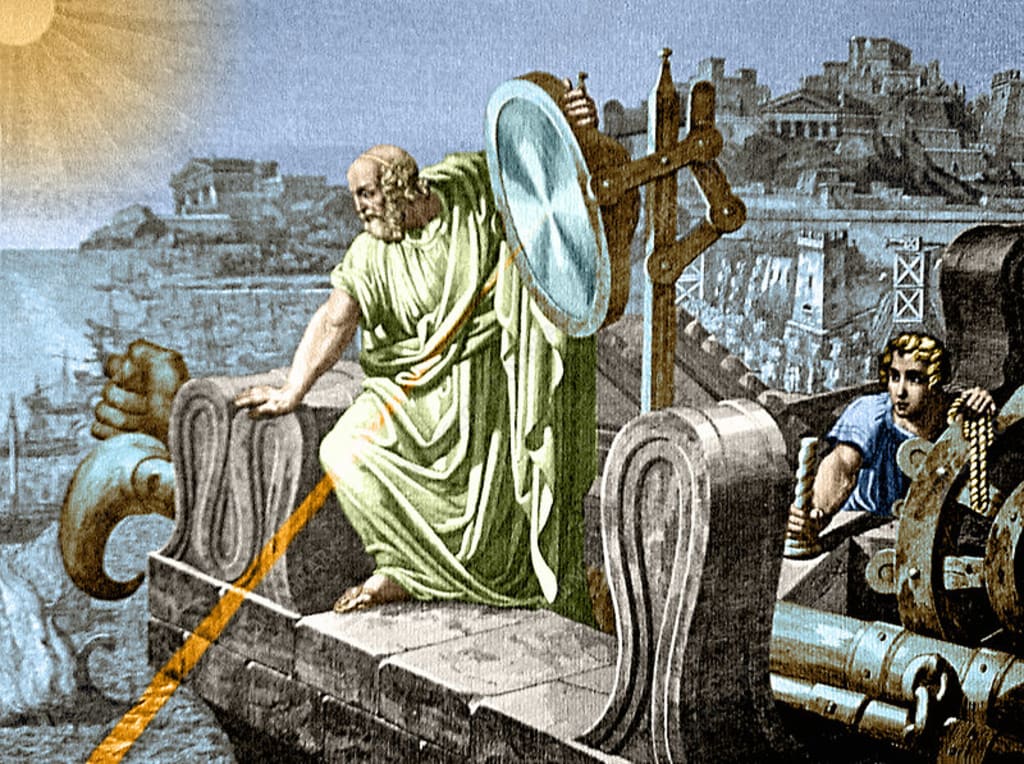
The Archimedes heat-ray
Archimedes of Syracuse was an ancient Greek mathematician, physicist, engineer, inventor, and astronomer. He is regarded as one of the leading scientists in classical antiquity. The 2nd-century author, Ellucian, wrote that Archimedes destroyed enemy ships with fire during the siege of Syracuse. Centuries later, Anthemius mentions burning glasses as Archimedes' weapon.
The device, sometimes called the Archimedes heat ray, was used to focus sunlight onto approaching ships, causing them to catch fire. The purported weapon has been the subject of the ongoing debate about his credibility ever since the Renaissance, a test of the Archimedes heat ray was carried out in 1973 by Greek scientists. The experiment took place at a naval base outside Athens. On this occasion, 70 mirrors were used, each with a copper coating and a size of around 5 by 3 feet. The mirrors were pointed at a plywood mock-up of a Roman warship at a distance of about 160 feet. When mirrors were focused accurately, the ship burst into flames within a few seconds!!
In 2006, MythBusters broadcasted the result of the San Francisco experiments. The claim was placed in the category of busted or failed because of the length of time in the ideal weather conditions required for combustion to occur. MythBusters tried again in 2010, failed to reproduce this ancient weapon, and declared it a myth. Yeah, so just because a TV show declares something a myth, it's case closed, hmm
Roman concrete
The vast Roman structures that have lasted thousands of years are Testaments to the advantages of Roman concrete over the concrete used today, showing signs of erosion after only about 50 years. Some Roman buildings are so spectacular in their construction and beauty that modern builders would never attempt something similar, even with today's technology. It's been known for a while that the volcanic sand used in Roman concrete and mortar made their buildings last for so long. Now a new study by a group of engineers and engineering researchers has discovered the precise recipe that made the Roman concrete endure much longer than the concrete used today, and we literally just found this recipe; we found it; we didn't like come up with it; we didn't create it; we literally just found the ancient recipe written down by Roman architect, Vitruvius.
Damascus steel
In medieval times, swords made of Damascus steel were being produced in the Middle East out of a raw material known as Walt steel from Asia. This thing was crazy strong, and the original method of producing Damascus steel is not known because of differences in raw materials and manufacturing techniques. Modern attempts to duplicate the metal have not been entirely successful. The reputation and history of Damascus steel have given rise to many legends, such as the ability of the Steel to cut through a rifle barrel or to cut a hair falling across the blade. The secret of making Damascus steel has only reemerged under the inspection of scanning electron microscopes in modern laboratories. It was first used around 300 BC, and the knowledge seems to have been lost around the mid-18th century.
Archeology expert K. Krist Hirst explained that nanotechnology was involved in producing Damascus steel in the sense that materials were added during the Steel's production to create chemical reactions at the quantum level.
Technology back in the day may be more advanced than we think clearly.
Let me know your thoughts about this topic in the comment section.
Thanks so much for reading; subscribe and share with your friends and family.
About the Creator
Allan MHC
A medical doctor by profession; reading and writing are my resting pills
5 Essential Tools You Need to Work Remotely
Remote work has moved from being a perk to a permanent way of working for millions of professionals worldwide. While working from home or anywhere with an internet connection offers flexibility and freedom, success in a remote environment depends heavily on the tools you use.
By Bahati Mulishi2 days ago in Education
The Dark Engine: France’s Carbon Black Evolution and the USD 863.78 Million Future (2026-2034)
France has long been a global pioneer in automotive engineering and chemical innovation, but in 2026, one of its most critical industrial materials is undergoing a quiet, high-tech revolution. Carbon Black the soot-like material that gives tires their strength and plastics their durability is no longer just a commodity. Driven by the aggressive transition to Electric Vehicles (EVs), stringent EU environmental mandates, and a nationwide shift toward the circular economy, the France carbon black market is entering a era of sophisticated growth. According to latest research, the market was valued at USD 597.72 Million in 2025 and is projected to reach USD 863.78 Million by 2034, exhibiting a steady CAGR of 4.18% during 2026-2034.
By Neeraj kumarabout 10 hours ago in Education
Dead and Wearing Green
She was wearing that green dress when I first saw her, five years ago to the day. Flowing meadow fabric draped over long legs, thick auburn hair flowing down her back. That smile. Of course, she is still beautiful now. But now she is no longer alive.
By Karen Cave7 days ago in Fiction




Comments
There are no comments for this story
Be the first to respond and start the conversation.