
1099-MISC vs 1099-NEC: Understanding the Difference That Could Save You Thousands
A Simple Guide to Choosing the Right Form, Avoiding Penalties, and Staying IRS-Compliant

I'll never forget the Monday morning I opened that envelope from the IRS. My stomach dropped as I read the penalty notice: $5,000 in fines for filing the wrong 1099 forms. As a small business owner who prides myself on getting things right, this was my worst nightmare come true.
The worst part? I had no idea I was doing anything wrong. I'd been using Form 1099-MISC for all my contractors and freelancers for years. Turns out, the IRS had changed the rules, and I missed the memo.
The Day Everything Changed
It was 2020 when the IRS brought back Form 1099-NEC after nearly 40 years. While accounting professionals were buzzing about this change, most small business owners like me were completely in the dark. We kept filing the way we always had, unaware that the rules had shifted beneath our feet.
The penalty notice wasn't just about the money—it was the hours spent on the phone with the IRS, the paperwork, the stress of wondering if I'd face additional penalties. That's when I decided to become an expert on 1099 forms, so no other business owner would have to go through what I did.
People Also Read: Understanding Your Taxes: A Beginner’s Guide to 10 Essential IRS Tax Forms
The Simple Rule That Changed Everything
Here's what I wish someone had told me: If you're paying someone for work they did for your business, it's probably 1099-NEC. If you're paying for anything else, it's likely 1099-MISC.
Let me break this down with examples from my own business:
1099-NEC is for DOERS:
- The freelance writer I pay $800 to write website content
- The web developer who charges $2,000 to build an online store
- The consultant I hire for $1,500 to improve our operations
- The graphic designer creating our marketing materials
1099-MISC is for EVERYTHING ELSE:
- The $1,200 monthly rent I pay for our office space
- Royalty payments to photographers for using their images
- Prize money for our annual customer contest
- Payments to attorneys for legal services
The Deadline Trap That Catches Smart People
Here's where it gets tricky—the deadlines are different, and missing them is expensive:
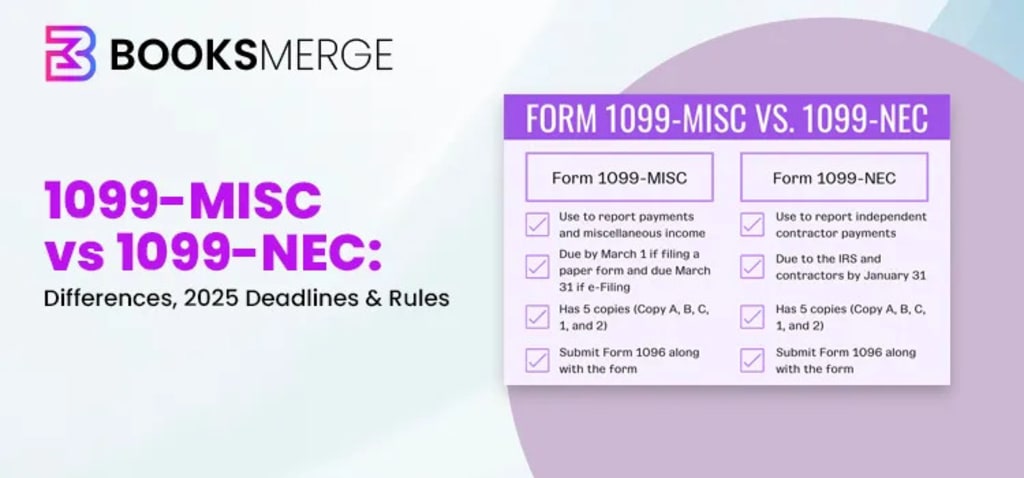
Form 1099-NEC: Due January 31st - no exceptions, no grace period
Form 1099-MISC: Due February 28th (paper) or March 31st (electronic)
I learned this the hard way. I thought I had until the end of February for all my 1099s. Wrong. The IRS hit me with late fees for every single 1099-NEC form I filed after January 31st.
The $600 Rule That's Not Always $600
Most business owners know the $600 threshold for filing 1099s, but here's what they don't tell you:
For 1099-NEC: It's always $600 for services
For 1099-MISC: It varies:
- $600 for rents, prizes, awards
- $10 for royalties
- Any amount for direct sales
- $600 for medical payments
I almost missed filing for a photographer because I only paid her $400 for a photoshoot. Then I remembered—I also paid her $300 in royalties for using her images. Since royalties have a $10 threshold, I needed to file a 1099-MISC.
The Three-Step System That Saved My Business
After my penalty disaster, I created a simple system that's kept me compliant for three years running:
Step 1: The Onboarding Packet
Every new vendor, contractor, or service provider gets a packet that includes a W-9 form. No W-9, no payment. It's that simple.
Step 2: The Quarterly Review
Every three months, I run a report of all payments to non-employees. I categorize them as:
Services (1099-NEC)
Everything else (1099-MISC)
Not reportable
Step 3: The January Blitz
The first two weeks of January are dedicated to 1099 preparation. I:
Verify all recipient information
Double-check payment totals
Prepare both forms
Send them by January 25th (giving myself a buffer)
Real Stories From the Trenches
My friend Sarah, who runs a boutique marketing agency, almost made the same mistake I did. She paid a designer $800 for a logo (1099-NEC) and also paid her $300 in royalties for using the logo in her promotional materials (1099-MISC). Two different forms for the same person.
Another business owner I know, Mark, learned about backup withholding the hard way. He paid a contractor who didn't provide a TIN (Taxpayer Identification Number). The IRS required him to withhold 24% of the payment—a surprise expense he hadn't budgeted for.
The Hidden Costs Nobody Talks About
Beyond the IRS penalties, there are other costs to getting 1099s wrong:
Time: I spent 40 hours dealing with my penalty situation—that's a week I couldn't work on growing my business.
Relationships: Sending incorrect forms to contractors damages your professional reputation.
Stress: The constant worry about making another mistake affected my sleep and my health.
Opportunity Cost: The time spent fixing 1099 errors is time not spent on revenue-generating activities.
When to Call in the Professionals
Here's my rule: If you have more than ten contractors or your business is growing rapidly, hire a professional. The $500 you might spend on an accountant could save you thousands in penalties and hundreds of hours of stress.
Look for these red flags that mean you need help:
- You're unsure how to classify a worker
- You have contractors working in multiple states
- You're being paid with cryptocurrency
- You've received an IRS notice
- You simply don't have time to stay current with tax law changes
We hope You Clear the Difference between 1099-misc vs 1099-nec. If you want read particularly on this topic check out booksmerge blog
The Peace of Mind Dividend
Getting your 1099s right does more than just avoid penalties—it gives you peace of mind. You can focus on what you do best: running your business. No more dreading mail from the IRS, no more panic attacks during tax season.
The $5,000 penalty was expensive, but the lesson was priceless. Now I view 1099 compliance not as a burden, but as part of running a professional, successful business.
Your Action Plan for Next Tax Season
Start today: Collect W-9s from every contractor
Set calendar reminders: January 10th - start 1099s, January 25th - send forms
Create a system: Use accounting software or spreadsheets to track payments
Know when to ask for help: Don't let pride cost you money
Remember, in the world of business taxes, what you don't know can hurt you. But with the right system and knowledge, you can master 1099s and focus on what really matters—growing your business.
About the Creator
BooksMerge
BooksMerge finds expert articles on small business accounting, bookkeeping, payroll, and tax strategies. We simplify complex financial topics to help your startup thrive and stay compliant. personal service for startups & small businesses.
Keep reading
More stories from BooksMerge and writers in Education and other communities.
1099-NEC vs 1099-MISC: The Guide to Choosing the Right Tax Forms
Every tax season, business owners face the same dilemma: which 1099 form should I use? The confusion between Form 1099-MISC vs 1099-NEC costs businesses millions in penalties each year. As the IRS processes over 2.6 billion information documents annually, getting your 1099 forms right isn't just important it's essential for your business's financial health.
By BooksMerge2 months ago in Education



Comments
There are no comments for this story
Be the first to respond and start the conversation.