
Wildfire Problems, Wild Horse Solutions
Horse Grazing as a Possible Management Tool for Wildfire Prevention in the Inland Northwest

Wildfires increasingly plague the inland Northwest each summer. Not only does this destroy homes, land, and affect air quality, in 2018 alone it cost Washington state $173,685,041 in damages (USDA Forest Service, 2018). The fire season continues to increase with warmer temperatures earlier in the season and draught being a common occurrence each summer. This allows fuels to dry out, which are also increasing due to the continuing expansion of invasive grasses such as cheatgrass. This causes millions of acres of land to become prime flammable areas. Although the very wet and cold winters of the region do help some, they more often cause an overgrowth of vegetation in the spring which then dries out and adds to the fuel later in the season. Of course, climate change is one of the most common explanations for this, but fire policy is another. The way that this is managed has not caused an increase in the number of fires, but an increase in fire intensity and acres burnt (Ward, 2018).
Due to the cost of fire suppression, which reached up to 2 billion dollars nationwide in 2017, funds normally used to reduce these fires are often unavailable. These methods include, but are not limited to, insect control, prescribed burns, and tree thinning. The cost of controlling fires has increased from 15% of the Forest Service budget to 55% (Ward, 2018). Besides the economic impact, it destroys natural areas, homes, lives, and causes the air quality to become so low that advisories are put in place to stay inside throughout most of August, and sometimes even as early as July.
One possible strategy to aid in prevention is the use of grazing animals. Targeted grazing has gained popularity in rangeland management over recent years. It can be used to exert pressure on certain species or areas based on the timing and frequency of grazing. Additionally, the trampling that accompanies it can achieve goals for defoliation to achieve management objectives. Targeted grazing utilizes plant ecology, livestock nutrition, and livestock foraging behavior as an integrative management tool (Bailey, 2019). As animals eat down the vegetation, before or after it has become dry, fuels that have accumulated are also reduced. However, before the fire season has hit is when vegetation is most nutritious for grazing animals which is also most beneficial for fuel reduction. By doing this, fire intensity will be reduced if there is a wildfire which allows the ecological impact to be less severe (Taylor, 2006).
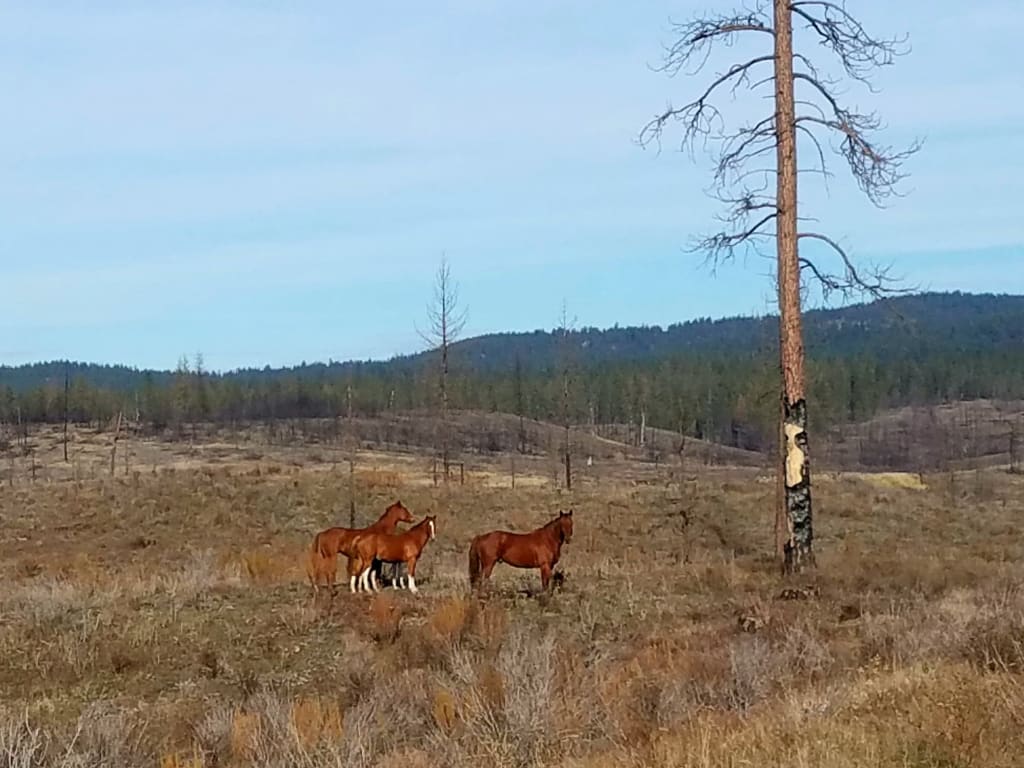
One possible solution worth exploring would be to use horses that are either unadoptable or at rescue centers with limited resources. Mustangs are constantly being captured and auctioned by the Bureau of Land Management (BLM) to keep their population within the environment’s maximum capacity, but often have a hard time being adopted due to the risk involved in training a wild horse. These horses often are placed in holding pens instead. As of March 2019, the BLM even offers a $1000 incentive to adopt a mustang to offset the continual cost of caring for the horses that are not adopted (Bureau of Land Management, 2019). Therefore, the use of these horses would give them a temporary home for part of the year while decreasing feeding expenses for those responsible for their care and providing an essential service that will help the fire ecology of the area. Horse rescue centers and BLM holding facilities will be able to regrow pastures and save money on hay from depleted pastures (or no pasture) while the horses will get a healthier diet of a variety of grasses and more room for exercise. Additionally, landowners that agree to let horses graze on their land during fire season will have less risk of fire on their property, which will be especially beneficial to farmers and ranchers doing crop rotation if they have their crops fenced off since wildfires can cost them millions of dollars if a fire reaches their fields that are producing that year. More research needs to be done on if horses can help increase soil fertility via manure which may also benefit farmers that plan to use the pasture space for crops on alternating years.
Sources Cited:
1. Bailey, D. et. al. (2019). Synthesis Paper: Targeted Livestock Grazing: Prescription for Healthy Rangelands. Rangeland Ecology and Management. Vol 72(6). Pp. 865-877. https://doi.org/10.1016/j.rama.2019.06.003
2. Bureau of Land Management. (2019). Wild Horse and Burro Adoption Incentive Program. Web. https://www.blm.gov/programs/wild-horse-and-burro/adoptions-and-sales/adoption-incentive-program
3. Nader, G., Henkin, Z., Smith, E., Ingram, R., & Narvaez, N. (2007). Planned herbivory in the management of wildfire fuels. Rangelands, Vol. 29(5), 18-24. http://www.carangeland.org/images/Planned_Herbivory_in_the_Management_of_Wildfire_Fuels.pdf
4. Simanonok, M.P., Burkle, L.A. (2020). High-severity wildfire limits available floral pollen quality and bumble bee nutrition compared to mixed-severity burns. Oecologia Vol. 192, 489–499. https://ntserver1.wsulibs.wsu.edu:2137/10.1007/s00442-019-04577-9
5. Taylor Jr, C. A. (2006). Targeted grazing to manage fire risk. Targeted grazing: A natural approach to vegetation management and landscape enhancement, pg. 107-112. https://www.webpages.uidaho.edu/rxgrazing/Handbook/Chapter_12_Targeted_Grazing.pdf
6. USDA Forest Service (2018). 2018 Pacific Northwest Wildland Fire Season. Bureau of Land Management: Oregon and Washington / USDA Forest Service- Section 6. Web. https://www.fs.usda.gov/Internet/FSE_DOCUMENTS/fseprd611322.pdf
7. Ward, Whitney. (2018). Inland Northwest keeps losing the month of August to wildfire smoke; Here's why. Krem-2 News. Web. https://www.krem.com/article/weather/air-quality/inland-northwest-keeps-losing-the-month-of-august-to-wildfire-smoke-heres-why/293-589222530
About the Creator
Keep reading
More stories from Jessica R Faunce and writers in Earth and other communities.
Night Rides
There was a chill to the night. Not just in the weather, but in the unsettling feeling of being alone in a land full of unknown nocturnal spectators. Coyotes howled and yipped in the distance, the sound of hoof beats made a continuous rhythm that matched my heartbeat, almost emphasizing it. I felt the heat of the horse’s warmed muscles through his shedding winter coat under my legs, like the warmth of the early spring day faded. Stars brightened the sky, but in the darkened woods it made no difference. There was a ranch house in the distance behind some trees, a beacon of light in an otherwise sea of darkness. The horse snorted out of excitement as he picked up his pace as we got closer to home. I was sure he also felt the same eeriness I felt. As we came around the corner of the dirt road we were following, he stopped suddenly.
By Jessica R Faunce4 years ago in Earth
Stock Market Today: Nasdaq Futures Rise; Oil Skids After Trump Dials Down Iran Tension
If you’ve been following the markets this week, you’ve probably noticed how sensitive traders are to geopolitical headlines. On Thursday, Nasdaq futures rose, while oil prices dropped after U.S. President Donald Trump made remarks that dialed down fears of immediate military escalation with Iran. It’s a classic example of how news can move multiple markets at once — tech stocks climbing while commodities react in the opposite direction. Nasdaq Futures Bounce Back Technology and growth-focused stocks led the recovery in futures trading. Nasdaq futures climbed, signaling that investors are regaining confidence after recent volatility. Many traders have been cautious, with some taking profits from high-flying tech names, but today’s rebound shows that market optimism is returning. Corporate earnings are a big factor here. Several tech giants, including semiconductor and software companies, have beaten analyst expectations in recent weeks. These results support longer-term growth narratives, giving investors confidence that the tech sector can continue to outperform even amid economic uncertainty. For anyone watching the markets, this is a reminder: futures are forward-looking indicators. When traders see signs of stabilization — like reduced geopolitical tension or strong earnings — markets often react positively before the official trading session even begins. Oil Prices Fall Amid Eased Tensions On the flip side, oil prices skidded. The energy market had been pricing in potential supply disruptions due to the tension with Iran, particularly in critical regions like the Strait of Hormuz. But after Trump’s comments, traders interpreted a lower risk of military conflict, and crude futures dropped sharply. West Texas Intermediate (WTI) and Brent crude both saw declines of around 4–5%, as investors adjusted their positions. This shows how geopolitical risk premiums can inflate commodity prices — and how quickly they can disappear once the perceived threat diminishes. Lower oil prices are a double-edged sword. On one hand, cheaper fuel eases costs for consumers and businesses. On the other, energy companies and oil-exporting nations may face pressure on revenue and profits if prices remain soft. Why Geopolitics Moves Markets The Middle East continues to be a major driver of global market sentiment. Even the possibility of conflict in oil-rich regions can make investors nervous, sending equities lower and commodities higher. Conversely, statements that calm these fears can produce quick rebounds in risk assets like stocks and a decline in commodities like oil. This week’s developments show just how reactive the markets have become. A single remark from a world leader — in this case, Trump — can shift risk perception and trigger immediate moves across multiple asset classes. Earnings and Economic Data Still Key While geopolitical headlines dominate daily moves, corporate earnings and economic data remain critical for long-term market trends. Financial giants like Morgan Stanley recently reported results that beat expectations, boosting their stock prices and reinforcing positive sentiment in the sector. Investors are paying close attention to these fundamentals. Earnings reports and macroeconomic indicators provide insight into underlying trends, helping traders separate short-term volatility from sustainable growth. What Investors Should Watch For stock investors: The rebound in Nasdaq futures suggests that growth and technology stocks are finding support, but volatility is still high. Active risk management and portfolio diversification remain essential. For energy markets: Today’s slump in oil prices highlights how commodities react to geopolitical sentiment. Traders should watch for developments in the Middle East, as any escalation could reverse the decline in prices almost immediately. For global markets overall: Investors must balance multiple narratives — geopolitical events, corporate earnings, economic data, and interest rate expectations. This interplay shapes risk appetite and influences how capital flows across sectors and regions. The Takeaway Today’s market action illustrates a broader theme: markets are highly sensitive to shifts in risk perception. When geopolitical tension eases, equities tend to rise, and risk-sensitive commodities like oil fall. But when threats reappear, sentiment can flip, reminding investors that global markets are dynamic and interconnected. This combination of Nasdaq gains and falling oil prices isn’t just about numbers — it’s about investor psychology, risk management, and the speed at which news travels in our global economy. The lesson is clear: staying informed and flexible is more important than ever for anyone participating in today’s markets.
By Muhammad Hassanabout 13 hours ago in Earth
Cement's Quiet Pivot
Why this is under-the-radar progress Cement and concrete account for a sizable slice of global CO₂, but the fastest cuts right now aren’t headline-grabbing moonshots — they’re practical shifts already filtering through specifications, standards, and procurement. Three forces are converging: (1) modern cement standards that enable big clinker reductions with reliable performance; (2) rapid market adoption of Portland-limestone cement (PLC) and new ternary blends such as limestone–calcined clay cements (LC3); and (3) public buyers setting embodied-carbon requirements that move the market. Together, these are driving real-world emission declines from the most-used construction material on earth — often without changing how structures are designed or built [8].
By Futoshi Tachino4 days ago in Earth



Comments
There are no comments for this story
Be the first to respond and start the conversation.