
Why Some of the Rainbow is Missing
the rainbow

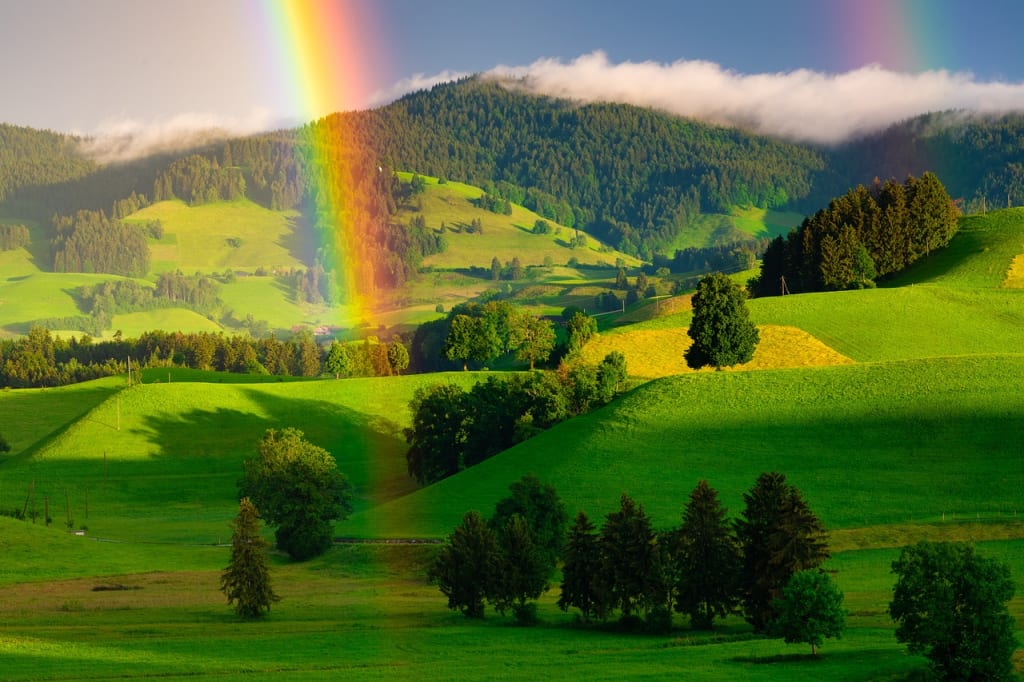
In the early 1800s, a German physicist named Joseph von Fraunhofer observed an intriguing phenomenon. While studying sunlight passing through a prism and projecting onto a wall, he noticed that a segment of the rainbow was absent. Across the spectrum from red to violet, there were distinct dark lines where colors should have been. Fraunhofer cataloged over 600 of these missing pieces from the rainbow, varying in intensity. These lines oddly resembled a barcode, serving as a kind of hidden code. Decoding these gaps would later unveil a concealed narrative that would enable scientists to unlock various mysteries of the universe. This is the story of how they achieved this feat and how you can as well.
The scientists who unraveled Fraunhofer's enigma were Gustav Kirchhoff and Robert Bunsen—yes, the same Bunsen of Bunsen burner fame. These two researchers were captivated by the diverse colors emitted by different elements when subjected to a flame. For instance, table salt produces a bright yellow flame, calcium emits an orange hue, and potassium displays a pinkish tinge. To delve into the light emitted more precisely, they devised a tool known as a spectroscope. This instrument directed light from a flame through a prism, dispersing it into its individual wavelengths, creating a spectrum. A secondary tube allowed them to observe the outcome.
When they scrutinized the colorful chemical flames through the spectroscope, they discerned slender bands of light at specific wavelengths. Notably, each element generated a distinct pattern of these bands, akin to a unique fingerprint. Sodium, for instance, exhibited a recognizable yellow line, lithium displayed a vibrant red line, and strontium showcased red lines among others. They even uncovered strong lines for calcium in green and red, alongside numerous fainter lines invisible to the naked eye.
In 1859, Kirchhoff and Bunsen made the groundbreaking revelation that resolved Fraunhofer's puzzle. Acquainted with the missing segments of the rainbow, they sprinkled ordinary table salt onto Bunsen's burner. Upon analyzing the spectral lines emitted by the burning sodium, they realized that these lines coincided precisely with two of Fraunhofer's absent lines. This alignment strongly suggested a connection between the two sets of lines.
By observing both sunlight and a sodium flame simultaneously, Kirchhoff and Bunsen deduced that the bright lines produced by burning sodium correlated with specific dark lines missing from Fraunhofer's rainbow. They postulated that these dark lines resulted from elements in the sun absorbing particular wavelengths of light. This revelation indicated that the spectral lines of individual elements could be matched with the absent lines in the sun's spectrum.
This intriguing breakthrough laid the foundation for deciphering elements present in the sun without requiring direct samples from the distant, blazing celestial body. This method, given the technological limitations of the time, was an insurmountable task. It led to the conclusion that certain elements release light at specific frequencies when heated, yet within a full spectrum of light, they absorb those same frequencies, resulting in spectral lines and gaps. This process occurs when sunlight interacts with elements in the sun's and Earth's atmospheres.
Today, we understand that an element's unique spectral signature is intricately linked to its atomic structure. Atoms consist of nuclei surrounded by electrons orbiting at different energy levels. When atoms absorb energy, such as through heating, electrons transition to higher energy states before swiftly returning to the ground state, emitting photons with precise wavelengths corresponding to the energy absorbed. Elements possess distinct energy level configurations for their electrons, leading to unique emission and absorption spectra.
This profound revelation has profound implications. Spectroscopy now allows us to determine the composition of objects across the universe, from nearby surroundings to galaxies far beyond our reach. It provided hints of the universe's expansion, revealing that galaxies farther away exhibit spectral redshifts, signifying their motion away from Earth. Spectroscopy also guides our search for extraterrestrial life by analyzing starlight filtered through exoplanet atmospheres.
In essence, decoding the hidden messages within sunlight's spectrum unveiled the secrets of our universe's composition, structure, and evolution. It transformed the once-mysterious rainbow into a cosmic encyclopedia, offering insights into celestial phenomena and sparking a quest for knowledge that continues to drive scientific exploration.
About the Creator
Exploring Earth's Wonders and Beyond
Welcome to my world of discovery and wonder! I am your guide through Earth's mysteries and beyond. I'm here to share captivating stories and the latest updates on Earth's wonders, animals, news, and more.
Keep reading
More stories from Exploring Earth's Wonders and Beyond and writers in Earth and other communities.
Earth's Hidden Enigmas: Diving Deep into the Mystery!
It holds the title of being the hottest place on Earth, specifically in terms of air temperature. On July 10, 1913, the temperature at this location surged to an astonishing and record-breaking 134.1 degrees Fahrenheit. It's no wonder that it has earned the ominous name of Death Valley. Notably, it also claims the distinction of being the lowest point in all of North America, situated a staggering 282 feet below sea level. Upon arrival, one might easily be deceived into thinking they are surrounded by ice. However, appearances can be misleading – the 'ice' is, in fact, salt. As rainwater intermingles with minerals, it dissolves the outer layer of rocks. When the water evaporates, it leaves behind only salt.
By Exploring Earth's Wonders and Beyond2 years ago in Earth
Flooding wetlands in an effort to combat climate change could backfire.
Despite making up a fairly small portion of the planet's surface area, wetlands store a disproportionate amount of carbon on land. Wetland soil disturbance can release massive volumes of greenhouse gases, which is why they are at the centre of climate debates.
By Francis Dami2 days ago in Earth
Rachel Reeves Delivers ‘Killer Blow’ to UK’s Most-Loved Place Tomorrow – Has It Gone Too Far?
The UK is bracing for a major policy announcement from Chancellor Rachel Reeves that critics have described as a potential “killer blow” to what many call one of Britain’s most-loved national features. While supporters argue the move is necessary for economic stability and modernization, critics warn it could damage businesses, communities, and cultural identity.
By Aarif Lashari5 days ago in Earth
Why Black History Matters in America?
The United States of America is celebrating their 250th anniversary in 2026. I'm proud to be an American and as someone who was born here, I wouldn't imagine myself living anywhere else. This is a country where opportunities are possible. Where anyone can be successful in anything they desire to do. Equality, community, and togetherness are the backbones of what America is and should be about. However, we have an administration who wants to erase and disregard those who have made positive, meaningful impacts in our country, specifically Black figures, such as Martin Luther King, Jr., Rosa Parks, and Maya Angelou. President Trump and his administration have been constantly complaining and fighting against what they call the "Woke agenda". They use this excuse as a distraction from other issues they refuse to address, such as the high cost of living, climate change, and inflation. That equality is dividing America, when in reality, it's bringing us together. Being woke is not tied to a specific political party. No matter where you stand on the political spectrum, you can still care about other people and their plights. Compassion and empathy for others isn't tied to a political party, either. We were taught as children to treat others the way we want to be treated and not judge others because they're different from us. Caring about others isn't a personal attack on your beliefs. It doesn't make you any less of a person. People who are easily offended over African American figures, past or present, or anything related to it, are grasping at straws. Current and future generations need to know who people like Harriet Tubman and Shirley Chisholm were, especially in the classroom. Black History is part of American History. It should be recognized, not hidden or forgotten. Besides, you can't shield children from everything, just because your feelings are easily hurt.
By Mark Wesley Pritchard 4 days ago in The Swamp


Comments
There are no comments for this story
Be the first to respond and start the conversation.