
Which country has the highest crime rate and here's why!
Highest Crime Rate: Venezuela


When it comes to crime rates, there are many factors that can contribute to a country's ranking. From poverty and unemployment to political instability and social inequality, various aspects can play a role in determining a nation's crime rate. While it is difficult to pinpoint one country with the highest crime rate, there are some nations that have consistently ranked high in recent years.
According to the Global Peace Index 2021, which ranks countries based on levels of peacefulness, Afghanistan, Syria, and Yemen are the three countries with the highest levels of conflict and violence. These countries have been affected by ongoing wars and political turmoil, which have resulted in widespread crime and instability.
Additionally, countries with high levels of poverty and unemployment tend to have higher crime rates. In many cases, individuals living in poverty may resort to criminal activities as a means of survival. They may steal or engage in other forms of criminal behavior to obtain food, shelter, and other basic necessities. Similarly, high unemployment rates can also contribute to crime as individuals struggle to make ends meet.
With this in mind, it is not surprising that some of the countries with the highest crime rates are also some of the poorest nations in the world. According to the United Nations Office on Drugs and Crime (UNODC), the countries with the highest homicide rates in the world include Honduras, El Salvador, and Venezuela. These countries have all struggled with poverty and political instability, which have contributed to high levels of violence and crime.
Honduras, for example, has consistently ranked as one of the most violent countries in the world in recent years. The country has been plagued by gang violence and drug trafficking, which have resulted in high levels of homicides and other violent crimes. In 2020, the homicide rate in Honduras was estimated to be 36.7 per 100,000 people, which is one of the highest rates in the world.
Similarly, El Salvador has also struggled with high levels of violence and crime. The country has been affected by gang violence, drug trafficking, and political instability, which have contributed to high levels of homicide and other violent crimes. In 2020, the homicide rate in El Salvador was estimated to be 29.3 per 100,000 people, which is also one of the highest rates in the world.
Venezuela is another country that has been affected by high levels of violence and crime in recent years. The country has been plagued by political instability and economic turmoil, which have contributed to high levels of violence and crime. In 2020, the homicide rate in Venezuela was estimated to be 45.6 per 100,000 people, which is one of the highest rates in the world.
In addition to poverty and political instability, social inequality can also contribute to high levels of crime. In many cases, individuals living in poverty may feel a sense of frustration and hopelessness, which can lead to criminal behavior. Similarly, individuals living in marginalized communities may also be more likely to engage in criminal activities due to a lack of access to resources and opportunities.
Brazil is an example of a country where social inequality has contributed to high levels of crime. While the country is known for its vibrant culture and natural beauty, it has also struggled with high levels of violence and crime in recent years. In 2020, the homicide rate in Brazil was estimated to be 27.8 per 100,000 people, which is one of the highest rates in the world. Brazil has been affected by social inequality, with many individuals living in poverty and facing a lack of opportunities.
In some cases, a country's geographical location can also contribute to high levels of crime. For example, countries located along major drug trafficking routes may be more likely to experience high levels of violence and crime.
About the Creator
Keep reading
More stories from Hunain Seven and writers in Earth and other communities.
The benefits and drawbacks of working remotely.
The COVID-19 pandemic has transformed the way we work, with many companies transitioning to remote work to comply with social distancing measures. Remote work has become more common, and it has presented both benefits and drawbacks for employees and companies alike. In this article, we will explore the benefits and drawbacks of remote work and the impact of the pandemic on the shift to remote work.
By Hunain Seven3 years ago in Education
The Reality of the Illusion of Time
Recently, as I strolled along the short stretch to my strength training session, I aimlessly took in the row of tatty shops and shabby buildings along the route and passed an off-street, in which one of my sisters used to live, around thirteen years ago.
By Chantal Christie Weiss2 days ago in Earth
Why Putin Went Quiet When Challenged by Trump Over Venezuela
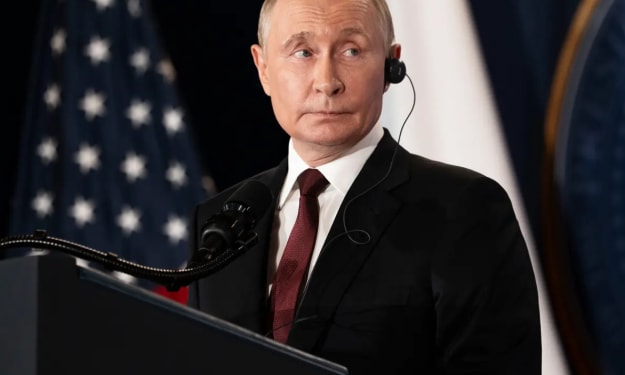
When U.S. forces captured Venezuelan President Nicolás Maduro in early January 2026, the world was stunned. Venezuela has long been a Russian ally, yet Russian President Vladimir Putin remained almost completely silent when challenged directly by U.S. President Donald Trump. Why would a leader so often outspoken on the world stage hold back in such a dramatic moment? Let’s unpack the story and explore what it means for global politics. A Bold Move That Shocked the World On January 3, U.S. forces executed a daring operation in Venezuela, taking Maduro into custody in New York to face charges including drug trafficking and narco‑terrorism. The operation was framed by the U.S. as a step to enforce justice, but critics saw it as an extraordinary overreach of power. Venezuela is no ordinary country for Russia. Since the days of Hugo Chávez, Moscow has cultivated close ties with Caracas, offering military support, energy deals, and diplomatic backing on the global stage. Past actions included Russian bombers visiting Venezuela and high-profile defense agreements. Given this history, many expected a fiery response from Putin. Yet, the Kremlin remained calm, issuing measured statements rather than sharp threats. Why Silence Was Strategic Experts suggest there are several reasons for Putin’s muted reaction, each revealing the careful calculation behind the Kremlin’s foreign policy. 1. Focus on the War in Ukraine Russia’s primary priority remains Ukraine. Engaged in a high-stakes military and diplomatic battle, Putin cannot afford distractions or new confrontations far from home. Escalating tensions with the United States over Venezuela could jeopardize Moscow’s position in Europe. A New York Times report highlighted that Russia is “subordinating all other interests to the war in Ukraine,” suggesting that even a high-profile ally like Venezuela takes a back seat to Moscow’s strategic goals. 2. Limited Military Options While Russia’s alliance with Venezuela is longstanding, much of the support has been symbolic rather than operational. Defense systems and military cooperation exist on paper, but Russia lacks the immediate ability to counter a U.S. operation thousands of miles away. Putin may have recognized that responding aggressively would be both ineffective and costly, potentially risking military and economic consequences that Moscow cannot afford. 3. Maintaining Diplomatic Channels with Washington With Donald Trump back in the White House since 2025, there has been cautious optimism in Moscow about recalibrating U.S.–Russia relations. Avoiding a dramatic confrontation over Venezuela keeps diplomatic channels open, allowing Russia to negotiate on other high-priority issues like Ukraine and sanctions relief. In other words, silence can be a calculated strategy, signaling restraint rather than weakness. 4. Russia’s Global Influence Is Waning The Maduro episode also highlights a broader geopolitical reality: Russia’s global reach has limits. Since the 2022 invasion of Ukraine, Moscow’s influence in regions like the Middle East and parts of the former Soviet Union has weakened. Venezuela remains one of its few high-profile allies outside Europe, but even there, Russia’s power is largely symbolic. By not escalating, Putin is acknowledging a practical truth: Russia cannot be everywhere at once, and some battles are not worth fighting. 5. Choosing Battles Wisely Some analysts emphasize that Putin’s quiet response is more about strategic prioritization than capitulation. In a world dominated by nuclear powers and volatile global politics, direct confrontation with the United States over Venezuela could spiral into a far larger crisis. By staying silent, the Kremlin may be signaling that it picks its battles carefully, focusing resources on Ukraine, where the stakes are highest. What This Means for the World Putin’s silence sends several messages: Russia is currently stretched, economically and militarily. Moscow is prioritizing Ukraine over symbolic allies. Strategic restraint is sometimes more powerful than public confrontation. The limits of Russian influence are becoming more visible to the world. This episode reflects a new reality in geopolitics: power is as much about choosing when not to act as when to assert force. The Bigger Picture The capture of Maduro is a defining moment not just for Venezuela, but for global politics. It shows the United States asserting power in a way not seen for decades, while Russia’s quiet reaction underscores its current limits and priorities. For observers, Putin’s silence is a lesson in modern geopolitics: even the most assertive leaders exercise restraint when stakes are high and risks are global. In the end, the Maduro affair reminds us that in today’s world, the loudest response is not always the most effective one — sometimes, quiet calculation speaks volumes. Sources and Further Reading The US capture of Maduro reveals Russia’s weakness – Atlantic Council ‘It sends a horrible signal’: US politicians react to capture of Nicolás Maduro – The Guardian Russia slams 'neocolonial threats' against Venezuela – Reuters
By Muhammad Hassan5 days ago in Earth
Getting Serious About Comedy (Part I)
If I were asked to remark on my life and the childhood that paved some road leading me to this point, I would have to say something about all the funny people who surrounded me for the last 26,872 days (and counting). Somewhere along that road, I became a big fan of laughter and the comedy that spawns it – and, I mean not only my own laughter, but the laughter of others, some of which I have actually been responsible for inducing.
By John Oliver Smith7 days ago in Humor



Comments
There are no comments for this story
Be the first to respond and start the conversation.