
When hot and cold water are put into the fridge at the same time, the hot water freezes first, which is counter-intuitive but true
Hot water and cold water in the fridge at the same time


When I went to my little cousin's house the other day, I happened to run into his mother and asked him to help me freeze the ice water. Then this little guy picked up the hot water he had just boiled, filled a glass, and put it in the fridge. When his mother saw this, she hurriedly took the hot water out and then criticized and taught him. Looking at his aggrieved face, I couldn't help but want to take revenge for him.
From the point of view of getting ice water faster, the young cousin did the right thing. But from the point of view of protecting the fridge, indeed, you can't put hot water in it. This is because the fridge will warp, the foaming agent will expand, the life of the compressor will be shortened, electricity consumption will increase and the temperature inside the fridge will rise, causing other items to warm up and deteriorate, and the walls of the fridge will tend to freeze with water vapor. In fact, my little cousin is still young and doesn't know anything and won't be criticized and educated. So I did it anyway. Eventually, he learned to care for the fridge, and through me, he understood that his actions were not wrong.
Having said that, I'm sure many of you are thinking, or probably thinking, that I misrepresented the facts for the sake of a child. Common sense dictates that to get ice water, it must be cooled down with cold water. It must take longer to cool down with hot water. After all, it takes a certain amount of time for hot water to cool down to cold, and the same amount of time to cool down to ice water at a later stage.
Yes, this is the result of our habitual thinking. But not all reality is the same as the reasoned conclusion. The laws of the world are sometimes strange. Let me give you an example. When we take something out of the fridge to defrost it, what kind of water do we choose? Most people just use a jug of hot water. But actually, the fastest way is to put it under the tap and rinse it with tap water.
The reason for hot water freezing faster is the mpemba effect. The phenomenon was discovered because of a child called Mpamba. At the time he was a secondary school student in the East African country of Tanzania. They were allowed to make ice cream at school. To have somewhere to freeze their own ice cream, he always added sugar to the hot milk and then immediately put it in the freezer. Later, he found that his ice cream froze the fastest. A few years later, in collaboration with Dr. Dennis Osbourne, he published a paper on this phenomenon, which he called the mamba effect.
However, the paper has been questioned, dismissed as a joke, and even appeared in the Top Ten Scientific Deceptions of the 20th Century, where it was widely circulated and quoted to refute the rumors. But anyone who has done the experiments in question knows that it is true that hot water freezes first. So people just extrapolate from common sense as their main basis, rather than refute it with the truth that comes from the experiment. This is why so many eye-catching articles and videos nowadays earn traffic and mislead people.
The Mpemba effect is that the molecules of a slightly warmer liquid in direct contact with the cooling environment will fall faster than those of a slightly cooler temperature for the same mass and the same cooling environment. If the cooling environment can always be kept at the same cooling capacity (constant temperature), the higher temperature liquid will fall to the cooling environment temperature first; if the temperature is below the freezing point of the liquid, the higher temperature liquid will freeze first.
Although it illustrates what this phenomenon looks like, the ultimate principle is still not an accurate statement. the Mpemba effect may be due to the freezing point. As we said before, there are impurities in the water and the freezing point will be different. Another theory is that water at lower temperatures is supercooled, not frozen and that the enhanced convection in water at higher temperatures accelerates cooling by maintaining a thermal gradient across the walls of the vessel. Another theory is that as the temperature increases, the overall hydrogen bonding weakens, where weak electrostatic hydrogen bonds break and the number of strong hydrogen bonds increases; as the warm water cools rapidly, the presence of small, strongly bound clusters caused by these small amounts of strong hydrogen bonds promotes the nucleation of hexagonal ice.
Opinions vary and each has its possibilities, but so far there is no definitive answer. After all, something so counterintuitive will not be accepted without an accurate statement (although many things are not necessarily accepted by the general public even when stated). So let's put it aside for now. We know the phenomenon, so let's learn it!
I think it's a summary of the main points :
1. The mpemba effect is that the molecules of a slightly warmer liquid in direct contact with the cooling environment will fall faster than those of a slightly cooler temperature, given the same mass and the same cooling environment. If the cooling environment can always maintain the same cooling capacity (constant temperature), the higher temperature liquid falls to the cooling environment temperature first, and the temperature below the freezing point of the liquid, the higher temperature liquid freezes first.
2. This phenomenon was discovered because of a child called Mpamba. At the time he was a secondary school student in the East African country of Tanzania. They were allowed to make ice cream at school. To have somewhere to freeze their ice cream, he always added sugar to the hot milk and then immediately put it in the freezer. Later, he found that his ice cream froze the fastest. A few years later, in collaboration with Dr. Dennis Osbourne, he published a paper on this phenomenon and called it the mpemba effect.
3. The mpemba effect may be due to the freezing point. We said before that the freezing point would be different with impurities in the water. Another theory is that water at lower temperatures is supercooled, rather than frozen, and that the enhanced convection in water at higher temperatures accelerates cooling by maintaining a thermal gradient across the walls of the vessel. Another theory is that as the temperature increases, the overall hydrogen bonding weakens, where weak electrostatic hydrogen bonds break and the number of strong hydrogen bonds increases; as the warm water cools rapidly, the presence of small, strongly bound clusters caused by these small amounts of strong hydrogen bonds promotes the nucleation of hexagonal ice.
About the Creator
Paul Weiest
Opening the windows of science to you
Keep reading
More stories from Paul Weiest and writers in Earth and other communities.
Earth as a living organism? The development of Gaia's theory, which eventually became the basis of the Earth discipline
I wonder if you have ever imagined that the Earth as a whole might be a living organism. If this idea is true, then we could explain some things. But to be honest, it's hard to guess. Our habitual thinking governs our thinking, so if we were to imagine the Earth as a living being, you'd wonder how to prove the idea. After all, even the most basic conditions for living, growing and moving around don't exist.
By Paul Weiest3 years ago in Earth
China’s Ambitious Satellite Plan: 200,000 Satellites and Counting
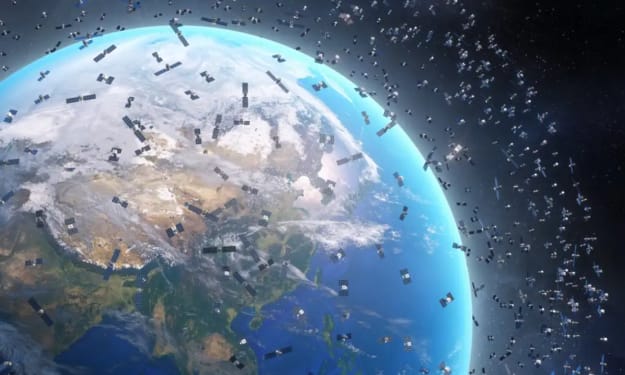
China has submitted an astonishing application to the International Telecommunication Union (ITU) to launch 200,000 satellites over the coming years. To put this into perspective, the entire world currently operates far fewer than this number. Even SpaceX’s Starlink project, one of the largest satellite networks globally, has plans for around 42,000 satellites. China’s proposal signals an unprecedented escalation in space activity and raises important questions: what are these satellites for, and what implications do they hold for global technology, security, and the environment? The Purpose Behind the Numbers At first glance, launching 200,000 satellites may seem excessive, but China’s goals are strategic and multifaceted. Experts suggest that these satellites could serve several purposes: 1. Global Internet Coverage China is aiming to build a massive low-Earth orbit (LEO) satellite network, similar to Starlink and OneWeb. By positioning thousands of satellites closer to Earth, they can provide high-speed internet to remote regions, rural areas, and even ships or aircraft in the oceans. This could help China expand its digital influence globally, offering connectivity in areas where traditional internet infrastructure is weak or non-existent. 2. Enhanced Military and Surveillance Capabilities A satellite network of this scale is also a game-changer for defense and surveillance. Satellites can monitor troop movements, track ships, and provide early warning systems. China’s military has been investing heavily in space-based technology, and these satellites could be a crucial part of modernizing its intelligence, surveillance, and reconnaissance (ISR) capabilities. 3. Scientific Research and Earth Observation Some of these satellites may be dedicated to Earth observation, collecting data on climate, agriculture, natural disasters, and urban development. With thousands of satellites constantly orbiting the planet, China could achieve near real-time monitoring of environmental changes and resource management, giving scientists and policymakers an unprecedented level of insight. 4. Competition in the Commercial Space Sector China’s plan is not purely for government use. The commercial potential of satellite networks is massive, from providing satellite internet services to supporting the burgeoning space economy. Companies under Chinese state and private ownership could leverage this infrastructure to offer services domestically and internationally, challenging Western tech giants in global space markets. The Scale of the Ambition Launching 200,000 satellites is not just ambitious; it’s historic. If approved and executed, China would operate more satellites than all other countries combined, fundamentally reshaping how space is utilized. However, there are serious logistical challenges. Manufacturing, launching, and maintaining hundreds of thousands of satellites requires enormous resources, advanced technology, and careful orbital planning to avoid collisions. China has made major progress in its space launch capacity, with frequent missions through the Long March rocket family and ongoing developments at the Wenchang and Jiuquan Spaceports. Yet, sustaining such a colossal fleet will test even the most advanced space programs. Global Implications The potential consequences of China’s satellite plan are profound, both technologically and geopolitically. 1. Space Traffic Management A network of 200,000 satellites could drastically increase the risk of collisions in orbit. Space debris is already a growing concern, and introducing tens of thousands of new satellites may exacerbate this problem. International cooperation and sophisticated traffic management systems will be essential to prevent catastrophic accidents in space. 2. Geopolitical Tensions China’s space ambitions may intensify global rivalry in space technology, particularly with the United States, Europe, and other spacefaring nations. Control over satellite networks can translate into strategic advantages, from military surveillance to dominance in global communications infrastructure. This may lead to a new phase of space competition reminiscent of the Cold War’s space race. 3. Impact on Astronomy Astronomers have already expressed concern over satellite mega-constellations interfering with observations. Thousands of bright satellites moving across the night sky can distort telescope images and hinder research into deep space phenomena. If China proceeds with 200,000 satellites, the challenge to professional and amateur astronomers will be enormous. 4. Global Connectivity Revolution On the positive side, if managed responsibly, China’s satellite network could revolutionize global connectivity, bringing internet access to millions of people who currently have none. It could accelerate digital development in underserved regions, support education, and foster global commerce in unprecedented ways. Regulatory Hurdles The ITU regulates global satellite usage, including frequency allocation and orbital slots. For China to launch 200,000 satellites, it must secure approval from the ITU, which evaluates whether such an immense network could interfere with other countries’ satellites or violate international agreements. This is not a mere formality—approval for a project of this scale could take years and may require negotiations with multiple nations. Conclusion: A Bold Step Toward the Future China’s application to launch 200,000 satellites is a bold statement about the future of space and global technology. It reflects the country’s ambition to dominate in digital infrastructure, military capability, and commercial space enterprise. While challenges abound—from space debris and regulatory hurdles to geopolitical tensions—the potential benefits are significant, particularly for connectivity and scientific advancement. As the world watches China’s next steps, one thing is clear: the age of satellite mega-constellations is here. How humanity navigates the risks and rewards of this new frontier will shape the future of communication, security, and our presence in space for decades to come.
By Muhammad Hassan4 days ago in Earth
How to Succeed at the Benson Directory®
Congratulations and welcome to the Benson Directory® employee #22391! As our newest call handler, you will have the privilege of speaking with dozens of unique and interesting people on a daily basis as well as the opportunity to earn bonuses for high performance. Contained within this handbook you will find a set of ease to follow instructions designed to help you settle in to your new role and begin paving the way to success.
By S. A. Crawford2 days ago in Fiction



Comments
There are no comments for this story
Be the first to respond and start the conversation.