
What happens when we get attracted by a Black Hole in the space?
Black Holes

Black Holes
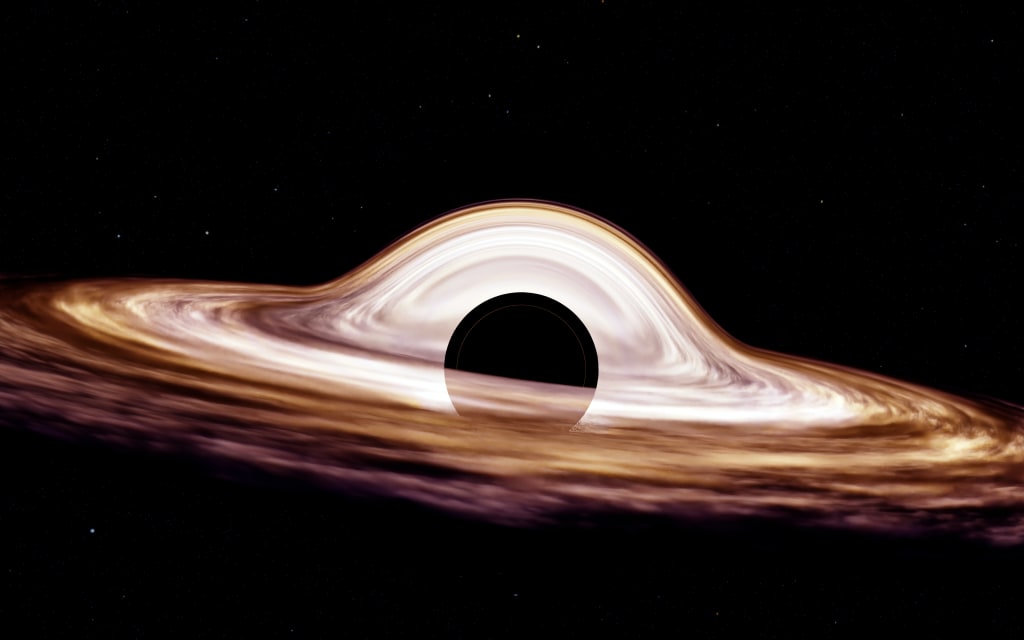
Space-time in which we live can be conceptualised as a grid. Any object which possesses a mass distorts space-time forming around it a gravitational well. If another object is close by, then it will get attracted and spiral down the gravitational well like a marble in a bowl. The greater the mass of the object, the stronger the attraction and the quicker the attracted object must move to free itself from the gravitational pull. If the mass of the object becomes huge without the object growing in size then the gravitational well created will be so great that the speed required to escape it would be greater than the speed of light. Since nothing can move faster than the speed of light then nothing will be able to escape this attraction, even light if it gets too close will be captured. This is a black hole. At its core, a black hole holds a gravitational singularity. This is a point in space at which the curvature of space-time becomes infinite. The further we move away from this singularity the weak of the gravitational pull. Once we reach a limit known as the event horizon, the gravitational pull becomes weak enough for light passing by to escape the black hole. As such, all entities outside the horizon can hope to escape the black hole but as soon as an object moves within the horizon it is destined to fall into the black hole without ever being able to come back.
Recognition of a Black Holes
Since black holes swallow up any light that gets too close, they appear black to us and as such cannot be seen directly. Nonetheless, they can be detected indirectly. Firstly, their presence is given away by their strong gravitational influence. Since they are capable of deviating light, the black holes effectively behave like gravitational lenses which deviate the trajectory of light rays coming from far away stars, thus creating a gravitational Mirage. Since they have a strong influence from far away, black holes can also be identified by looking at the trajectories of stars close by. Finally, even though black holes do not emit any sort of radiation themselves, they do emit some indirectly. Indeed, around certain black holes attracted surrounding matter will form a disc rotating around the singularity. This disc by rotating at high speeds will warm up and emit X and gamma rays which are relatively straightforward to detect.
Sizes of Black Holes
There exist in the universe black holes of all sorts of size. The smallest ones known as stellar black holes are caused by the collapse of massive stars with the size of only a few kilometers. They, nonetheless, have a mass several times greater than our Sun. The largest black holes are found at the center of galaxies, ours included. These supermassive black holes are enormous reaching several billion kilometres in size. Finally, while black holes cannot emit radiation, complex quantum effects result in every black hole evaporating slowly emitting a certain unique type of radiation which we call Hawking's radiation. The larger a black hole the more time it would take to evaporate. As such, for normal sized black holes this evaporation is extremely slow spread out over billions of years and therefore of little importance to us. However, there could well exist microscopic black holes which might have formed following the Big Bang. For these primordial black holes, the evaporation phenomenon would be very important leading to an almost instantaneous disappearance.
Black holes are complex objects full of mystery and which continued to feed scientific imagination. They have given rise to many questions and hypotheses such as the existence of shortcuts which could enable us to travel through space-time wormholes.
About the Creator
Mohamed Abdallah Abdoul-Halim
Let's talk about the Cosmos and discover our Galaxy and all its mysteries.
Reader insights
Good effort
You have potential. Keep practicing and don’t give up!
Top insights
Easy to read and follow
Well-structured & engaging content
Eye opening
Niche topic & fresh perspectives
Expert insights and opinions
Arguments were carefully researched and presented
Keep reading
More stories from Mohamed Abdallah Abdoul-Halim and writers in Earth and other communities.
Is there life on other worlds
Exists life on other planets? The quickest answering to this is question is, we still don't know but the hunt has picked up since the launch of the James Webb Space Telescope (JWST) in 2021 and intriguing new possibilities have emerged. In the search for these signs, the best that scientists Smite manage is an estimate of the probability of life and that is exactly what has happened. The JWST has discovered evidence of carbon-based molecules in the atmosphere of an ocean world. The exoplanet known as K218B is a tantalising target for astronomers as they search for life beyond the solar system and James Webb Telescope has discovered that the planet could be an ocean or hyphen world replete with vital ingredients for life. K218B has a radius between two and three times larger than Earth's and located 120 light years away from the solar system. The new results showed traces of carbon dioxide and methane in K218B’s atmosphere without detecting ammonia which likely indicates that a water ocean under a hydrogen-rich atmosphere with mass around 8.6 times that of Earth and located in its cool star's habitable zone. The region which is neither too hot nor too cold to host liquid water. K218B is an example of a planet with a size between Earth and the solar system mice giant Neptune these worlds are referred to as sub Neptunes and are unlike inner planets in the solar system which makes them something of a mystery to astronomers who are currently debating the nature of their atmospheres. This research should help start to lift the veil surrounding the atmospheres and environmental conditions of both subnet dunes and hyphen worlds. In addition, to turning up carbon molecules the JWSD findings also show the possible presence of something potentially more exciting in the atmosphere of K218B. The Space Telescope seems to have detected dimethyl sulphide which on Earth is only produced as a byproduct of life mainly created by phytoplankton. The team is cautious about this detection which is far less certain than the presence of carbon molecules. This sense of caution has to be applied to the K218B findings in general when it comes to speculating about alien life. Even if the planet has a liquid water ocean and an atmosphere containing carbon molecules that doesn't necessarily mean it Harbours life or that the exoplanet could even support living things at all. With a width of around 2.6 times that of Earth the planet's size means its interior contains high pressurised similar to Neptune but with a thinner atmosphere and an ocean surface this means the planet may be boiling away liquid water making its oceans too hot to host life. Assessing the composition of the atmospheres of Distant Worlds like K218B is no easy task because the light that reflects off their atmospheres is very faint compared to the light from their apparent Stars. The team's findings reflect data collected by the JWD during just two transits of K218B across the face of its parent star. More observations of the exoplanets are on the way but the team behind these findings thinks what they have seen thus far is already proof of the power of the JWST with the ultimate goal being the identification of life on a habitable exoplanet which would transform our understanding of our place in the universe. These new findings are a promising step towards a deeper understanding of Haitian worlds in this Quest but what do I know.
By Mohamed Abdallah Abdoul-Halim2 years ago in History
The Mysterious Giant: Exploring the Rare and Remarkable Rafflesia hasseltii
Introduction: Nature’s Enigmatic Marvel In the dense, humid rainforests of Southeast Asia, a botanical wonder exists that captures the imagination of scientists, travelers, and nature enthusiasts alike. Rafflesia hasseltii, one of the most intriguing plants on Earth, defies conventional understanding of flora. Unlike typical plants, it lacks stems, leaves, or even roots and relies entirely on a host plant to survive. Its enormous flowers, pungent odor, and unique parasitic lifestyle make it one of the rarest and most fascinating species in the plant kingdom.
By Ahmed aldeabella5 days ago in Earth
White Mushroom Market Size and Forecast 2025–2033
Introduction White mushrooms—scientifically known as Agaricus bisporus—are no longer confined to salads, pizzas, and soups. Once considered a humble kitchen staple, they are now emerging as a strategic crop in the global agrifood ecosystem. Driven by sustainability trends, plant-based eating, and rising health consciousness, white mushrooms have carved out a powerful position in both consumer markets and foodservice industries.
By jaiklin Fanandish4 days ago in Earth
My New Book is Finally Here
My poetry collection Beautiful and Brutal Things is done. It's actually done and finally published over 270 pages. Over a year of my life went into this book. More than a year, really. Long days at my computer, sometimes seven days a week because I couldn't stop even when I probably should have. Then two months of editing that felt harder than the writing itself. But it's finished, and I'm still standing, and the book is real.
By Tim Carmichael3 days ago in BookClub



Comments (1)
Thank You, for this knowledge. I am subscribing you cause I am really interested in science and your story are well presented. 👏