
Waves of Resilience
Navigating the Emotional Landscape of Climate Refugees

In the year 2035, as the consequences of climate change escalated, the coastal village of Oceanside faced an imminent threat. Rising sea levels, fueled by melting polar ice caps, were eroding the once-sturdy shoreline, devouring homes and livelihoods. The villagers, once deeply connected to the sea that sustained them, found themselves becoming reluctant refugees in their own homeland.
Among them was the Thompson family – Mark, a fisherman whose ancestors had cast their nets into these waters for generations; Sarah, a schoolteacher who had taught the village children about the wonders of marine life; and their two children, Emma and Liam, who had grown up building sandcastles on the now vanishing beaches.
As the salty breeze turned into a relentless storm, Mark and Sarah faced the heart-wrenching decision to abandon the only life they had known. The government had declared Oceanside an endangered zone, and evacuation orders were issued. They clung to the memories of their quaint wooden house overlooking the ocean, its weathered facade telling tales of storms weathered and calm seas enjoyed.
The evacuation process was a tumultuous ordeal, a chaotic ballet of families desperately salvaging what they could, the roar of the encroaching waves serving as a cruel reminder of the impending loss. The Thompsons, like so many others, gathered their most cherished belongings and boarded buses that would take them to temporary shelters inland.
The transition was jarring. The once close-knit community, accustomed to sharing their lives and seafood catches, found themselves dispersed in a vast sea of unfamiliar faces. Emma and Liam struggled to adapt to the bustling city life, their eyes missing the rhythmic dance of the ocean waves that once lulled them to sleep.
In the crowded shelter, Mark and Sarah shared a quiet moment, their eyes reflecting the anguish of displacement. "We'll rebuild, find a new home," Mark whispered, trying to reassure Sarah. Yet, in the stillness of that moment, their glances betrayed the uncertainty that loomed over their future.
As weeks turned into months, the Thompsons became part of a growing population labeled as climate refugees – individuals forced to flee their homes due to environmental changes. The term carried a heavy emotional weight, echoing the loss of not just a physical space but an entire way of life.
Emma and Liam enrolled in a new school, surrounded by children from various displaced communities. Their once playful laughter now held a somber undertone, as they exchanged stories of vanished beaches and sunken memories. It was a shared language of loss that bound these young souls together.
Sarah, determined to maintain a semblance of normalcy, continued teaching. The subjects shifted from marine biology to tales of resilience and adaptation. She became a pillar of strength for the displaced children, using education as a lifeline to anchor them in this sea of uncertainty.
Mark, however, struggled to find his place in the concrete jungle. The smell of saltwater seemed like a distant memory, replaced by the acrid scent of exhaust fumes. Fishing boats were replaced by skyscrapers, and the daily rhythm of tides was drowned out by the ceaseless honking of traffic.
One day, as the family strolled through a city park, they stumbled upon a memorial dedicated to climate refugees. The names of lost villages were engraved on weathered stones, a silent testimony to the ever-growing diaspora. Emma and Liam, tracing their fingers over the inscriptions, felt a profound connection to the others who shared this unwanted title.
Driven by a yearning for solace, Mark and Sarah sought refuge in a support group for climate refugees. In that shared space, surrounded by people who understood the weight of their experience, they found comfort and camaraderie. Each person had a story, a scar left by the changing climate, and in their collective pain, a sense of solidarity emerged.
As months turned into years, the Thompsons began to rebuild their lives. The city became a new home, but the longing for the sea never faded. Mark, with the support of the refugee community, started a small urban gardening project. The rooftop garden, filled with salt-tolerant plants, became a symbolic link to their maritime roots.
Emma and Liam, resilient like the saplings they planted, discovered new passions amid the unfamiliar terrain. Emma's love for marine life found expression in volunteering at an aquarium, while Liam, once an avid beachcomber, embraced photography as a way to capture fleeting moments and preserve memories.
In the evenings, the Thompsons would gather on their apartment balcony, a humble attempt to recreate the sunset views they once enjoyed by the sea. As the sun dipped below the city skyline, casting hues of orange and pink across the urban landscape, they found solace in the beauty that persisted despite the upheavals.
The scars of displacement never fully faded, but the Thompsons, like so many climate refugees, learned to carry them with grace. Their story became a testament to human resilience, the ability to adapt, and the unyielding spirit that emerges from the depths of loss.
In the quiet moments, when the city slept and the distant hum of the ocean remained a distant memory, the Thompsons would share stories of Oceanside. The laughter of children playing on the beach, the salty breeze that whispered tales of ancient mariners – these memories became treasures held close to their hearts.
As climate refugees, the Thompsons navigated the turbulent waters of change, finding strength in the shared narratives of those who had weathered similar storms. And in their journey, they discovered that while the physical landscape of home may change, the resilience of the human spirit endures, a beacon guiding them through the uncharted seas of a shifting world.
User
Wr
C
T
Subtitle
Message
About the Creator
Keep reading
More stories from Chidoziem Mmesoma and writers in Earth and other communities.
Echoes of Terra
Title Subtitle In the not-so-distant future, where the Earth's pulse was increasingly erratic under the weight of climate change, a small coastal town named Seaview stood as a fragile testament to humanity's tenacity. The townspeople, bound by the ebb and flow of the ocean, were unaware that their lives were about to be reshaped by a force beyond the predictable tides.
By Chidoziem Mmesoma 2 years ago in Earth
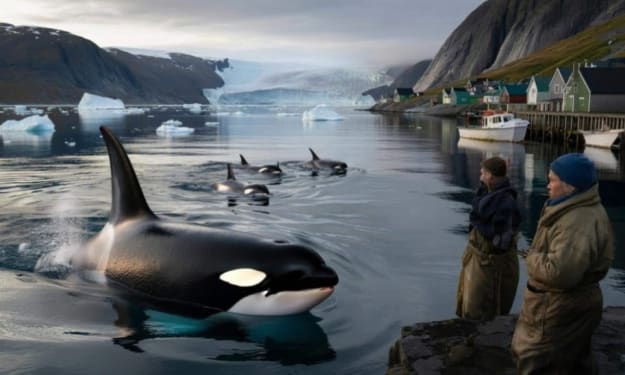
Greenland Declares State of Emergency as Scientists Link the Growing Presence of Orcas to Accelerating Ice Melt
In a landmark decision that reflects the intensifying impacts of climate change, the government of Greenland has officially declared a state of environmental emergency—a rare and solemn move that underscores the accelerating transformation of Arctic ecosystems. The catalyst for this declaration? An unusual and growing presence of orcas—also known as killer whales—in waters once locked in sea ice, a phenomenon scientists say reveals the alarming scale of ice melt in the region.
By Sadaqat Aliabout 14 hours ago in Earth
‘Final Nail in Coffin’: Scottish Sector Under SNP Tax Threat
A growing political and economic debate is unfolding in Scotland as critics warn that proposed or expanding tax pressures under the Scottish National Party (SNP) government could act as the “final nail in the coffin” for a struggling sector of the economy. Business groups, industry leaders, and political commentators are increasingly raising concerns about competitiveness, investment, and long-term sustainability.
By Aarif Lashari7 days ago in Earth
The Piggy Project
I’ve had so many names in this life I lose track of which ones were ever really mine and which ones I wore because someone needed me to. Some were handed to me before I had words to refuse them, before I knew what they meant, before I knew I could say no. Most weren’t meant to hurt. That doesn’t mean they didn’t leave marks. Marks that told me who I belong to, who I am by way of who claims me, recognizes me in the good and bad, who walks beside me.
By Fatal Serendipity6 days ago in Confessions


Comments
There are no comments for this story
Be the first to respond and start the conversation.