
Walking on Fire
The Physics Behind a Fiery Feat That Amazes the World

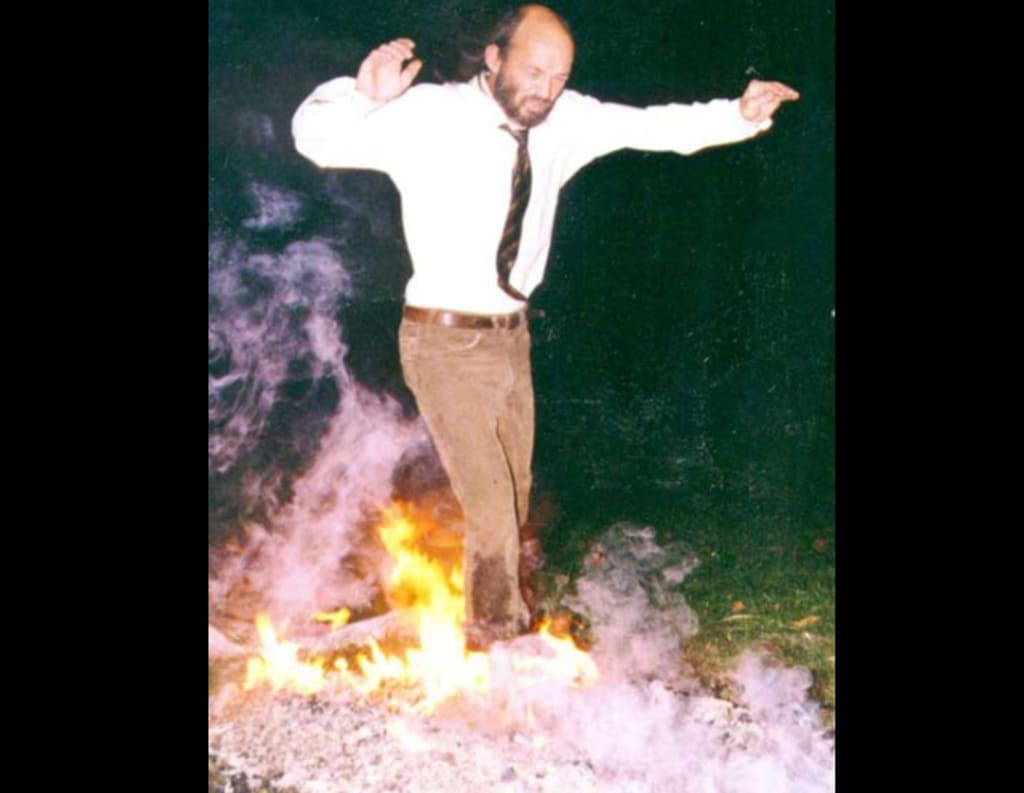
For thousands of years, firewalking has captivated the human imagination. From ancient tribal rituals to modern-day spectacles, the sight of a person walking barefoot across a bed of glowing red-hot coals continues to stir awe, disbelief, and sometimes fear. But according to one award-winning American physicist, there’s no magic involved—just physics.
Professor David Willey, a physics lecturer at the University of Pittsburgh at Johnstown, recently amazed students and onlookers alike when he demonstrated how to walk barefoot across a path of burning embers—without getting burned. His demonstration not only stunned the audience but also sparked a deeper curiosity: How is this even possible?
Presidential Recognition and a Fiery Experiment
Professor Willey isn’t your average physics teacher. He was recently honored with a prestigious teaching excellence award by the President of the United States, and he’s known for his hands-on, high-impact approach to science education. Instead of lecturing with dry formulas on a chalkboard, Willey prefers to show science in action—and few things are more thrilling than walking through fire to make a point.
In one of his most memorable demonstrations, Professor Willey walked across a firebed with surface temperatures reaching a scorching 1,100 degrees Celsius (2,012 degrees Fahrenheit)—a feat that seemed impossible to most. And yet, Willey completed the firewalk with no burns, no injuries, and a big smile on his face.
So, what’s the secret?
The Physics of Firewalking
According to Professor Willey, the ability to walk on fire is not about supernatural powers or mystical protection. It’s about understanding how heat transfer works.
“The key lies in the thermal conductivity of the materials involved,” Willey explains. “Wood, which turns into charcoal during burning, is actually a very poor conductor of heat. So even though the coals may be glowing hot, they don’t transfer heat to the foot very efficiently.”
This low thermal conductivity means that when a person briefly steps on a coal, very little heat is actually transferred to the skin. Combine that with a quick, confident walking pace, and the foot doesn’t stay in contact with the hot surface long enough to burn.
In fact, one layer of protection comes from the ashes and char on top of the embers. These ashes act as an insulating barrier between the burning core and the sole of the foot, further reducing heat transmission.
“It’s important to keep a steady pace,” Willey advises. “The foot should be lifted swiftly after each step, allowing it to cool in the air while the other foot takes the next step. This process prevents the buildup of heat that could otherwise cause burns.”
A Personal Record and the Role of Dead Skin
Professor Willey once set a personal record by walking over coals at temperatures that would instantly ignite paper. Yet, his feet remained unscathed. Part of the protection, he says, comes from the natural calluses on the soles of the feet.
“The dead skin under the foot cools rapidly once lifted into the air,” he notes. “This layer also acts like insulation, and as long as you keep moving, the heat doesn’t have time to penetrate deeply.”
This is why hesitation or standing still can be dangerous. If you stop mid-step, your skin stays in contact with the burning coal long enough for the heat to transfer—resulting in painful blisters or burns.
Anyone Can Do It—With the Right Mindset
Perhaps the most surprising part of Professor Willey’s research is his conclusion: most healthy people can walk on fire without injury, provided they understand the science and follow the rules.
“It’s not just about the physics—it’s about overcoming fear,” Willey says. “The biggest challenge isn’t the heat beneath your feet, but the hesitation in your mind.”
He emphasizes that the first step is the hardest. “You have to train your mind to believe that your feet will be fine. Once you commit to that first step, and maintain a confident rhythm, the science will take care of the rest.”
This psychological barrier is often what separates those who succeed from those who freeze at the edge. In this way, firewalking becomes not just a scientific demonstration, but a powerful metaphor for conquering fear through knowledge and courage.
The Ancient Ritual Meets Modern Science
While the physics of firewalking are now well understood, the practice itself is anything but modern. Firewalking ceremonies have been held for thousands of years in cultures around the globe—from Polynesian tribes to Greek villages and Indian festivals. These rituals were often symbolic, representing strength, purification, or spiritual rebirth.
What was once considered mystical is now explainable through science, but the emotional impact remains just as powerful.
Professor Willey believes that bringing science into everyday experiences—especially those that seem magical—helps students engage with learning in a more profound way. “When students see something they thought was impossible become possible, their curiosity ignites,” he says. “And that’s when real learning begins.”
Lessons from the Fire
In a world full of misinformation and pseudoscience, Willey’s firewalking demonstration is more than just a show—it’s a lesson in critical thinking, observation, and trust in scientific principles.
By teaching that firewalking isn’t a miracle but a matter of physics, he encourages students and the public to replace fear with understanding. Whether it’s walking on fire or tackling a challenging life decision, the same rule applies: Know the facts, take the step, and keep moving forward.
So, next time you see someone walking barefoot across burning embers, remember—it’s not magic. It’s science. And with enough courage and the right knowledge, maybe you could do it too.
About the Creator
Eleanor Grace
"Dream big.Start small.Act now."
Keep reading
More stories from Eleanor Grace and writers in Earth and other communities.
Dire Wolves Were Never True Wolves
Dire Wolves Were Never True Wolves New Genetic Research Reveals a Shocking Truth About the Ice Age Predator For decades, the Dire Wolf (Canis dirus) stood as one of the most iconic predators of the Ice Age. With its massive jaws and powerful build, it was believed to be a close relative of the modern gray wolf (Canis lupus), a dominant carnivore of today's wilderness. But recent breakthroughs in genetic research have upended everything scientists thought they knew about this ancient beast.
By Eleanor Grace9 months ago in Earth
65% of Workers Are Interested in ‘Microshifting’ Their Schedules as an Alternative to the Strict 9-to-5
The traditional 9-to-5 workday has long been considered the standard, but recent research suggests that employees are seeking more flexibility than ever before. A striking 65% of workers report interest in ‘microshifting’ their schedules, a concept that allows them to adjust their work hours in smaller increments rather than sticking to a rigid daily routine. For many, this is more than just a scheduling preference — it’s a way to reclaim control over their time, reduce stress, and boost productivity.
By Muhammad Hassanabout 11 hours ago in Earth
How Much Do You Need in an ISA for a Passive Income That Beats the State Pension?
For many people in the UK, the State Pension is expected to form the backbone of retirement income. But with rising living costs and growing uncertainty about the future, more savers are asking a crucial question: Can I build a passive income that beats the State Pension — and how much would I need in an ISA to do it?
By Aarif Lasharia day ago in Earth




Comments
There are no comments for this story
Be the first to respond and start the conversation.