
Urban Agriculture: Cultivating Food in the Cities of the Future
Sustainable Solutions for Urban Living: How Cities are Transforming into Green Food Hubs

Introduction
Definition of Urban Agriculture
Urban agriculture refers to the practice of cultivating food within urban or peri-urban areas. This can include community gardens, vertical farms, rooftop greenhouses, and indoor cultivation using techniques such as hydroponics and aeroponics. The goal is to utilize urban spaces to produce fresh food close to consumers, reducing transportation needs.
Current Importance and Relevance
Urban agriculture is gaining relevance in response to global challenges like climate change, rapid urbanization, and food security. With a projected 68% of the world’s population living in urban areas by 2050, innovative and sustainable food production solutions are urgently needed.
Article Objectives
This article explores urban agriculture’s origins, benefits, technologies, challenges, and future prospects, aiming to provide a comprehensive understanding of its potential to create more sustainable and resilient cities.
1. The Growth of Urban Agriculture
Brief History of Urban Agriculture
Urban agriculture is not a new concept. Ancient Rome had private and community gardens, and “Victory Gardens” during World War II provided vital food sources. Recently, urban agriculture has reemerged, driven by sustainability and technological advancements.
Factors Driving Its Spread
Several factors contribute to urban agriculture’s spread:
• Environmental Sustainability: The need to reduce the ecological footprint of cities has driven people to seek ways to produce food locally, thereby reducing emissions associated with food transportation.
• Health and Wellbeing: Access to fresh and local food has a positive impact on public health, improving diet quality and reducing the incidence of diet-related diseases.
• Community Growth: Urban gardens and community agriculture projects foster social cohesion, creating common spaces where people can meet and collaborate.
• Technological Innovation: Advancements in cultivation technologies, such as hydroponics and vertical farming, have made it possible to implement efficient agricultural systems even in limited spaces.
Successful Examples in Various Cities Around the World
Numerous cities worldwide have successfully adopted urban agriculture practices:
• New York, USA: Rooftop gardens like those of Brooklyn Grange, which produce tons of vegetables every year directly on the rooftops of city buildings.
• Singapore: The city-state has heavily invested in vertical and hydroponic agricultural technologies, aiming to produce 30% of its food needs locally by 2030.
• Havana, Cuba: A pioneer in urban agriculture, with over 90% of its fresh vegetables produced locally through a system of community gardens and agricultural cooperatives.
2. Benefits of Urban Agriculture
Environmental Benefits
Urban agriculture offers numerous environmental benefits. One of the main advantages is the reduction of the carbon footprint associated with food transportation. By cultivating fresh produce within cities, the need to transport food over long distances is significantly reduced, thereby decreasing greenhouse gas emissions. Additionally, urban agricultural practices can help improve air quality: plants absorb carbon dioxide and release oxygen, while gardens and green spaces can reduce the urban heat island effect, lowering local temperatures.
Another environmental benefit is stormwater management. Green urban spaces, including gardens, can absorb rainwater, reducing the risk of flooding and improving water resource management. Moreover, urban agriculture can promote biodiversity in urban environments, creating habitats for insects, birds, and other animals.
Social Benefits
Urban agriculture not only brings environmental benefits but also has a significant impact on society. One of the main advantages is community cohesion. Urban agriculture projects, such as community gardens, provide spaces where people can meet, collaborate, and develop relationships. These spaces can become centers of social and cultural activity, helping to strengthen the social fabric of cities.
Additionally, urban agriculture can play a crucial role in food education. By involving citizens, especially the youth, in food cultivation, it promotes greater awareness of food origins and the importance of a healthy and sustainable diet. This can lead to more conscious food choices and an overall improvement in public health.
Economic Benefits
Urban agriculture also has potential economic benefits. It can create job opportunities in various sectors, from cultivation and harvesting to distribution and sale of agricultural products. In particular, it can offer employment opportunities to groups of people who may have difficulty finding work, such as young people and low-income individuals.
Moreover, access to fresh and healthy food at affordable prices can have a positive impact on the local economy. By reducing dependency on global food markets and promoting local production, cities can improve their food security and economic resilience. Finally, urban agriculture can attract investment in innovation and green technologies, further stimulating sustainable economic development.
3. Technologies and Methods Used
Hydroponics and Aeroponics
Hydroponics and aeroponics are two of the most innovative and promising technologies in urban agriculture. Hydroponics is a cultivation method that uses nutrient solutions in water instead of soil. Plants are grown in a controlled environment where they receive exactly the nutrients they need, minimizing water and fertilizer waste. This technique allows a wide variety of plants to be grown in limited spaces, making it ideal for urban environments.
Aeroponics, on the other hand, is a system where plant roots are suspended in the air and misted with a nutrient solution. This method not only further reduces water use but also allows greater aeration of the roots, promoting faster and healthier plant growth. Both methods are particularly suited for vertical farming, another key element of urban agriculture.
Vertical Farming
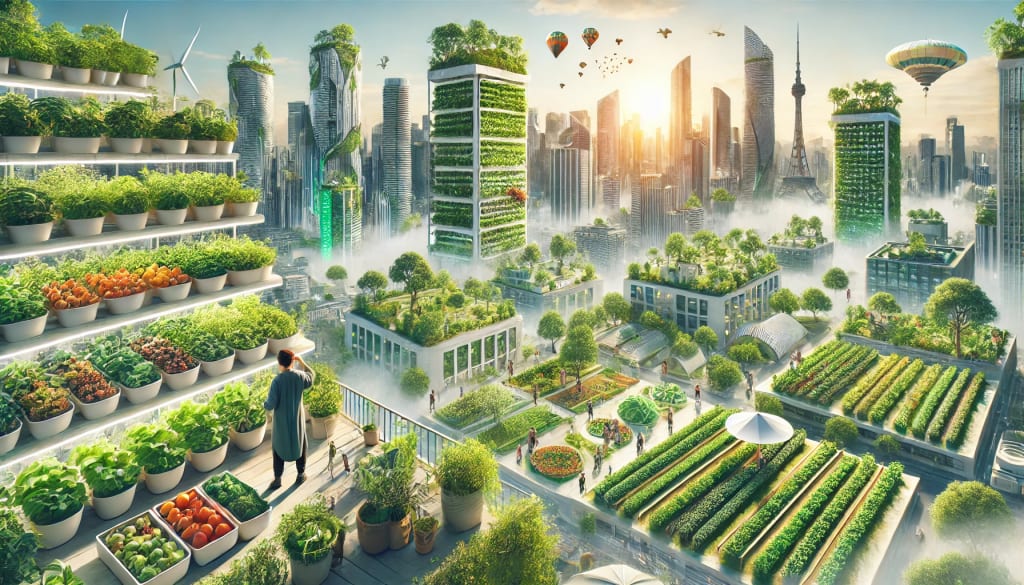
Vertical farming is a technique that utilizes vertical structures to grow plants in urban environments. Using shelves and towers, plants can be grown in multiple layers, maximizing the use of available space. This approach not only increases agricultural production per square meter but can also be integrated into existing buildings such as skyscrapers, offices, and residences.
Vertical farming technologies often combine the use of full-spectrum LED lights to simulate sunlight, drip irrigation or hydroponic systems to provide water and nutrients, and advanced sensors to monitor growth conditions. This allows for the creation of a highly controlled and optimized growth environment, reducing risks associated with adverse weather conditions and plant diseases.
Use of Urban Greenhouses
Urban greenhouses are another effective method for growing food in cities. These structures can be installed on rooftops, in courtyards, or other available spaces. Greenhouses allow for the extension of the growing season and protection of plants from adverse weather conditions, creating an ideal microclimate for cultivation.
Modern greenhouses can be equipped with advanced technologies such as temperature and humidity control systems, artificial lighting, and automated irrigation systems. This allows for optimized growing conditions and increased productivity, making it possible to cultivate a wide range of plants even in non-ideal climates.
Urban Permaculture Projects
Permaculture is an approach to agricultural design that mimics natural ecosystems to create sustainable and self-sufficient agricultural systems. Urban permaculture projects integrate plants, animals, and infrastructure in ways that maximize the efficiency and resilience of the agricultural system.
In an urban context, permaculture can include the design of community gardens, rooftop gardens, and multifunctional green spaces that combine food production with stormwater management and biodiversity promotion. This approach not only contributes to environmental sustainability but also creates recreational green spaces for the community, improving urban quality of life.
4. Challenges and Obstacles
Space and Resource Limitations
One of the main challenges of urban agriculture is the limitation of available space. Cities, by nature, have limited and highly contested spaces for various uses such as housing, commerce, and infrastructure. Finding suitable spaces for cultivation can therefore be difficult. Even when space is available, it can be costly and complicated to adapt it for agricultural use, especially if it requires significant infrastructural modifications.
Another critical resource is water. Although techniques such as hydroponics and aeroponics are more water-efficient than traditional agriculture, the availability of clean water can still be a challenge in some urban areas. Additionally, the management of organic waste and the provision of sustainable nutrients are issues that need to be addressed to ensure the long-term viability of urban agriculture.
Regulatory and Legislative Issues
Regulations and urban planning laws can be a significant obstacle to the implementation of urban agriculture projects. In many cities, local laws are not updated to adequately include or support urban agriculture. This can include restrictions on where and how food can be grown, food safety requirements, and regulations regarding the use of land and water resources.
Addressing these issues often requires negotiations and collaborations with local authorities, which can be a lengthy and complex process. Additionally, the lack of a clear regulatory framework can discourage potential investors and entrepreneurs from getting involved in urban agriculture projects.
Economic and Funding Challenges
Starting and maintaining urban agriculture projects require significant investments. Initial costs for purchasing or leasing land, installing necessary infrastructure, and acquiring technological equipment can be prohibitive for many small urban farmers. Additionally, the economic return on these investments may take time, making it difficult for urban agricultural projects to sustain themselves financially in the early years.
Funding sources for urban agriculture can be limited, and projects often have to compete for grants and investments with other urban initiatives. The lack of access to credit and concessional financing can hinder the development of new projects. Therefore, it is essential to develop sustainable business models and identify alternative funding sources, such as public-private partnerships, crowdfunding, and government grants.
Technical and Operational Challenges
Finally, technical and operational challenges can be a significant obstacle for urban agriculture. Managing complex cultivation systems such as hydroponics and vertical farming requires specialized skills and training. The maintenance and operation of these technologies can be costly and require constant monitoring to ensure their efficiency and productivity.
Additionally, integrating urban agriculture into existing infrastructures can present logistical and operational problems. For example, managing distribution and logistics to bring fresh produce from cultivation sites to final consumers can be complicated in dense urban contexts. Addressing these challenges requires innovation, adaptability, and strong commitment from the communities and stakeholders involved.
5. Supportive Initiatives and Policies
Government Policies and Incentives
Government policies play a crucial role in promoting and supporting urban agriculture. Some cities have begun implementing urban planning strategies that include dedicated spaces for urban agriculture, offering tax incentives and grants to encourage citizens to engage in agricultural activities. For example, cities like New York and Toronto have developed strategic plans to integrate urban agriculture into their sustainability programs, including incentives for installing rooftop gardens and transforming vacant lots into community gardens.
Additionally, some local administrations are simplifying regulations to facilitate the start of urban agriculture projects. These regulatory changes can include reducing taxes for the agricultural use of urban spaces, offering grants for the construction of agricultural infrastructures, and creating training programs to educate citizens on urban cultivation techniques.
Community Projects and NGOs
Non-governmental organizations (NGOs) and community projects are fundamental to the spread of urban agriculture. These organizations often operate at the neighborhood level, directly involving residents and promoting community participation. Through workshops, educational events, and volunteer initiatives, NGOs can help disseminate the knowledge necessary to start and maintain urban agriculture projects.
A significant example is the “Community Supported Agriculture” (CSA) model, where community members purchase shares of a local farm and regularly receive fresh produce. This model not only economically supports urban farmers but also creates a direct link between producers and consumers, fostering social cohesion and food education.
Role of Private Companies and Startups
Private companies and startups are also playing an increasingly important role in urban agriculture. These entities can bring innovation and capital, developing new technologies and business models to make urban agriculture more efficient and scalable. Agritech startups are experimenting with advanced hydroponics, aeroponics, and vertical farming systems, creating solutions that can be implemented in urban contexts of various sizes.
Partnerships between the public and private sectors can be particularly effective in promoting urban agriculture. For example, projects like “Gotham Greens” in New York have seen collaboration between government entities, private companies, and local communities to create highly successful urban greenhouses. These projects not only produce fresh food for local markets but also serve as examples of how innovation and collaboration can lead to sustainable and profitable solutions.
Education and Awareness
Education and awareness are essential components for the long-term success of urban agriculture. In many cities, schools and universities are integrating urban agriculture programs into their curricula, offering courses on sustainable cultivation techniques, resource management, and agricultural entrepreneurship. These educational programs not only train the next generation of urban farmers but also help create a culture of awareness and appreciation for local food production.
Additionally, public awareness campaigns can help educate citizens about the benefits of urban agriculture and how they can participate. Through the use of social media, community events, and informational publications, organizations can spread knowledge and encourage greater participation in urban agriculture projects.
6. The Future of Urban Agriculture
Technological Innovations on the Horizon
The future of urban agriculture promises to be rich with technological innovations that will further revolutionize the way we grow food in cities. One of the most promising areas is the integration of the Internet of Things (IoT) with urban agriculture. Advanced sensors and connected devices can monitor plant conditions in real-time, optimizing the use of water, nutrients, and light. This allows for more efficient resource management and higher productivity.
Another significant innovation is the use of artificial intelligence (AI). AI algorithms can analyze complex data to predict optimal growth conditions and automate many aspects of agricultural management, reducing manual labor and improving overall efficiency. Additionally, the use of robotics for planting, harvesting, and maintaining crops can make urban agriculture even more sustainable and scalable.
Long-term Prospects
In the long term, urban agriculture has the potential to radically transform cities. Imagine a future where every urban building could host a rooftop garden or a vertical greenhouse, significantly contributing to local food production. This vision also includes the use of unconventional spaces, such as old factories and abandoned warehouses, which can be repurposed into high-tech cultivation centers.
The cities of the future could become truly self-sufficient ecosystems, where urban agriculture not only provides fresh food but also helps improve air quality, manage stormwater, and create recreational green spaces for citizens. This integrated approach can help make cities more resilient to climate change and food crises, improving overall urban quality of life.
Potential Impacts on Cities and Communities
The widespread adoption of urban agriculture can have profound social and economic impacts on cities and communities. Socially, access to fresh and local food can significantly improve public health, reducing diet-related diseases and promoting a healthier lifestyle. Additionally, the green spaces created by urban agriculture can serve as meeting and socializing places, strengthening community bonds.
Economically, urban agriculture can stimulate the creation of new jobs and business opportunities. From small agricultural enterprises to tech startups, to local farmers’ markets, the urban economic ecosystem can greatly benefit from the integration of agriculture. Moreover, local food production can reduce dependency on imports, increasing food security and economic resilience for cities.
The Role of Sustainability
Sustainability is a key principle of urban agriculture. Urban agricultural practices can contribute to more efficient use of resources, reducing water and nutrient waste and minimizing environmental impact. Additionally, urban agriculture can promote biodiversity and contribute to the sustainable management of organic waste through composting and other recycling techniques.
The cities of the future will face significant challenges related to climate change and population growth. Urban agriculture offers a sustainable solution that can help mitigate these impacts, creating greener, healthier, and more resilient cities. Promoting and supporting urban agriculture is therefore essential to building a sustainable future for future generations.
Conclusions
Urban agriculture presents an innovative and sustainable response to the modern challenges faced by cities. By transforming available urban spaces into productive agricultural hubs, we can produce fresh and nutritious food close to consumers, significantly reducing the carbon footprint associated with long-distance food transportation. This approach also offers numerous environmental, social, and economic benefits, from improving air quality and fostering community cohesion to creating job opportunities and enhancing food security.
Technological advancements such as hydroponics, aeroponics, and vertical farming are revolutionizing urban agriculture, making it possible to cultivate a wide variety of plants efficiently even in limited spaces. However, despite its promising potential, urban agriculture still faces significant challenges, including space and resource limitations, regulatory and legislative barriers, and financial hurdles.
Supportive initiatives and policies from governments, communities, and private entities are crucial for overcoming these obstacles. By providing incentives, simplifying regulations, and promoting education and awareness, we can create an environment conducive to the growth of urban agriculture. Moreover, the collaboration between public and private sectors can drive innovation and investment, further enhancing the viability and scalability of urban farming projects.
Looking to the future, urban agriculture holds the potential to radically transform our cities, making them greener, healthier, and more resilient. The integration of advanced technologies and sustainable practices can turn urban areas into self-sufficient ecosystems, contributing to the overall well-being of urban residents. By embracing urban agriculture, we can build a more sustainable future, where cities are not only centers of consumption but also hubs of food production and environmental stewardship.
In light of these benefits and opportunities, it is essential for individuals, businesses, and governments to support and promote urban agriculture. Together, we can create thriving urban environments that are capable of meeting the food needs of growing populations while enhancing the quality of life for all.
About the Creator
Fabio Smiraglia
I am a passionate content writer with extensive experience in crafting engaging texts for blogs, websites, and social media. I love telling stories, informing, and connecting with audiences, always with creativity and precision.
Keep reading
More stories from Fabio Smiraglia and writers in Earth and other communities.
Sustainable Travel: How to Explore the World Without Harming the Environment
Introduction Tourism is an expansive global industry, offering economic benefits, cultural exchange, and personal enrichment. However, it also presents significant environmental and social challenges. The rise of sustainable travel seeks to address these issues by promoting responsible tourism practices that minimize negative impacts and enhance positive outcomes. This article provides a comprehensive overview of how travelers can embark on journeys that are mindful of the planet and respectful of local communities, from selecting eco-friendly destinations and transportation to supporting local economies and engaging in conservation efforts.
By Fabio Smiragliaabout a year ago in Earth
How Much Do You Need in an ISA for a Passive Income That Beats the State Pension?
For many people in the UK, the State Pension is expected to form the backbone of retirement income. But with rising living costs and growing uncertainty about the future, more savers are asking a crucial question: Can I build a passive income that beats the State Pension — and how much would I need in an ISA to do it?
By Aarif Lashariabout 19 hours ago in Earth
Tiny Lion Cubs Struggle To Keep Up With Mom
In the heart of the African savannah, life is a constant lesson for young animals. Few scenes are as endearing — or as heartwarming — as tiny lion cubs trying to keep pace with their mother. These little bundles of fur face a world full of challenges, from learning to hunt to avoiding dangers, all while depending on the guidance and protection of their experienced mom. Watching cubs wobble and tumble as they attempt to keep up with their mother reminds us that growing up, even in the wild, is a journey full of struggle, determination, and adorable missteps. The Early Days of Lion Cubs Lion cubs are born blind and helpless, usually in litters of two to six. For the first few weeks, they rely entirely on their mother for warmth, food, and safety. Even after opening their eyes and beginning to explore, the cubs are far from independent. The first months are crucial. Cubs learn social cues, hunting basics, and survival skills simply by watching their mother and the pride. But as anyone who has observed them knows, there’s often a huge gap between observation and action. Tiny cubs often struggle to match their mother’s pace, especially when she moves through long stretches of savannah or leads the family on patrols. A Mother’s Role in the Wild For a lioness, raising cubs is a full-time commitment. She hunts, defends her territory, and teaches her young, all while staying alert to predators such as hyenas, leopards, and even rival lions. The cubs, meanwhile, attempt to mimic her every move — often with clumsy yet charming results. A mother lion’s patience is remarkable; she frequently slows down, nudges them along, or stops to ensure no cub is left behind. These moments, while stressful for the tiny cubs, are vital learning opportunities. Struggling to Keep Up: Why It’s So Hard There are several reasons why tiny lion cubs have trouble keeping pace with their mother: Short Legs, Big Steps: Lion cubs’ legs are tiny and their coordination is limited, making it difficult to cover the same distance as an adult lioness. Curiosity: Cubs are naturally curious. A single butterfly or rustling bush can distract them, leaving mom to pause repeatedly. Energy Levels: Young lions tire quickly. Even with frequent naps, the cubs’ stamina is far lower than their mother’s. Learning Through Play: Play is not just fun; it teaches hunting, balance, and social skills. Running off to pounce on a sibling or chase an insect is all part of their education. Despite these challenges, the cubs’ determination to keep up demonstrates their resilience and growing understanding of the wild world. Lessons in Teamwork and Survival Every cub struggling to keep up is also learning crucial survival skills. The journey across the savannah is more than a test of speed — it’s a lesson in: Coordination: Cubs learn how to move efficiently across different terrains. Patience: They begin to understand the rhythms of adult life and the pace required for survival. Social Skills: Staying with the group teaches cubs how to interact with siblings and the pride, which is essential for their future roles. Observation: By following their mother, cubs study hunting techniques, territorial behavior, and predator awareness. Even the moments when cubs stumble or lag behind are essential for their development. These experiences prepare them for independence, which comes sooner than many might expect. The Cutest Moments in the Wild Anyone who has watched tiny lion cubs knows that their struggles are often irresistibly cute. Video clips from wildlife reserves frequently show cubs toddling along, tumbling over each other, or getting distracted mid-step. Observers often comment that these little stumbles reveal personality, determination, and playfulness, making them one of nature’s most heartwarming spectacles. While their mother is serious and focused, the cubs inject a sense of humor and lightness into life on the savannah. Why This Matters The struggles of lion cubs aren’t just adorable — they’re vital for understanding wildlife behavior. Conservationists and animal behaviorists use these moments to study growth patterns, social structures, and survival strategies in lion populations. These observations also highlight the importance of preserving natural habitats. Cubs must learn in a safe environment to survive; habitat loss, poaching, and climate change make these early struggles even more dangerous. Protecting the African savannah ensures that future generations of lions can experience the same lessons and playful tumbles. The Road to Independence Within a year, these tiny cubs will be more agile, faster, and more confident. By the time they reach two to three years old, males may begin to leave the pride, while females often stay and become caretakers themselves. Every misstep, tumble, and lagging moment is part of the journey toward strength, coordination, and independence. Watching them now gives us a glimpse of the challenges they will overcome, and the survival skills they will carry for life. A Celebration of Motherhood Ultimately, these scenes remind us of the incredible bond between mother and cubs. Her patience, vigilance, and teaching are the foundations of their future. The cubs’ struggles highlight the trials of growing up, while their determination showcases the resilience and beauty of wildlife. For those observing, it’s a powerful lesson in care, guidance, and perseverance, not just in lions but in the natural world as a whole. Final Thoughts Watching tiny lion cubs try to keep up with their mother is both entertaining and enlightening. It’s a story of growth, struggle, and resilience — a reminder that even the fiercest creatures start small, learning step by step. These little lions capture hearts while teaching life lessons: patience, determination, teamwork, and the importance of guidance. As they tumble and waddle across the savannah, they show us that growth is a process, one adorable misstep at a time. For wildlife enthusiasts, animal lovers, and anyone enchanted by nature, these tiny cubs are proof that even in the wild, love, care, and persistence are universal truths.
By Aarif Lashariabout 20 hours ago in Earth




Comments (3)
Well detailed analysis, thanks
Liked your explanation
Interesting one