
Understanding Quantum Computing: Unlocking Limitless Possibilities
The Path Forward: Overcoming Challenges and Expanding Quantum Computing's Reach

Quantum computing, a groundbreaking field at the intersection of physics and computer science, holds the potential to revolutionize the way we process information. Unlike classical computers that rely on bits to represent data, quantum computers use quantum bits, or qubits, which can exist in multiple states simultaneously. This unique property allows quantum computers to perform complex calculations exponentially faster than their classical counterparts, opening up a world of limitless possibilities. In this article, we will delve into the principles behind quantum computing, explore its potential applications, and discuss the challenges it faces.
The Principles of Quantum Computing
At the heart of quantum computing lies the principle of superposition. In classical computing, a bit can be either 0 or 1. In contrast, a qubit can exist in a superposition of both 0 and 1 states simultaneously. This is akin to a coin spinning in mid-air, being both heads and tails until observed and collapsing into a definite state. Superposition enables quantum computers to process vast amounts of information simultaneously, leading to exponential computational speedup.
Another crucial principle is entanglement. Entanglement occurs when two or more qubits become interconnected, such that the state of one qubit instantaneously affects the state of the others, regardless of the distance between them. This phenomenon allows for the creation of highly correlated qubit states and enables quantum computers to perform parallel computations, providing a significant advantage over classical computers for certain types of problems.
Applications of Quantum Computing
While quantum computing is still in its early stages, it has the potential to transform numerous fields and industries. Here are some areas where quantum computing could make a significant impact:
- Cryptography: Quantum computers have the potential to break currently used cryptographic algorithms, rendering sensitive information vulnerable. However, they also offer new possibilities for secure communication through quantum cryptography, which leverages the principles of quantum mechanics to ensure unbreakable encryption.
- Optimization and Simulation: Quantum computers excel at solving optimization problems, which involve finding the best solution among a vast number of possibilities. They can tackle complex optimization challenges, such as route optimization for logistics or portfolio optimization in finance. Additionally, quantum computers can simulate quantum systems accurately, allowing scientists to study molecular interactions, design new materials, and explore chemical reactions more efficiently.
- Machine Learning and Artificial Intelligence: Quantum computing can enhance machine learning and AI algorithms by processing and analyzing massive datasets much faster. It can facilitate tasks such as pattern recognition, natural language processing, and data clustering, leading to more advanced AI systems.
- Drug Discovery: The pharmaceutical industry can greatly benefit from quantum computing's ability to simulate molecular structures and interactions. Quantum computers can accelerate the process of drug discovery by efficiently predicting the effectiveness and side effects of potential drug candidates.
Challenges and Limitations
Despite its vast potential, quantum computing faces several challenges that need to be overcome:
- Quantum Decoherence: Qubits are incredibly delicate and can lose their quantum state due to environmental interference. This phenomenon, known as decoherence, poses a significant obstacle in building and maintaining stable quantum systems. Researchers are actively working on developing error-correction techniques and improving qubit coherence times.
- Scalability: Building large-scale quantum computers with a sufficient number of qubits remains a significant technical hurdle. Quantum systems are prone to errors, and increasing the number of qubits amplifies this challenge. Advancements in qubit stability and error correction are necessary to scale quantum computers effectively.
- Cost and Accessibility: Quantum computers are still expensive and complex to build and maintain. Currently, they require specialized environments with extremely low temperatures and precise conditions. Ensuring accessibility and affordability will be vital for the widespread adoption of quantum computing.
Quantum computing holds tremendous promise for solving complex problems that are intractable for classical computers. From revolutionizing cryptography to enabling faster optimization and simulation, quantum computing has the potential to transform various industries. However, significant challenges, such as quantum decoherence and scalability, need to be addressed before quantum computers can reach their full potential. As research and development continue, quantum computing is poised to unlock limitless possibilities, pushing the boundaries of what is possible in computation and problem-solving. The future of quantum computing is exciting, and its impact on society could be truly transformative.
About the Creator
Keep reading
More stories from Samuel Aballa and writers in Earth and other communities.
The Impact of 5G Technology on Connectivity and Communication
In today's fast-paced digital era, staying connected and having seamless communication has become a vital aspect of our lives. The introduction of 5G technology has revolutionized the way we connect and communicate, offering unprecedented speed, reliability, and capacity. This article explores the impact of 5G on connectivity and communication, delving into its benefits, challenges, and the transformative potential it holds.
By Samuel Aballa3 years ago in Earth
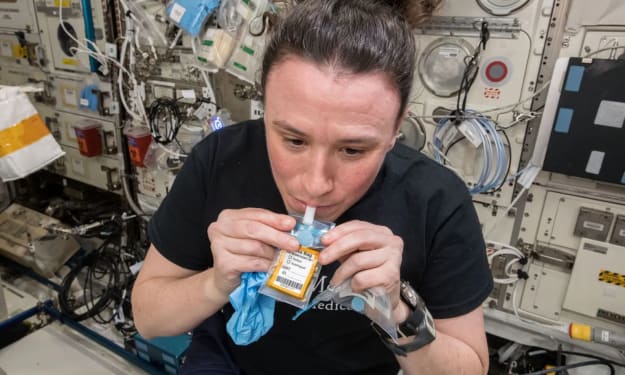
Scientists Probe How Long-Term Spaceflight Alters Immunity
On Earth, a human body with a properly functioning immune system will work to overcome an infection. But in space, that same immune system will have to work a bit harder to overcome the same infection. In the isolated environment of the International Space Station, many factors — physiological stress, disrupted circadian rhythms, radiation, microgravity, and other spaceflight factors — can alter an astronaut’s immune response.
By Voice of Reality7 days ago in Earth



Comments
There are no comments for this story
Be the first to respond and start the conversation.