
"Transforming Industries''
''How 5G is Reshaping Healthcare"
Introduction :
The deployment of 5G networks is poised to revolutionize numerous industries, and healthcare stands at the forefront of this transformation. With its lightning-fast speeds, ultra-low latency, and massive device capacity, 5G technology is reshaping healthcare delivery, enabling innovative applications, and improving patient outcomes. In this article, we explore the profound impact of 5G on healthcare and how it is transforming the industry.
Enhanced Telemedicine and Remote Consultations:
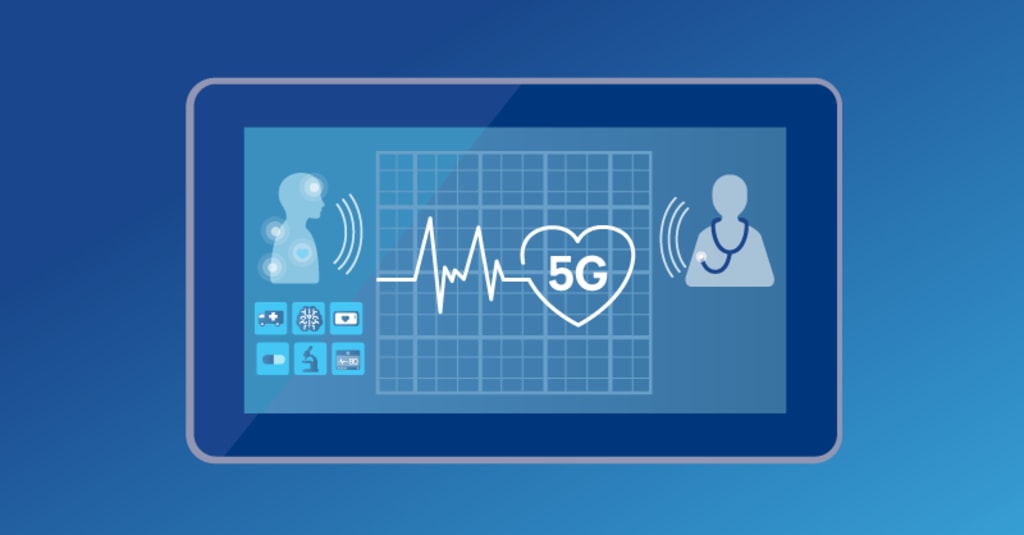
One of the significant benefits of 5G in healthcare is its ability to revolutionize telemedicine and remote consultations. With its ultra-low latency and high-speed connectivity, 5G enables real-time, high-definition video conferencing between healthcare providers and patients. This allows for more accurate assessments, improved diagnosis, and personalized care delivery, regardless of geographical distances. Remote consultations become seamless, as doctors can remotely monitor vital signs, view medical images, and even perform virtual examinations through robotic systems. 5G-powered telemedicine not only enhances access to healthcare for rural or underserved areas but also provides convenient healthcare options for patients, reducing the need for unnecessary hospital visits and enabling better management of chronic conditions.
Enabling Remote Surgeries and Augmented Reality:
The low latency and high bandwidth capabilities of 5G make it an ideal technology for enabling remote surgeries. Surgeons can utilize real-time haptic feedback, augmented reality (AR), and precise robotic control to perform procedures from a remote location. This breakthrough technology allows renowned specialists to offer their expertise globally, reducing the barriers of distance and improving patient outcomes. With 5G's seamless connectivity, there is minimal delay in transmitting data, ensuring the surgeon's movements are accurately translated into the robotic instruments. Furthermore, AR overlays can provide surgeons with real-time patient data, surgical plans, and vital information during the procedure, enhancing precision and efficiency.
IoT-Enabled Healthcare and Remote Monitoring :
The Internet of Things (IoT) is revolutionizing healthcare by connecting medical devices, wearables, and sensors to improve patient monitoring and optimize healthcare delivery. With 5G's massive device capacity and low latency, healthcare providers can leverage IoT-enabled devices to monitor patients remotely in real-time. This allows for continuous monitoring of vital signs, medication adherence, and early detection of potential health issues. For example, wearable devices equipped with biosensors can collect and transmit data to healthcare professionals instantly, enabling timely interventions and personalized care plans. Additionally, 5G-powered IoT devices facilitate the seamless exchange of information between various stakeholders in the healthcare ecosystem, including hospitals, clinics, pharmacies, and insurance providers, streamlining communication and enhancing care coordination.
Data-Driven Healthcare Analytics and Research :
The exponential growth of data in healthcare necessitates powerful connectivity to process and analyze vast amounts of information. 5G's high-speed connectivity enables real-time data transmission, empowering healthcare providers and researchers to derive valuable insights from complex datasets. With faster data processing capabilities, 5G facilitates advanced analytics, artificial intelligence (AI), and machine learning applications, enabling predictive modeling, disease surveillance, and drug discovery. Real-time data analytics and AI algorithms can identify patterns, predict outbreaks, and improve treatment outcomes. Additionally, 5G networks can support secure and efficient data sharing among healthcare institutions, fostering collaboration and accelerating medical research breakthroughs.
Conclusion :
The deployment of 5G technology is revolutionizing the healthcare industry, enabling transformative applications and improving patient care. From enhanced telemedicine and remote consultations to enabling remote surgeries, IoT-enabled healthcare, and data-driven analytics, 5G is reshaping how healthcare is delivered, improving accessibility, and driving innovation. With its unprecedented connectivity capabilities, 5G has the potential to transform healthcare and usher in a new era of patient-centric care.
About the Creator
Europe Draws a Red Line on Greenland After a Year of Trying to Pacify Trump
For nearly a year, European leaders walked a diplomatic tightrope. They tried calm language, quiet reassurance, and strategic patience as former U.S. President Donald Trump repeatedly revived his controversial interest in Greenland. What began as provocative rhetoric gradually evolved into something Europe could no longer ignore. Now, after months of behind-the-scenes diplomacy, Europe has drawn a clear red line on Greenland — signaling that compromise has its limits when sovereignty and regional security are at stake. This shift marks more than a response to one leader’s remarks. It reflects Europe’s growing determination to defend territorial integrity, manage Arctic competition, and assert strategic autonomy in an increasingly unpredictable geopolitical environment. How Greenland Became a Flashpoint Again Greenland, an autonomous territory within the Kingdom of Denmark, has long held strategic importance. Rich in rare earth minerals, located along key Arctic routes, and home to critical U.S. military infrastructure, the island sits at the crossroads of security, climate change, and great-power rivalry. Donald Trump’s original proposal in 2019 to “buy” Greenland was widely mocked in Europe. But as his political influence resurged, so did concerns that his renewed interest was not just symbolic. Over the past year, Trump’s rhetoric — framed around U.S. security, resource access, and countering China and Russia in the Arctic — became more persistent. European capitals initially chose restraint. Officials hoped that de-escalation, quiet diplomacy, and alliance solidarity would prevent the issue from spiraling into a transatlantic rift. A Year of European Pacification For much of the past year, Europe adopted a strategy of pacification rather than confrontation. Denmark emphasized its close defense cooperation with Washington. EU leaders reiterated NATO unity and the importance of Arctic stability. Diplomats avoided public criticism, choosing private channels instead. The goal was clear: prevent Trump’s Greenland narrative from becoming official U.S. policy while preserving transatlantic relations. However, this approach had limits. As Trump’s language grew sharper — hinting at leverage, pressure, or “strategic necessity” — European patience began to erode. What once sounded like political theater increasingly resembled a challenge to European sovereignty norms. Why Europe Finally Drew the Line Europe’s tougher stance did not emerge overnight. It was driven by several converging realities. 1. Sovereignty Is Non-Negotiable At the heart of Europe’s response is a firm principle: territorial sovereignty cannot be bargained away. Greenland is not a commodity, and its future cannot be dictated by external powers — regardless of alliance ties. European leaders made it clear that any attempt to apply pressure on Denmark or Greenland would cross a red line, undermining international law and democratic self-determination. 2. Arctic Competition Is Intensifying The Arctic is no longer a frozen backwater. Melting ice has opened new shipping routes and intensified competition over resources. Russia has militarized large parts of its Arctic territory, while China has declared itself a “near-Arctic state.” Against this backdrop, Europe fears that normalizing aggressive rhetoric over Greenland could set a dangerous precedent, encouraging other powers to challenge borders under the guise of security or economic necessity. 3. Europe’s Strategic Confidence Has Grown Compared to 2019, Europe today is less willing to absorb geopolitical shocks quietly. The war in Ukraine accelerated Europe’s defense integration and sharpened its sense of strategic responsibility. Standing firm on Greenland is part of a broader shift: Europe is signaling that being a U.S. ally does not mean surrendering political agency. Greenland’s Own Voice Matters One crucial difference between past debates and today is the prominence of Greenlandic leaders themselves. Officials in Nuuk have repeatedly emphasized that Greenland’s future will be decided by its people, not by foreign capitals. Calls for respect, partnership, and economic development — rather than transactional geopolitics — have resonated strongly in Europe. By drawing a red line, European leaders are also amplifying Greenland’s right to self-determination, reinforcing the idea that Arctic communities are stakeholders, not strategic prizes. What This Means for Transatlantic Relations Europe’s firmer stance does not signal a break with the United States. NATO cooperation in the Arctic remains strong, and U.S. military presence in Greenland continues with Danish consent. However, the message is unmistakable: allies must respect boundaries. European officials are increasingly willing to publicly disagree with Washington when core principles are threatened. This reflects a maturing alliance — one where unity does not require silence. In the long run, this clarity may actually strengthen transatlantic relations, reducing ambiguity and preventing future misunderstandings. A Signal Beyond Greenland Europe’s red line on Greenland sends a message far beyond the Arctic. It signals to Russia and China that Europe will defend its territorial order, even under pressure from powerful actors. It reassures smaller states that sovereignty remains a foundational norm. And it underscores that Europe is learning to balance diplomacy with firmness in an era of great-power competition. Conclusion: From Pacification to Principle After a year of cautious diplomacy, Europe has chosen principle over placation. The red line drawn around Greenland is not an act of hostility — it is an assertion of values. In a world where power politics are returning, Europe is making one thing clear: sovereignty is not negotiable, alliances are not blank checks, and Arctic stability requires respect — not rhetoric. Greenland may be vast and sparsely populated, but the message Europe is sending from its icy shores is unmistakably global.
By Muhammad Hassan8 days ago in Earth
Stanislav Kondrashov on the Quiet Power Driving the Energy Transition: Electrification
In the global conversation about the future of energy, it's often the loudest innovations that capture attention—new technologies, sweeping policy changes, and major infrastructure projects. Yet beneath the surface, a quieter revolution is taking place. One that Stanislav Kondrashov believes may ultimately prove to be the backbone of the entire energy transition: electrification.
By Stanislav Kondrashov8 days ago in Earth



Comments
There are no comments for this story
Be the first to respond and start the conversation.