
This is the only green comet that visits Earth
On January 12, Comet E3 made its closest approach to the sun. After safely passing the "dangerous period" when it is closest to the sun, it gradually gets closer to the Earth.
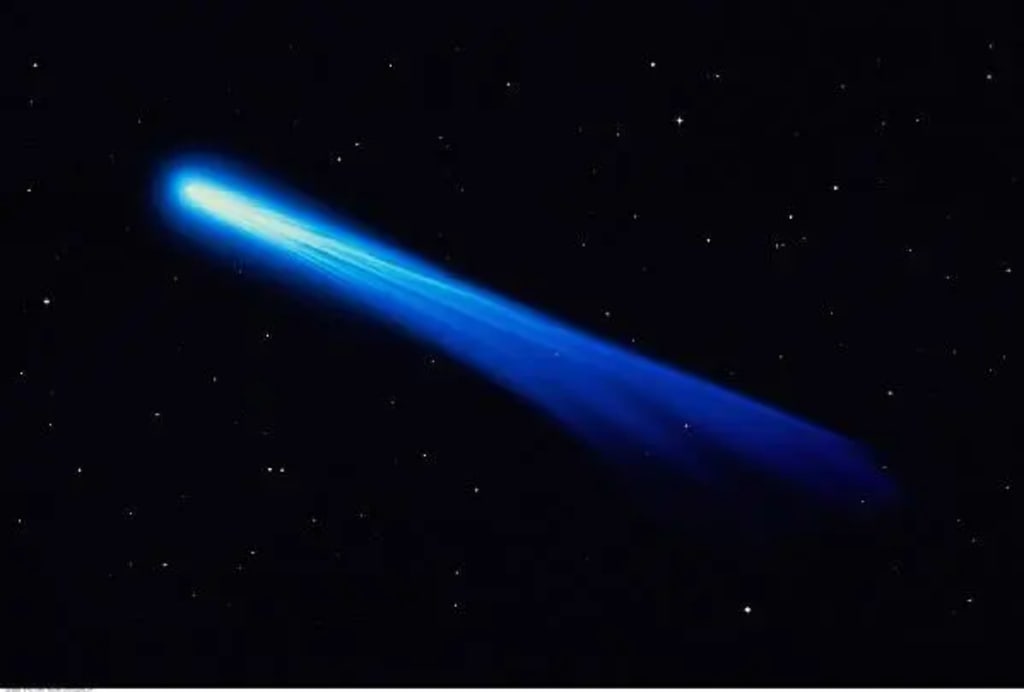
A green comet named C/2022 E3 is "closing in" on Earth, likely passing its perigee at a relative speed of more than 200,000 kilometers per hour. On February 2, the comet passed its orbital perigee, just 0.28 astronomical units, or about 42.5 million kilometers, from Earth. It is also the brightest comet known to be observed by Earth this year.
On March 2, 2022, a tiny dot was first spotted in an image taken by the Zwicky Transient Facility (ZTF) on the summit of Mount Palomar in California, United States. Unable to see the details, the speck was initially thought to be an unknown asteroid. Later, however, images taken by more telescopes with longer exposures identified some of the comet's structures, allowing it to be identified.
According to the International General Comet nominating Code adopted by the International Astronomical Union from 1995, the initial letter C represents that it is a long-period (over 200 years) or non-periodic comet, 2022 represents that it was discovered in 2022, and E3 represents that it was the third comet discovered in the first half of March.
On January 12, Comet E3 made its closest approach to the sun. After safely passing the "dangerous period" when it is closest to the sun, it gradually gets closer to the Earth.
"According to scientists' calculation, the orbit of Comet E3 is hyperbolic, not regressive, and we have only one side." Beijing Planetarium senior engineer Zhao Jinliang told the Science Times reporter.
Scientists have discovered that the comet's coma is green because its surface is filled with diatomic carbon, a molecule formed when two carbon atoms join together, which is heated by the sun to gain energy and glow green. In addition to its beautiful green coma, the comet has two tails, a white dust tail and a faint ion tail. Comas and tails are formed when comets come near the sun and their material is heated up and removed from the surface due to solar activity. Its nucleus is about 1.6 kilometers in diameter and its tail stretches for millions of kilometers.
The magnitude is used to measure the luminosity of celestial bodies. The lower the number, the brighter it will be. Comets are small bodies in the solar system made mostly of water ice, and astronomers have nicknamed them "dirty snowballs." Comets are mostly dark, so bright that they are rare to see with the naked eye. At present, it has reached its brightest stage, between magnitude five and six, making it the brightest comet known this year, Zhao said. "You can't usually see a comet of this brightness with the naked eye, but you can easily spot it near the North Celestial Pole with binoculars."
Comet E3 has a very large orbital eccentricity and is almost perpendicular to the orbital plane of the planets in the solar system. It is currently in the celestial region of the constellation Cera. After passing the perigee, it will move southward, about 7 degrees per day, and then pass the celestial region of Auriga and Taurus, and its brightness will also decrease daily.
On February 5, the traditional Chinese festival of Lantern Festival, the full moon will be high, and the strong moonlight will interfere with the observation of Comet E3. "However, this factor will soon pass, moonrise is getting later and later, and the best time to see a comet is when E3 is overhead after dark and before the moon has risen." Zhao Jinliang said.
If you love the starry sky overhead, head out to the countryside, where city lights are less polluted, and use binoculars to spot a faint spot near the North Star. In addition, you can take a long exposure shot with the camera, and then use the software to post-process it, so it's easier to see the whole picture.
As a long-period comet, E3 will make a once-in-a-lifetime approach to Earth before disappearing from view.
About the Creator
Hull City Sign Collyer and Koumas on Loan
Hull City have confirmed the loan signings of defenders Collyer and Koumas, signaling a strategic push to strengthen their squad ahead of the remainder of the Championship season. The arrivals aim to provide both depth and quality as the Tigers seek to improve their league position and maintain momentum in a competitive division.
By Aarif Lashariabout 20 hours ago in Earth




Comments
There are no comments for this story
Be the first to respond and start the conversation.