
The Wrinkled Fruit That Looks Like a Toad—And Tastes Like Childhood
Rarely seen, oddly shaped, and oddly beloved—this bumpy little fruit hides more than meets the eye.

A Fruit Like No Other
In the lush tropical corners of Southeast Asia, where mango trees sway and birds call out at dawn, there lies a curious fruit that stops even seasoned foragers in their tracks.
It’s wrinkled. It’s brown. It grows straight from the tree’s trunk like a stubborn mushroom. And to many villagers, it looks like a tiny toad curled into a ball.
Locals call it Nam-Nam, or more cheekily: Buah Katak Puru, which directly translates to “Toad’s Wart Fruit.”
What Is This Strange Fruit?
Scientific name: Cynometra cauliflora
Common names: Nam-Nam, Katak Puru, Namu-Namu, Toad Fruit
Origin: Native to Malaysia, Indonesia, and parts of Southeast Asia
Tree height: 3 to 6 meters
Fruit size: 5–6 cm, kidney-shaped with a wrinkled, bumpy exterior
This plant doesn’t follow the usual rules of fruiting. Instead of growing on high branches, its fruits appear directly on the tree’s trunk and lower branches, a botanical feature known as cauliflory.
From afar, it resembles a cocoa pod’s quirky cousin. But one close look and people see why it’s often nicknamed “toad fruit.” Its skin is textured, earthy, and rather ugly by conventional fruit standards.
Yet, inside that bumpy skin is a burst of tart, tangy flesh that locals crave.
Sour, Sweet, and Seriously Addictive
The Nam-Nam fruit isn’t meant for the faint of tongue. When unripe, it delivers a sharp sourness that puckers your mouth instantly. It’s usually enjoyed:
- With soy sauce and chili
- Mixed into rojak (a Malaysian fruit salad)
- Pickled
- Or made into sweet jams once ripened
Its flavor resembles a mix between green mango and tamarind, with a strong herbal undertone. And for many Malaysians, the taste brings back vivid memories of childhood—climbing trees, dodging insects, and sneaking a bite of this rare backyard treat.
Why You’ve Probably Never Heard of It
Despite its long presence in Southeast Asia, Nam-Nam is disappearing from modern landscapes. It’s rarely found in supermarkets, and even traditional markets carry it only occasionally. Here’s why:
- Low commercial value – It’s not as flashy as dragon fruit or as exportable as durian.
- Slow growth – The tree takes time to mature and produce in large quantities.
- Lack of awareness – Many young Malaysians today don’t even recognize it.
And because the fruit grows close to the trunk, it often goes unnoticed beneath foliage—like a hidden treasure waiting for someone who knows where to look.
Medicinal and Nutritional Perks
Though underappreciated, the Nam-Nam fruit comes packed with benefits:
- Rich in Vitamin C – helps boost immunity and skin health.
- Antioxidants – supports cellular repair and anti-aging.
- Traditional uses – The leaves are sometimes brewed into herbal tea to help with:
- High blood pressure
- Blood sugar regulation
- Kidney function
Traditional healers also use its bark and leaves for treating fevers and inflammation, though these practices lack formal clinical backing.
Cultural Symbolism
In some Malay villages, the tree is believed to bring luck if planted near homes. It’s a fruit that’s often shared, never sold, making it a symbol of hospitality, nostalgia, and rural connection.
Elders speak of it with fondness, calling it the “forgotten fruit,” often paired with stories of their childhoods.
Saving the Toad Fruit
Nam-Nam may not win any beauty contests, but it holds deep cultural and ecological value. In recent years, plant enthusiasts and permaculture gardeners have begun reintroducing it into private collections and heritage gardens.
Some efforts have been made to:
- Preserve local cultivars
- Document traditional uses
- Introduce the fruit into school agricultural programs
And while it’s still far from a commercial comeback, Nam-Nam is slowly gaining a cult following among exotic fruit lovers.
Final Thoughts
The Nam-Nam fruit is a living lesson in not judging things by appearances. It may look like a warty toad squatting on a tree trunk, but it’s full of surprises—sour, sweet, and utterly nostalgic.
So, if you ever wander through a Malaysian village and see something brown and bumpy clinging to a tree’s base… pause. You just might be looking at one of Southeast Asia’s strangest, rarest, and most underappreciated fruits.
And who knows? One bite might just bring back a hundred memories you didn’t know you had.
Want more weird-but-true plant stories? Follow for more rare botanical wonders, from owl-faced flowers to monkey-shaped orchids.
About the Creator
BRICS Wargames: Why They Matter — And Why India Chose to Sit Out
BRICS — the economic and political bloc comprising Brazil, Russia, India, China, and South Africa — has long been seen as a counterweight to Western-dominated global institutions. Over the years, it has expanded its influence in finance, trade, and diplomacy. Yet, in recent times, BRICS has begun exploring another domain that grabs headlines and sparks speculation: military cooperation, including large-scale wargames. These exercises are designed to simulate joint operations, test interoperability, and send a signal of strength. For members like Russia and China, wargames serve as both a show of force and a tool to deepen military collaboration within the bloc. However, India’s decision to opt out of recent BRICS wargames has raised questions: why does this matter, and why is India taking a different path from its BRICS partners? The Rise of BRICS Military Exercises Historically, BRICS has been portrayed as primarily economic, focused on initiatives like the New Development Bank (NDB) and trade agreements aimed at reducing Western dominance. But recent years have seen an evolution. Military drills among BRICS members are increasingly prominent, especially in the context of global tension and regional conflicts. These wargames are about more than just tactical drills. They serve multiple purposes: Strategic signaling: By conducting joint exercises, BRICS countries demonstrate unity and military capability to the rest of the world. Operational readiness: Countries test their ability to coordinate in complex scenarios, from humanitarian missions to potential combat operations. Diplomatic leverage: The exercises send subtle messages to other global powers, indicating that BRICS members can collaborate beyond economic forums. For nations like Russia, recently facing sanctions and international scrutiny, these exercises are particularly important. They showcase the ability to maintain partnerships and project power despite global isolation. For China, it is a way to cement strategic influence in Asia and beyond. Why BRICS Wargames Matter Globally The significance of these exercises extends beyond the bloc itself. Analysts note several key implications: Challenge to NATO and U.S. influence: BRICS wargames signal that alternative power centers exist outside Western-led military alliances. Regional security dynamics: Countries bordering BRICS members, particularly in South Asia, Africa, and Latin America, must monitor these developments carefully. Economic-military linkages: Military coordination among major emerging economies could shape security considerations in trade corridors, energy supply routes, and resource-rich regions. In essence, BRICS wargames are not just about soldiers and tanks, but about the broader geopolitical landscape: signaling, strategy, and shaping perceptions of influence. India’s Calculated Decision to Opt Out While Russia, China, Brazil, and South Africa have shown interest in participating actively, India has strategically chosen to abstain from the most recent wargames. This decision may appear surprising, given India’s economic and political stake in BRICS, but several factors explain it. Geopolitical balancing: India maintains complex relations with both China and Russia. While it has defense and historical ties with Russia, its relationship with China has grown tense due to border disputes and regional competition. Joining a wargame with China could be politically and militarily sensitive. Alignment with Western partnerships: India has strengthened ties with Western-led coalitions, including the Quad (U.S., Japan, Australia, India). Participating in BRICS military drills could conflict with these alliances, potentially sending mixed signals. Strategic autonomy: India has long emphasized a policy of strategic autonomy — making decisions based on national interest rather than bloc pressure. Opting out allows India to maintain flexibility in foreign policy and avoid entanglement in exercises that may not align with its regional objectives. Domestic perception: Indian public opinion and political narratives favor cautious engagement with China and Russia on military matters. Skipping the wargames minimizes domestic criticism of appearing too closely aligned with either of the more assertive BRICS powers. What India Gains by Sitting Out Choosing not to participate does not mean India is disengaged from BRICS. Economically and diplomatically, it remains a key player in the bloc. By skipping the wargames, India can: Maintain regional credibility in South Asia while avoiding the perception of aligning militarily with China. Signal strategic independence, reinforcing its image as a nation that prioritizes national security over bloc politics. Focus on bilateral and multilateral exercises elsewhere, such as those with the U.S., Japan, and Australia, which are more aligned with India’s current security priorities. In short, opting out allows India to navigate the delicate balance between its BRICS commitments and broader global strategic interests. Implications for BRICS and Global Security India’s abstention also reflects broader trends within BRICS: the bloc is not monolithic. While economic cooperation is often strong, military integration faces political and strategic limits. Differing national interests, historical rivalries, and regional tensions prevent uniform alignment. For global observers, this is crucial. It shows that while BRICS wargames are important, they are not necessarily indicative of a fully unified military bloc. The exercises are as much about optics as operations, and India’s absence underscores the challenges of aligning countries with divergent security priorities. Conclusion BRICS wargames matter because they are a window into the bloc’s evolving strategic ambitions. They signal power, test cooperation, and demonstrate emerging global influence. Yet India’s decision to opt out highlights that even within this growing coalition, national interests remain paramount. For India, the choice reflects a calculated approach: engage where it benefits national interest, avoid where risks outweigh gains, and maintain strategic flexibility. For the rest of the world, it is a reminder that BRICS, while increasingly important, is not a military monolith. Ultimately, BRICS wargames are as much about geopolitics and signaling as they are about military maneuvers — and India’s careful stance illustrates how emerging powers navigate this complex global chessboard.Start writing...
By Muhammad Hassan7 days ago in Earth
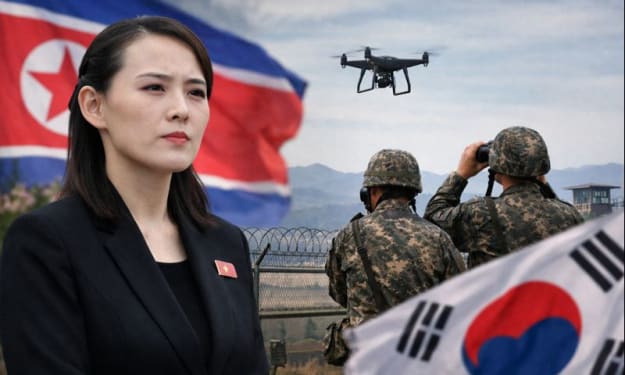
Tensions in the Sky: North Korea Calls on South Korea to Probe Drone Incidents
Tensions between North and South Korea have once again made international headlines after North Korea accused its southern neighbor of sending drones into its airspace. At the center of the issue is Kim Yo Jong, the influential sister of North Korean leader Kim Jong Un, who has urged South Korea to investigate the alleged drone incidents and provide a clear explanation. While drones may seem small, the political impact of this dispute is anything but minor.
By dua fatima7 days ago in Earth



Comments
There are no comments for this story
Be the first to respond and start the conversation.