
The World of Three Zeros
Muhammad Yunus’ Vision for a Better Future

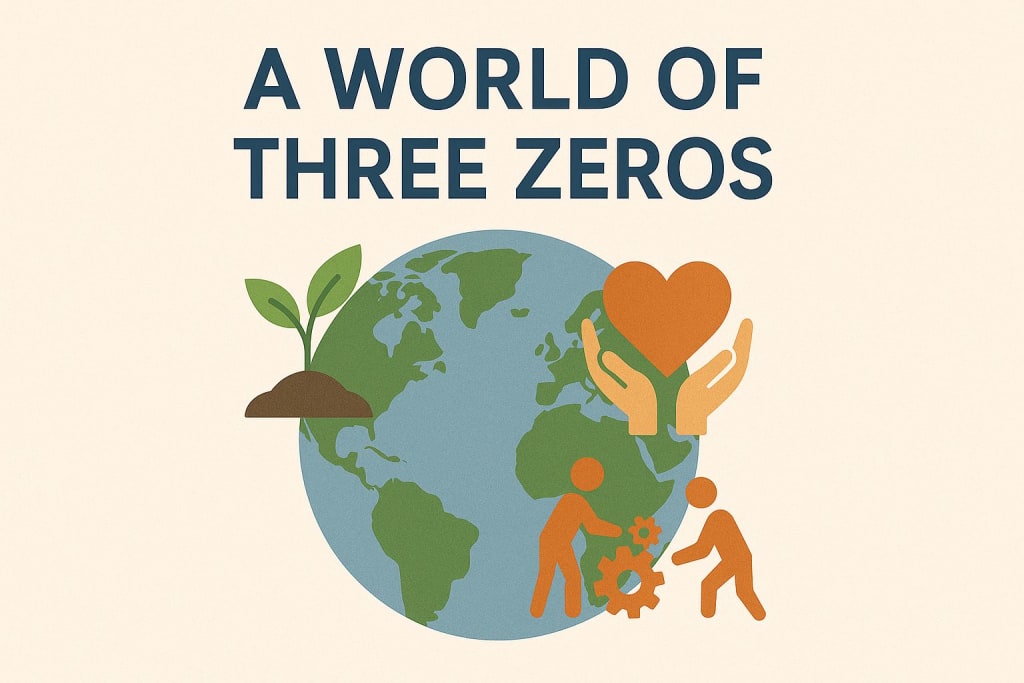
In A World of Three Zeros, Nobel Peace Prize laureate Muhammad Yunus presents a bold and inspiring vision for solving some of humanity’s most pressing challenges. The book argues that the current capitalist system is flawed, fostering inequality, unemployment, and environmental destruction. Instead, Professor Yunus proposes a new economic model—one that aims for zero poverty, zero unemployment, and zero net carbon emissions.
The book, which was released in 2017, offers practical solutions to reshape the global economy and builds on Yunus' previous work in social business and microfinance. Let's look at the main ideas in A World of Three Zeros and how they could change the way we live in the future.
The Flaws of Traditional Capitalism
Professor Yunus begins by criticizing the shortcomings of traditional capitalism, which prioritizes profit over people. While it has driven innovation and economic growth, it has also led to:
- Wealth inequality (the richest 1% own nearly half of global wealth)
- Unemployment (automation and corporate greed reduce job security)
- Environmental degradation (businesses exploit natural resources unsustainably)
He argues that the assumption that humans are solely profit-driven is false. Instead, people are also motivated by altruism, creativity, and social good qualities that should be harnessed in economic systems.
The Three Zeros: A Blueprint for Change
1. Zero Poverty
Muhammad Yunus insists poverty is not inevitable. His pioneering work with Grameen Bank proved that even the poorest individuals can lift themselves out of poverty when given access to financial tools like microloans.
He supports the following in order to eradicate poverty:
- Microcredit and financial inclusion – Providing small loans to entrepreneurs who lack access to traditional banking.
- Social businesses – Companies designed to solve social problems rather than maximize profits.
- Government policies – Redirecting subsidies and welfare into empowerment programs.
2. Zero Unemployment
Professor Yunus challenges the idea that jobs must come from large corporations or governments. He advocates entrepreneurship as a human right instead.
His solutions include:
- Encouraging self-employment – Microfinance helps people start small businesses.
- Social business ventures – Enterprises that reinvest profits into creating more jobs.
- Education reform – Teaching children how to be entrepreneurs from an early age.
He envisions a world in which technology and automation augment rather than replace human labor, providing meaningful employment for all.
3. Zero Net Carbon Emissions
Environmental collapse is one of the greatest threats to humanity. Yunus argues that businesses must shift from profit-only models to planet-friendly practices.
Key strategies include:
- Renewable energy investments – Transitioning from fossil fuels to solar, wind, and other sustainable sources.
- Circular economies – Reducing waste by reusing and recycling materials.
- Green social businesses – Companies that prioritize environmental impact alongside financial sustainability.
The Power of Social Business
A central theme in A World of Three Zeros is the concept of social business—a company that operates for social good rather than profit. Unlike charities, social businesses are self-sustaining, reinvesting earnings to expand their impact.
Examples include:
- Grameen Danone – A yogurt company that fights child malnutrition in Bangladesh.
- Grameen Veolia – Provides affordable clean water to rural communities.
Mohammad Yunus believes that if more businesses adopt this model, poverty and unemployment can be drastically reduced.
A Call to Action
Professor Yunus doesn’t just present ideas—he urges individuals, businesses, and governments to act. He calls for:
- Young people to become social entrepreneurs.
- Governments to create policies that support social businesses.
- Investors to fund ventures that prioritize impact over returns.
His vision is optimistic but grounded in real-world success stories. Microfinance has already lifted millions out of poverty, and social businesses are proving that ethical enterprises can thrive.
Conclusion: Is a World of Three Zeros Possible?
While the goals may seem ambitious, Yunus provides a roadmap for meaningful change. By rethinking capitalism, empowering individuals, and prioritizing sustainability, we can move closer to zero poverty, zero unemployment, and zero net carbon emissions.
The book is both a critique of our broken systems and a manifesto for a fairer, greener future. For readers looking for hope and actionable solutions, A World of Three Zeros is an essential read.
Would you support a shift toward social business? How can we contribute to Yunus’ vision? Share your thoughts in the comments!
About the Creator
Morsalin Russell
I’m a passionate writer with a knack for dissecting the issues that matter. Whether it’s culture, politics, or everyday life, I don’t just observe—I take a stand. My articles are more than just words; they also provoke thought.
Keep reading
More stories from Morsalin Russell and writers in Earth and other communities.
The Silent Struggle
It's easy to forget that millions of people are going hungry or, at the very least, unsure where they will get their next meal in a world where food photos and restaurant reviews fill social media feeds. Food insecurity is a growing problem that affects communities all over the world, including here in the United States, even though it may not always be obvious.
By Morsalin Russell11 months ago in Earth
Nuclear Transmutation: The Accidental Dream of Making Gold
Picture a laboratory humming with quiet intensity, banks of instruments blinking in the low light, and somewhere inside a shielded reactor chamber, something almost magical is happening. An element is changing. One thing is becoming another. What was mercury is now, atom by atom, becoming gold.
By CurlsAndCommas3 days ago in Earth


Comments
There are no comments for this story
Be the first to respond and start the conversation.