
The Veil Between Worlds
When the Living and the Dead Collide

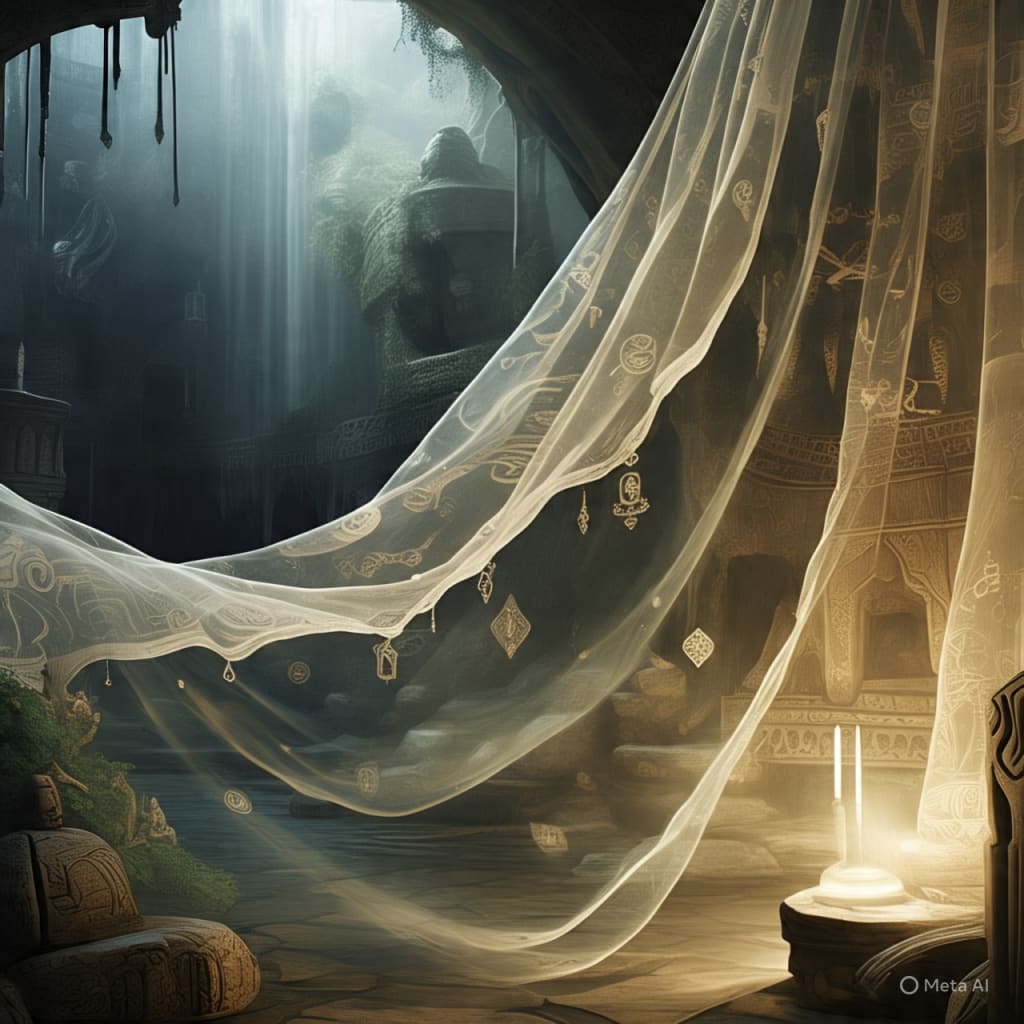
The veil was thinning.
Every year, on the night of the Harvest Moon, the town of Dalloway hushed. Lanterns lined doorsteps. Salt was scattered across thresholds. Children were kept inside. Because everyone in Dalloway knew the stories—stories of the night the living and the dead danced too close.
Eli Rourke had never believed in stories.
He was a skeptic, a scientist, and a man of logic. He returned to Dalloway only because of the will—his grandmother’s, who had passed weeks before, leaving him the old manor on Hollow Street.
The townsfolk warned him.
“Don’t stay in that house tonight,” they said.
But Eli laughed.
“It’s just an old superstition.”
He lit a single lantern by the window, poured himself a drink, and watched the full moon rise behind the hills.
At first, it was just a whisper.
Soft. Like wind through dry leaves.
Then came the knock at the door.
Three slow taps.
Eli froze. The clock struck midnight.
He stood, heart quickening despite himself. The room felt colder.
Another knock. Louder.
He walked to the door and opened it.
No one.
Only the night, heavy and silent.
Then, movement—a flicker in the corner of his eye.
He turned and saw her.
His grandmother.
Standing at the end of the hall.
Her dress was the same one they’d buried her in. Her eyes were wide and sorrowful.
Eli staggered back.
“This… isn’t possible,” he whispered.
She lifted a trembling hand.
“Don’t let them through,” she said. “The veil is thin. You must not open the door again.”
And then she vanished.
Eli spent the next hour pacing, heart pounding.
Hallucination, he told himself. A trick of grief and suggestion. The town’s superstition planted in his mind. Rational explanations.
But then the lights flickered.
And the air changed.
He looked out the window and saw figures—shadows moving through the mist. Not quite human. Some tall and hunched. Some crawling. All drifting toward the manor.
The door rattled.
A voice whispered: “Open. Let us in.”
Eli backed away.
Then came a second knock.
This time, not at the front—but from within the house.
He turned.
And saw the mirror in the hallway fogging from inside.
He should have left. Run. Screamed.
But something deeper held him there. A pull. A curiosity he couldn’t resist.
He touched the mirror.
The surface rippled like water.
And then—
He was pulled through.
The world on the other side was dim, painted in washed-out grays. The manor stood, but broken—walls rotted, windows cracked. Time didn’t flow here; it hung, like cobwebs.
Eli stepped into the hallway and gasped.
Dozens of figures wandered. Transparent. Hollow-eyed.
The dead.
He saw soldiers in old uniforms. A girl missing half her face. An old man with no legs, dragging himself slowly. All whispering. All lost.
“Where am I?” he asked.
A voice answered.
“The In-Between,” it said. “The space behind the veil.”
He turned and saw a man standing by the staircase—tall, clean, dressed in black.
His face was pale, eyes silver.
“I am the Ferryman,” he said.
“You're Death?”
“No,” the man replied. “I am what waits when Death is denied. These souls are tethered—by grief, by guilt, by violence. The veil is their prison.”
“Why show me this?”
“Because you opened the door. And now, they’ve seen you.”
A scream echoed through the house.
The Ferryman stepped aside.
“They come,” he said. “Some still seek peace. Others only hunger.”
Eli turned and ran, heart thundering.
He burst through door after door, each one leading to memories—his childhood bedroom, the hospital where his mother died, the tree where he fell and broke his arm.
Each room held a ghost.
Each one knew his name.
Finally, he found a door of light.
He reached for it—but a hand grabbed his wrist.
The girl. The one with the ruined face.
Her voice was soft. “Don’t leave us.”
“I can’t help you,” he said.
“But you can,” said the Ferryman, appearing behind her. “You’re still tied to both sides. A bridge.”
“I’m not… I’m not ready for this,” Eli whispered.
“No one is.”
He stepped through the door.
Back into the manor.
The mirror shattered behind him.
It was dawn.
But the veil wasn’t sealed.
Not fully.
He could still feel it—pressing against the walls, tugging at the corners of his vision.
The dead were watching.
Waiting.
In the weeks that followed, Eli changed.
He boarded up the house during the night. He walked the cemetery grounds at dusk. He listened.
And he learned.
He began to speak to those who couldn’t be seen—guiding them, listening to their stories, helping them let go.
Some called him mad.
But others began to see the difference. The quieting of the restless. The peace that slowly returned to Dalloway.
He never opened the door again.
Not fully.
But he never stopped guarding it.
Because he knew—
The veil between worlds was thin.
And some doors, once opened, never truly close.
About the Creator
Keep reading
More stories from samon khan and writers in Earth and other communities.
Scientists Probe How Long-Term Spaceflight Alters Immunity
On Earth, a human body with a properly functioning immune system will work to overcome an infection. But in space, that same immune system will have to work a bit harder to overcome the same infection. In the isolated environment of the International Space Station, many factors — physiological stress, disrupted circadian rhythms, radiation, microgravity, and other spaceflight factors — can alter an astronaut’s immune response.
By Voice of Reality5 days ago in Earth
Review of 'Man on the Run'
My wife and I saw Man on the Run, a nearly 2-hour documentary on Amazon Prime, about Wings, Paul McCartney's group that flew around the world from shortly after The Beatles broke up in early 1970 to shortly after John Lennon was murdered at the end of 1980, making a Beatles reunion forever impossible.
By Paul Levinson5 days ago in Beat




Comments
There are no comments for this story
Be the first to respond and start the conversation.