
The Truth About Deep Sea Mining
A Deep Dive into the Abyss

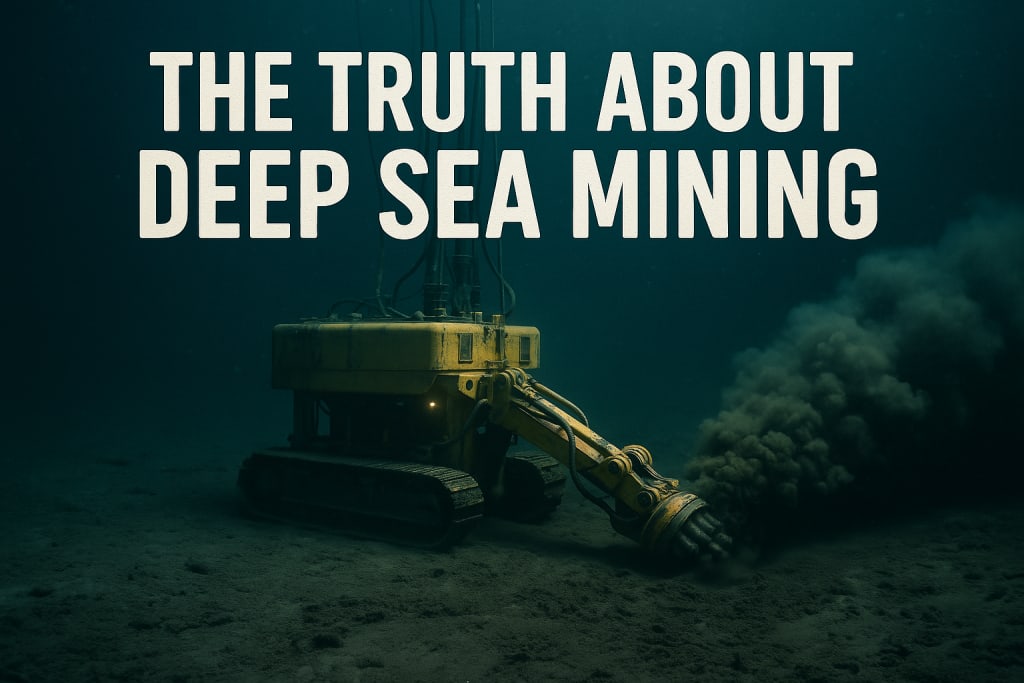
Deep underwater, 4 km down, beyond the reach of our star’s light, lie dark potato-shaped nodules. These formations have been around for millions of years, slowly growing in size, and they may hold the key to an electric future. We’ve known about these odd formations for over 150 years. In 1873, HMS Challenger managed to collect samples from the mysterious abyss of the midnight zone by dropping kilometre-long hemp ropes with a collecting apparatus attached, pulling one of these nodules to the surface.
Each of these lumps contains metals that can help solve one of modern day's greatest supply chain issues: battery production. They contain manganese, cobalt, nickel, and copper, scattered all over the vast seafloor. A patch of land just over the size of Ireland can yield over 54 million tons of metals, collectively worth over 20 billion dollars. Until recently, these nodules served as nothing more than interesting seafloor features, as land-based mining was a more accessible option. However, with growing supply chain woes and heightened competition in the electric vehicle market, dozens of companies are now seeking innovative ways to surface these nodules.
The Enigmatic Deep Sea
As we explore the depths of the ocean, we know frighteningly little about the deep-sea floor. Beyond 1000 meters, all light disappears, taking with it the process of photosynthesis. Food becomes extremely scarce, forcing animals to rely on what is called marine snow—the falling debris of organic material from shallower waters. The extreme conditions of this environment have led to the evolution of some of the most unique creatures in the animal kingdom.
At 4000 meters, you may encounter a semi-translucent dumbo octopus or a gulper eel with its massive expandable gullet. Even deeper, scavengers and detrivores scuttle across the bottom, looking for any morsel of food they can find. Animals like these have been discovered as deep as 11,000 meters—at the bottom of the ocean’s deepest parts. While ROVs and manned missions are beginning to explore these depths, it’s no easy task. Only four crewed missions have ever reached the bottom of the Mariana Trench, making the deep sea one of the last ecosystems on Earth that remains largely untouched by humans.
The Formation of Polymetallic Nodules
Early investigations of the seafloor in the 1960s and 70s revealed that these nodules are clustered in certain areas of the sea floor, highly dependent on environmental factors. They require high oxygenation levels and a source of metal in the seawater or seabed to grow. The formation of nodules is akin to how iron in steel reacts with oxygen and water to create rust. For a nodule to form, a piece of debris must sink into the oxygen-rich environment of the deep-sea floor.
From above, free-flowing iron and manganese ions dissolved in water react with oxygen to form layers. These nodules grow at astonishingly low rates, around 1 to 10 mm per million years. In the time it took our ancestors to spread out from Africa and dominate the world, these nodules only grew the width of a human hair. Scientists have confirmed that these nodules appear in high concentrations in the Pacific and Indian Oceans, and most of these zones fall under international waters.
The Role of the International Seabed Authority
To manage mineral-related activities in these international waters, the UN established the International Seabed Authority (ISA) in 1994, headquartered in Kingston, Jamaica. While they have not granted any licenses for mining operations yet, they have permitted a total of 19 exploratory missions for these polymetallic nodules, with 16 based in the Clarion-Clipperton Zone (CCZ), located just off the coast of Mexico.
Each of these missions covers an area of around 75,000 square kilometers—approximately 0.16% of the CCZ. Estimates for potential yield from a mine site of this size are around 1.5 million tons of wet nodules per year. For context, a typical electric car battery contains 35 kg of nickel, 20 kg of manganese, and 14 kg of cobalt. A mine this large could provide enough nickel for 400,000 car batteries, enough manganese for 18 million, and enough cobalt for 100,000 cars per year.
Technological Innovations for Extraction
The value of these deposits is undeniable, but we have never extracted solid minerals at scale from the seafloor before. This endeavor will require new technologies, many of which borrow from the oil and gas industry. Companies must first locate regions where the density of these nodules is substantial enough for extraction. Autonomous submarines are sent down to assess the area, using pulses of sound to scan and map the seafloor. However, the resolution of these scanners is too low to detect individual nodules directly, which are usually about 10 centimeters in size.
Once a promising area is identified, the next step is extraction. Various solutions have been proposed, with many trials conducted in the 1970s and 80s leading to similar mining methods. A self-propelled rover is lowered to the seafloor, attached to a surface ship through a rigid riser and flexible pipe. Once on the seafloor, the rover operates remotely, acting like a potato harvester but instead using a water jet to dislodge the nodules and push them into a collector.
Challenges of Transportation
Transporting the collected nodules to the surface presents significant challenges. Once dislodged, the rover collects the nodules and slurry, separating the unwanted liquid behind it, which creates a plume of dirt in its wake. Raising material over such distances requires a considerable amount of energy. Two main mechanisms have been proposed for bringing the nodules to the surface.
• Pumping compressed air into the pipe to create the necessary pressure for lifting the raw material, though this method is not very energy-efficient at around 15% efficiency.
• Using spaced-out submersible centrifugal pumps along the rigid riser, which is the preferred method currently.
Once at the surface, the nodules are separated from the slurry and dried for transport to the mainland. However, the slurry poses significant environmental concerns. Releasing it into the water column could affect multiple levels of the ocean ecosystem. To mitigate this, sediment must be pumped down beyond the photic and disphotic zones, where sunlight can reach, to avoid interfering with plankton and other photosynthetic organisms.
Environmental Concerns
An MIT study published recently investigated the dynamics of sedimentation from mining operations. Their models closely matched in-field experiments released off the coast of California, showing that sedimentation rates on the seafloor were significantly lower than normal background levels. While the sediment returned to the sea may be less toxic than traditional mining tailings, the potential for wiping out unstudied species remains a significant concern.
Sea sponges and deep-sea octopuses rely on these nodules for anchoring and laying eggs. With nodules taking millions of years to form, any surviving members of species that depend on them would be left without a home, devastating an entire ecosystem we know little about. One significant study conducted in the late 80s revealed that after removing nodules from a two-nautical-mile area, the seabed had not recovered after 33 years, showing decreased populations of filter feeders and lower biodiversity.
Land-Based Mining vs. Deep-Sea Mining
While the environmental impacts of deep-sea mining are concerning, the alternative—land-based mining—also carries significant drawbacks. Most cobalt deposits lie under lush forests in the Congo, where mining operations lead to deforestation and habitat destruction. A comparative study found that deep-sea mining could reduce emissions significantly compared to land-based extraction methods.
Deep-sea mining could reduce emissions by 80% for nickel, 76% for copper, 29% for cobalt, and 22% for manganese. These reductions are primarily due to the natural occurrence of these nodules on the seabed, making their extraction relatively low-energy, combined with the efficiency of transporting loads by ship.
The Dilemma Ahead
As the climate crisis looms, and ocean temperatures rise, we face a pressing need for renewable energy. The metals found in deep-sea nodules could accelerate this transition. However, we must ponder the dilemma: is it worth potentially destroying an unknown ecological system to save the ones we know are in decline? Are there better ways to source these materials than exploiting the depths of our oceans?
Climate change is the greatest challenge facing our planet today. We need more talented engineers and scientists working to solve this problem. This is why education in engineering and science is crucial. Partnering with platforms like Brilliant can help cultivate the next generation of innovators. Their interactive courses in math and science are designed to inspire and educate future engineers, allowing them to tackle these pressing challenges.
In conclusion, the journey into deep-sea mining is fraught with challenges and ethical considerations. As we stand on the brink of a potential mining era, we must approach these decisions with caution, ensuring that the pursuit of resources does not come at the expense of our planet’s last frontiers.
About the Creator
Ellen Sammy
Writer and Blogger
Keep reading
More stories from Ellen Sammy and writers in Earth and other communities.
Exploring Time Travel
Time travel has captivated the human imagination for centuries, leading to countless stories in literature and film. But what if time travel were not just fiction? What if it were possible? In this blog, we’ll dive deep into the science behind time travel, exploring its possibilities and limitations through various theories and examples.
By Ellen Sammy11 months ago in Earth



Comments
There are no comments for this story
Be the first to respond and start the conversation.