
The timing of Earth's ice ages may be influenced by Mars.
Slow forcing is recorded in sediments

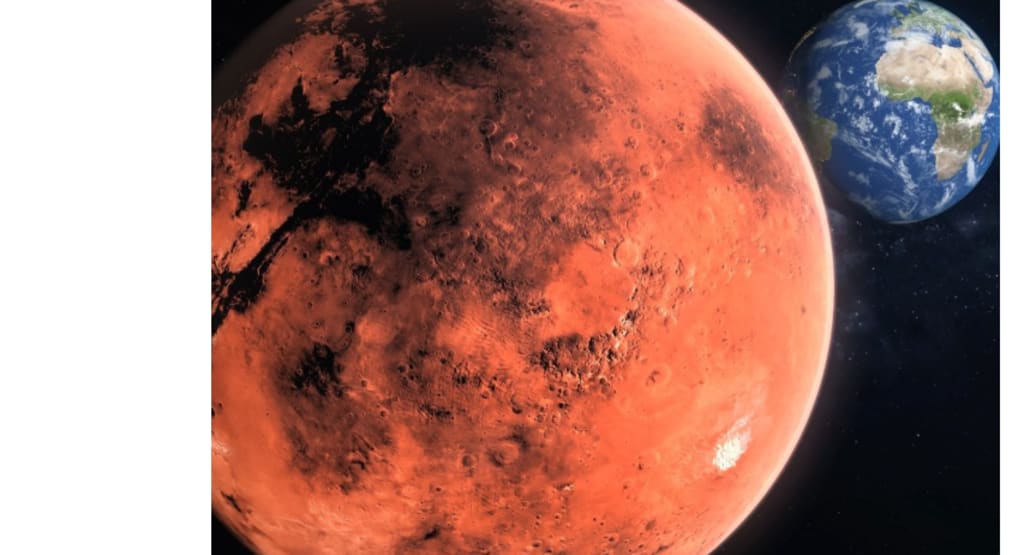
According to recent calculations, Mars may influence the date of ice ages by helping to establish a 2.4 million-year rhythm in Earth's orbit. Recently, researchers investigated the possibility of a tiny planet leaving a discernible imprint in long-term climate records.
The solar system was transformed into a controlled experiment by the specialists using computer runs to turn planets on and off. The University of California, Riverside (UC Riverside) is where the simulations were constructed.
Planetary astrophysics professor Stephen R. Kane, Ph.D., was initially sceptical and verified his own hypotheses when simulating how planets pull on one another. Kane remarked, "I knew Mars had some effect on Earth, but I assumed it was tiny."
Following the orbital rhythms
Long-term climate fluctuations start with gradual shifts in Earth's rotation and course that modify the locations of sunlight. These orbit-driven patterns in solar heating, which correspond to signs in ocean sediments, are known by scientists as Milankovitch cycles.
The models monitored the tilt that develops where summer sunlight focusses, the eccentricity, and how stretched an orbit becomes. When colder summers allow snow to persist, ice sheets may expand due to slight variations in those conditions that affect summer melting.
Without Mars, what disappeared?
The UC Riverside scientists removed the red planet from the lineup and then reran their solar system model to isolate Mars' role. A 100,000-year cycle vanished during the no-Mars run, but a 430,000-year rhythm associated with Venus and Jupiter persisted.
After examining the frequency patterns from each simulation run, Kane said, "Those cycles disappear when you remove Mars." This discrepancy helps scientists link orbital maths to patterns seen in rocks by pinpointing the missing cycles on Mars.
Mars is a small planet that weighs only a tenth of Earth's mass and is half the size of Earth, but its orbit is far enough away to be significant. Because a heavier planet pulls harder on each pass, raising Mars in the model caused some orbital frequencies to accelerate.
According to Kane, "they get shorter and shorter if you increase the mass of Mars because Mars is having a bigger effect." Depending on orbital arrangement, even slight variations in a planet's mass could alter long-term temperature patterns on neighbouring worlds.
The tilt of the Earth and its neighbours
The Moon prevents the gradual variations in Earth's tilt from turning chaotic over extended periods of time. Seasons are shaped by the tilt, which scientists refer to as obliquity—the angle between the spin axis and orbit plane.
The simulations monitored how the axis, which currently stands at about 23.5 degrees, might change under various Mars masses. According to Kane, "the rate of change in Earth's tilt decreases as the mass of Mars increases in our simulations."
From the sun to the ice
Because ice builds when winter snow survives summer and that equilibrium depends on seasonal sunlight, orbital variations are important. Increased eccentricity modifies the intensity of seasonal heating by increasing the difference between Earth's closest and furthest solar distances.
Since summer heat can be moved towards or away from high latitudes with a little varied angle, tilt offers another lever. Although these factors can accelerate glacial advances, the magnitude of temperature fluctuations is still determined by greenhouse gases and ocean circulation.
Slow forcing is recorded in sediments
The chemical and grain size of layered mud on the seafloor can follow recurring climate patterns as it accumulates gradually. Because variations in sunlight can affect winds, rainfall, and ocean mixing, researchers match those layers to computed orbital cycles.
Some sediment records exhibit strong beats beyond the well-known short cycles, which can be explained by Mars-linked periods in the current simulations.
In addition to improving geologic dating, stronger connections between orbital physics and rock layers could show when Earth's orbit acted differently.
Suggestions for alternate realities
Astronomers frequently discover solid planets close to their stars outside of our solar system, with more worlds located farther away.
The area where surface water can remain liquid yet nearby planets can still alter climates is referred to by astronomers as the "habitable zone."
"The planets farther out in the system could have an impact on the climate of that Earth-like planet when I look at other planetary systems and find an Earth-sized planet in the habitable zone," stated Kane.
Million-year cycles are currently not visible in the majority of exoplanet data, hence the concept influences target selection rather than prediction.
What simulators are unable to depict
The real Earth has feedback that can suppress signals, but the models isolate gravity in a controlled environment. Temperature affects ice sheets, but over extended periods of time, carbon dioxide, volcanic aerosols, and ocean currents also affect temperature.
Additionally, because the simulations start with the current planetary configuration, they are unable to replicate previous solar system instabilities or rearrangements. However, the exercise identifies which orbital cycles originate from which neighbours, which is a crucial stage prior to complete climate modelling.
A tiny planet is important.
When combined, the findings demonstrate how Mars influences Earth's orbital geometry and determines when slow climate cycles occur.
Future research can determine whether other solar systems have comparable sensitivity by connecting these orbital inputs to ice-sheet models.
About the Creator
Keep reading
More stories from Francis Dami and writers in Earth and other communities.
Antibiotic resistance is released into rivers and other essential water supplies by melting glaciers.
Sea level rise and the disappearance of landscapes are not the only effects of glaciers melting quickly. Melt water may also contain buried genetic material that aids in bacterial resistance to drugs, scientists are now cautioning.
By Francis Dami7 days ago in Earth
GWR Confirms ‘Major Investment’ with Office Lease: What It Means for Plymouth and the South West
Great Western Railway (GWR) has confirmed a major long-term investment in Plymouth by securing a significant city-centre office lease close to the railway station. While the announcement may sound like a routine property deal on the surface, it actually signals something much bigger — a vote of confidence in the city, a boost for local regeneration, and a clear statement about the future direction of rail-led development in the South West.
By Muhammad Hassana day ago in Earth
El Niño is likely to return in 2026. Here's what that means for Houston and Texas.
La Niña has been active since mid-October. However, according to the January update from the National Oceanic and Atmospheric Administration, it’s likely to end over the next couple of months, and a transition to El Niño is likely to occur later this year.
By Dena Falken Esq6 days ago in Earth
Rachel Reviews: The Spiral Archive by Pieter Hendrik
It's difficult for me to know where to start with a review of this book as it was, for me, an entirely unique experience and one that I'll probably never have again. I don't want that to be interpreted as unenjoyable but it has left me scratching my head a little and ruminating on its content, its themes and its characters.
By Rachel Deeming2 days ago in BookClub


Comments
There are no comments for this story
Be the first to respond and start the conversation.