
The Secret Life of Spices: How Flavor Changed Human History
From Ancient Trade Routes to Modern Kitchens: How Spices Shaped History, Culture, and Identity

Introduction – A World in a Pinch of Flavor
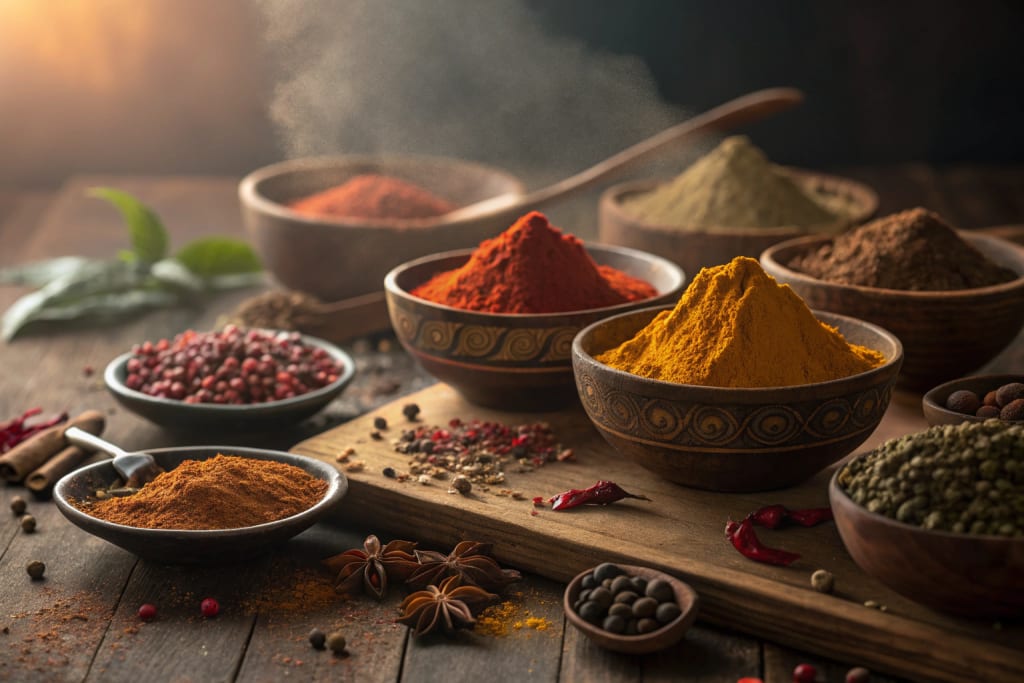
Open a kitchen drawer, and there they sit—a stash of miniature glass jars—cinnamon, black pepper, turmeric, nutmeg, paprika. They rest quietly, unobtrusively, until called upon to sprinkle into a sauce or dust over bread. But for two millennia, these minute shavings of plants mounted epic journeys, founded empires, overthrew dynasties, rewired economies. Spices are not just flavor—they are history, medicine, and memory reduced to pinches and handfuls.
From the cinnamon-perfumed caravans of Arabia to the pepper-hauling galleons of the Portuguese empire, spices charted the very course of human civilization. They were more valuable than gold, they were fought for like gold, and they were bought like gold. Even today, though we no longer wage wars over nutmeg, the world's spice trade remains an icon of culture, identity, and human connection.
This is the underground life of spices: a story of taste, influence, and survival.
The Ancient Highways of Flavor – Spice Trade Routes
Spice history cannot be disentangled from exploration history. Long before airplanes and container vessels, ancient peoples mapped dangerous routes to transport peppercorns, cloves, cinnamon, and saffron across continents.
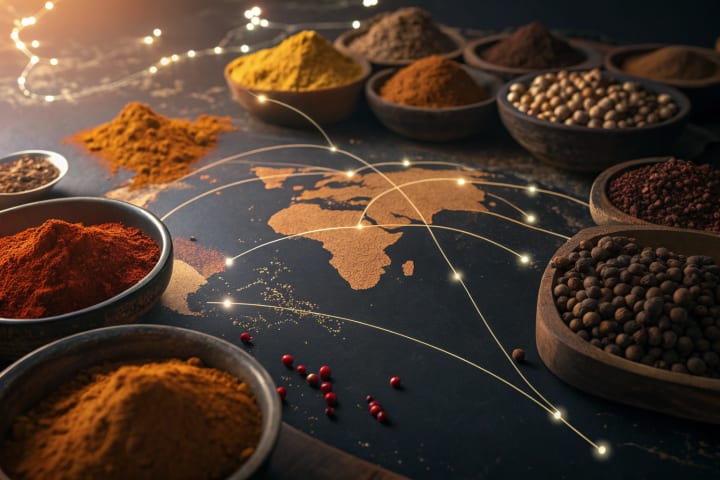
The Silk Road was not merely a silk road—it was also a spice highway. Caravans carried cardamom from India, saffron from Persia, and cinnamon from Sri Lanka across deserts and mountains to the Roman markets. Roman senators and emperors, old records have it, were pepper-crazy, so crazy that pepper at one time was used to bribe and to pay rents. Nero reportedly used a year's supply of cinnamon on his wife's funeral pyre, a mourning in large measure.
Southward, the sea spice routes across the Indian Ocean linked East Africa, India, Arabia, and Southeast Asia. Traders traveled by star and monsoon, linking Zanzibar cloves to China star anise. Venice and Genoa became spice middlemen during the medieval period, charging tolls on every grain of pepper and dash of nutmeg coming into Europe.
Spices created such a craving that they launched the Age of Exploration. Columbus sailed west for India's pepper; Vasco da Gama navigated storms along Africa's Cape of Good Hope; Dutch and Portuguese navies fought bloody wars over islands of cloves and nutmeg. The Banda Islands in Indonesia, the world's only source of nutmeg, was a war zone for massacres and colonial wars. Spices were not just flavor—they were destiny.

The Biology of Flavor – Why Spices Affect Our Senses So Powerfully
Why in the world would people kill and die over something as small as a peppercorn? The secret to this puzzle is biology.
Spices are chemical firecrackers. Capsaicin from chili peppers activates pain receptors to create heat without combustion. Piperine in black pepper slices flavors on the tongue. Cinnamaldehyde in cinnamon warms our senses, and eugenol in cloves numbs and soothes. These chemicals emerged as plant defenses to repel insects and animals. Human beings re-engineered them into pleasures.
Psychologically, spices are linked to brain reward circuits. They activate dopamine, the pleasure neurotransmitter, and enhance food's perception. Culturally, this physiological boost became ritual—food that was seasoned not just for sustenance but for pleasure, status, and identity.
In the tropics, spices even served an utilitarian function. Practically all of them are antibacterial—garlic, onion, cinnamon, and cloves are able to inhibit bacteria. Anthropologists find it due to the reason why spiced food was born in warmer latitudes where food did spoil quicker. Taste, in this sense, was a question of survival.
Spices as Symbols of Power – Across Civilizations
Every culture imbued spices with symbolic significance.
In Egypt, cinnamon and myrrh were incensed within temple ceremonies and embalming rites, connecting the mortal with the sacred. In India, turmeric was marked as a symbol of purity and was brought into wedding ceremonies, where brides wore turmeric paste for blessing and safeguarding. In China, star anise and ginger appeared in medicine and myth alike, used to balance yin and yang.
Spices were wealth and want to medieval Europeans. To feed bountifully spiced food meant to flaunt riches, since only the rich could pay for nutmeg or saffron. Banquets glowed not only with golden cups but with golden hues of saffroned rice. Shakespeare even referenced nutmeg in a play, indicating sophistication.
Spices created language and imagination too. To "add spice" is to introduce enthusiasm. To call a person "worth their salt" (the oldest spice itself) is to summon value and respect. Flavor became metaphor, and metaphor became culture.
Medicine in the Cupboard – Healing Traditions
Before there were pharmacies there was the spice cupboard.
Spices have been medicine as much as food for thousands of years. Ayurveda, medicine in ancient India, still uses turmeric for inflammations, ginger for digestions, and black pepper for circulation. Traditional Chinese Medicine employs cinnamon bark for colds and licorice root for balance.
Even in Europe, even prior to the scientific revolution, spices were medicinal reputation. Cloves were chewed to dull a toothache, nutmeg was ground for digestive ailments, and saffron was infused to treat melancholy. In the Black Death, Europeans burned aromatic spices, hoping the smoke would ward off disease.
Modern science now validates some of these traditions. Turmeric contains curcumin with anti-inflammatory properties; ginger contains gingerol that aids in nausea relief; capsaicin creams relieve pain. The spice rack is thus a double as a pharmacy—once possessed ancient knowledge that was aided by twenty-first-century science.

From Kitchens to Continents – Globalization and Fusion
Spices are migration made edible.
As colonial ships carried pepper, nutmeg, and chili peppers across seas, cultures blended and transformed. Chili peppers, which hailed from the Americas, traveled east with Spanish and Portuguese merchants and became a mainstay of Indian curries, Korean kimchi, and Thai stir-fries. Potatoes and tomatoes followed suit and transformed entire culinary cultures. Attempt Italian food sans tomatoes or Sichuan food sans chili—unrecognizable.
The global spice trade generated hybrid foods that define nations today. Jamaican jerk seasoning is a blend of African, European, and Native ingredients. Moroccan ras el hanout is a union of cinnamon, cumin, ginger, and more into a powerful sign of cross-cultural mixture. Even humble curry powder is a British colonial invention, a attempt to bottle Indian complexity for export.
This constant dialogue made flavor a human common language. To live global history, you simply need to step into a street food market.
Memories in a Mouthful – Spices and Identity
Asides from history and economics, spices are highly personal.
A grandmother's bay leaf-flavored soup. Cinnamon rolls from childhood days. Cardamom tea shared over a chilly winter morning with a friend. Spices are memory triggers, anchoring us to individuals and places that no longer exist. Neuroscience offers the explanation as well—smell and taste are associated with the limbic system, the emotional center of the brain.
Immigrants will carry small packets of spices with them as bits of home. A sprinkle of cumin will bring one back to a kitchen half a world away. Diasporic spice shops are cultures in confluence, places where identity is contained in flavor.
The individual and the communal converge here. To cook with the spices of ancestors is to be a part of a tradition of taste that stretches back generations. Spices are heritage in the kitchen.
The Spice Economy Today – From Small Farms to Global Shelves
Saffron is no longer a luxury for kings anymore—spices are a global good. Supermarkets sell saffron alongside sugar, cinnamon alongside cereal. But stocking these shelves is a vast economy of small farmers, traders, and exporters.
India remains the world's largest producer and exporter of spices, with cardamom, turmeric, chili, among others, coming from there. Madagascar vanilla takes world markets by ransom, though its production is fragile—weather, thievery, and labor make it one of the world's most expensive spices. Indonesia's nutmeg and mace keep tolling like their colonial history. And as European and North American consumers become more interested in "real" blends—garam masala, za'atar, berbere—spices entwined in cultural narrative as much as taste.
Fair trade and sustainability mark the conversation today. Climate change threatens spice crops, especially those like vanilla that require delicate cultivation climates. Ethical sourcing initiatives strive to ensure that farmers are fairly compensated for products once more valuable than gold.
Case Studies – The Spices That Changed the World
Black Pepper – The King of Spices
Indian peepers were so precious in Rome that they were even used to weigh against gold at times. Medieval European love for pepper made Venice a wonderful trading metropolis, and later encouraged Portugal's Vasco da Gama to sail to India, rewriting history itself.
Saffron – Threads of Gold
Each thread of saffron is a crocus stigma, harvested by hand. It would require approximately 75,000 flowers to produce one pound of saffron, which explains the reason why it has been more expensive than gold for centuries. Saffron was delicately valued in Persian cuisine, Spanish paella, and Indian biryani, and soon it did not just add flavor but became poetry—its yellow hue a symbol of light, wealth, and religious innocence.
Nutmeg – The Spice That Caused Wars
The Indonesian Banda Islands were the world's sole source of nutmeg. The Dutch East India Company in the 17th century waged fierce wars to possess them, even trading Manhattan with the British for nutmeg-cultivating Run Island. A spice altered maps and cities.
Chili Peppers – A Global Traveler
Borne in the Americas, chili peppers transformed global cuisines. In a hundred years of their arrival, they had spread to Africa, Asia, and Europe. Now, they are so integral that most cultures forget that they were once outsiders—picture Korean kimchi, Indian vindaloo, or Hungarian goulash without chili heat.
Conclusion – Spices as Cultural Connectors
The history of spices is, ultimately, the history of humankind. It is a history of caravans and ships, of rituals and recipes, of memory and medicine. Of small seeds and bark, world maps and lives were re-mapped in turn.
To sauté with cinnamon or sprinkle with pepper is to be responsible for the same threads that tied Rome, Cairo, Calicut, and Lisbon together. Spices remind us that culture is not fixed—it is bartered, blended, reimagined, and handed down with every meal.
Understanding the secret life of spices enhances our enjoyment not just of food, but of human connection in general. Flavor is history, flavor is medicine, flavor is memory. And with every pinch, we relive the past and carry it on.
About the Creator
The Chaos Cabinet
A collection of fragments—stories, essays, and ideas stitched together like constellations. A little of everything, for the curious mind.
Keep reading
More stories from The Chaos Cabinet and writers in Earth and other communities.
The Psychology of Storytelling: Why Humans Are Hardwired for Stories
From flickering cave shadows in the distant past to the vibrant universes of the cinema today, storytelling has been at the center of human existence. Across every culture and across every century, human beings have gathered to share stories—myths of beginnings, epic poems of heroes, cautionary tales, and personal histories. Stories are not entertainment alone; they are a way of making sense of the world, of passing knowledge, and of bonding with others. They build societies, convey moral codes, and even guide behavior.
By The Chaos Cabinet4 months ago in Earth
Chameleon: Nature’s Master of Disguise
When most people think of camouflage in the animal kingdom, the chameleon immediately comes to mind. These small reptiles have fascinated scientists, photographers, and wildlife enthusiasts for centuries, not only for their astonishing color-changing abilities but also for their incredible adaptations that make them masters of survival. The chameleon is more than just a showpiece of nature’s artistry; it is a symbol of evolutionary ingenuity and adaptability. The Science of Color Change Chameleons are perhaps best known for their ability to change color, a trait that has captivated observers for generations. While many assume this ability is solely for hiding from predators, the reality is far more complex. Color change serves multiple purposes, including: Camouflage: Blending with surroundings to avoid predators or ambush prey. Communication: Displaying bright colors during courtship or aggressive interactions with rivals. Thermoregulation: Adjusting skin color to absorb or reflect sunlight, helping regulate body temperature. The process of color change is made possible by specialized cells called chromatophores in the chameleon’s skin. These cells contain pigments, and by expanding or contracting them, chameleons can create an array of colors. Beneath the chromatophores, iridophores and guanophores reflect light in ways that produce iridescence, enabling even more intricate patterns. Scientists have discovered that chameleons’ color change is not purely reactive; it is also influenced by mood, social signals, and environmental conditions, making it one of the most sophisticated forms of adaptive behavior in the animal kingdom. Physical Adaptations That Enhance Survival Color change is just one aspect of the chameleon’s impressive survival toolkit. These reptiles have evolved several other features that reinforce their mastery of disguise: Eyes: Chameleons have independently rotating eyes, which allow them to observe nearly 360 degrees around them. This unique vision helps them spot predators and prey while remaining stationary and hidden. Tongue: Chameleons are equipped with a rapidly extending tongue that can be up to twice the length of their body. This allows them to catch insects from a safe distance without revealing their position. Feet and Tail: Chameleons have zygodactylous feet (two toes pointing forward, two backward) and prehensile tails, which allow them to grip branches securely while moving slowly and deliberately—perfect for stealthy navigation through trees. Body Shape and Movement: Many species have laterally flattened bodies and move in a rocking, slow-motion gait, mimicking leaves swaying in the wind. This natural motion enhances camouflage and reduces detection by predators. Chameleons Around the World Chameleons are primarily found in Madagascar, Africa, and parts of southern Europe and Asia. Madagascar is home to the most diversity, with hundreds of unique species adapted to various habitats, from tropical rainforests to arid deserts. Panther Chameleon (Furcifer pardalis): Native to Madagascar, males display spectacular colors during mating rituals, with bright reds, blues, and greens. Jackson’s Chameleon (Trioceros jacksonii): Recognizable by its three horns, this species originates from East Africa and is often found in cooler highlands. Veiled Chameleon (Chamaeleo calyptratus): Known for its prominent casque (helmet-like head), it inhabits Yemen and Saudi Arabia and can exhibit dramatic color changes depending on mood and temperature. Each species has evolved specific adaptations for its environment, demonstrating the chameleon’s remarkable ecological versatility. Chameleons as Masters of Stealth The combination of color change, movement, and physical adaptations makes chameleons extraordinarily difficult for predators to detect. Birds, snakes, and small mammals may prey on them, but chameleons’ stealthy strategies give them a fighting chance. Moreover, the ambush hunting technique of chameleons is equally impressive. By remaining motionless and blending into foliage, they can capture unsuspecting insects with precision and efficiency. This makes them both predator and prey masters of disguise, a dual role that is rare in the animal kingdom. Threats and Conservation Despite their incredible adaptations, chameleons face growing threats from human activity. Habitat destruction, climate change, and the exotic pet trade have put several species at risk. In Madagascar, deforestation has significantly reduced available habitat, threatening endemic chameleon species. Conservation efforts are underway in some regions, including: Protected areas and national parks to preserve habitats. Captive breeding programs to maintain population diversity. Regulations on pet trade to prevent over-collection of wild specimens. Educating the public about the ecological importance and unique biology of chameleons is crucial to ensure these masters of disguise continue to thrive in the wild. The Fascination with Chameleons Chameleons have captured human imagination for centuries. They are featured in art, folklore, and modern media, symbolizing adaptability, secrecy, and transformation. In modern science, studying chameleons has inspired research in camouflage technology, color-changing materials, and robotics, showing that nature’s ingenuity can inform human innovation. Their behavioral complexity, visual mastery, and survival strategies continue to fascinate scientists, highlighting how evolution crafts creatures perfectly adapted to their environments. Conclusion Chameleons are more than just colorful reptiles; they are nature’s ultimate masters of disguise. Their ability to change color, move stealthily, and adapt to diverse environments demonstrates an extraordinary blend of physical and behavioral evolution. From the tropical forests of Madagascar to arid mountains of Yemen, chameleons continue to amaze, reminding us of the creative power of nature. In a world where many species face extinction, understanding and protecting these remarkable reptiles is more important than ever. By studying chameleons, we not only gain insight into evolutionary brilliance but also learn valuable lessons about adaptation, survival, and the hidden wonders of our natural world.
By Muhammad Hassanabout 5 hours ago in Earth
Mother of Elon Musk’s Child Sues xAI Over Grok Deepfakes
Imagine waking up one day to find realistic, sexually explicit images of yourself circulating online—and you never agreed to them. For Ashley St. Clair, the mother of one of Elon Musk’s children, this nightmare became reality. She is now suing xAI, Elon Musk’s AI company, alleging that its chatbot Grok generated harmful deepfake images of her, including depictions of her as a minor and in sexualized contexts.
By Aarif Lashariabout 5 hours ago in Earth




Comments
There are no comments for this story
Be the first to respond and start the conversation.