
"The Royal Bengal Tiger: Pride of India's Wildlife"
An Overview of the Bengal Tiger's History and Populations in India

INDIAN TIGERS:
Indian tigers are a magnificent and iconic species of big cats that are native to India. They are also known as Bengal tigers, as they are mostly found in the Bengal region of India. These majestic creatures are a source of national pride and have been an important part of Indian culture for centuries. In this blog post, we will explore some interesting facts about Indian tigers.
APPEARANCE AND CHARACTERISTICS:
Indian tigers, are a subspecies of the Panthera tigris species and are the largest members of the cat family. They are easily recognizable by their distinctive reddish-orange coat with black stripes, which vary in thickness and pattern. Each tiger's stripe pattern is unique, much like a human fingerprint, making it easier for researchers to identify individuals.
Indian tigers have muscular bodies, sharp claws, and powerful jaws, which make them formidable predators. They have excellent vision, acute hearing, and an incredible sense of smell, which they use to locate prey. Tigers have a sleek and powerful build, which enables them to reach speeds of up to 60 km/h and jump over 6 meters in a single bound.
Male Indian tigers are generally larger than females, with an average weight range of 180 to 258 kg (400 to 570 lb) and a length range of 270 to 310 cm (110 to 120 in) from nose to tail. Females are slightly smaller, weighing between 100 to 160 kg (220 to 350 lb) and measuring between 240 to 265 cm (94 to 104 in) in length.
In addition to their size and strength, Indian tigers have a distinctive roar that can be heard from up to 3 km (1.8 miles) away. Their roar is a powerful territorial call that lets other tigers know that they are in the area and should stay away.
Overall, Indian tigers are incredibly powerful and impressive animals, with a combination of physical and sensory characteristics that make them one of the most awe-inspiring species on the planet.
HABITAT:
Indian tigers, are found primarily in India, but also inhabit smaller areas of Bangladesh, Bhutan, Nepal, and Myanmar. Within India, they are distributed across different habitats, including tropical forests, subtropical forests, mangrove swamps, grasslands, and savannas.
The largest population of Indian tigers is found in the forests of Central India, which includes the states of Madhya Pradesh, Maharashtra, and Chhattisgarh. Other important tiger reserves in India include the Sunderbans in West Bengal, Sariska in Rajasthan, Bandhavgarh in Madhya Pradesh, Pench in Maharashtra, and Kanha in Madhya Pradesh.
Overall, Indian tigers require large areas of forest with dense vegetation, water sources, and adequate prey populations. The availability of these resources can vary by season and region, leading to some seasonal movement by tigers within their home range.
BEHAVIOUR:
Indian tigers, are the most numerous tiger subspecies and are found in India, Bangladesh, Bhutan, and Nepal. They are apex predators and play a crucial role in maintaining the ecological balance in their respective habitats. Here are some key behaviors exhibited by Indian tigers:
1. Solitary animals: Indian tigers are mostly solitary animals and prefer to hunt and live alone. However, females may live with their cubs for a period of time.
2. Territorial: Tigers have large home ranges, and males tend to have larger territories than females. They will mark their territories with urine, feces, and scratch marks on trees.
3. Nocturnal: Indian tigers are mainly active at night and are crepuscular (active during dawn and dusk).
4. Excellent swimmers: Tigers are excellent swimmers and are known to swim across rivers and lakes to hunt prey.
5. Ambush hunters: Tigers are ambush predators and will patiently wait for their prey to come close before pouncing on them.
6. Diet: Indian tigers are carnivorous and mainly feed on deer, wild pigs, and other smaller mammals. They are also known to occasionally attack domestic animals.
7. Vocalisations: Tigers communicate with each other through vocalizations such as roars, growls, and snarls.
CONSERVATION:
Conservation of Indian tigers is crucial to ensure their survival as they are an endangered species. Here are some of the measures taken to conserve Indian tigers:
1. Protected areas: The Indian government has set up several protected areas like national parks, wildlife sanctuaries, and tiger reserves, which provide a safe habitat for tigers and other wildlife.
2. Anti-poaching measures: Poaching is one of the biggest threats to Indian tigers, and efforts are being made to curb it through strict law enforcement and anti-poaching patrols.
3. Habitat management: Habitat destruction and fragmentation are major threats to Indian tigers, and efforts are being made to manage and restore their habitat by planting native vegetation, controlling invasive species, and reducing human-wildlife conflicts.
4. Public awareness: Public awareness campaigns are being conducted to educate people about the importance of conserving tigers and the need to protect their habitat.
5. Community participation: Local communities living near tiger habitats are being involved in conservation efforts through ecotourism, job opportunities, and incentives for conservation practices.
6. Research and monitoring: Regular monitoring of tiger populations and their habitats is essential to assess the success of conservation efforts and identify areas that require further attention.
7. These conservation efforts have helped increase the number of tigers in India from around 1,400 in 2006 to over 2,600 in 2019. However, much more needs to be done to ensure the long-term survival of this iconic species.
CULTURAL SIGNIFICANCE:
Indian tigers, hold significant cultural importance in India. These majestic creatures are not only the national animal of India but also an important symbol of power, strength, and courage. Here are some of the ways Indian tigers hold cultural significance in India:
1. Religious Importance: In Hinduism, the goddess Durga is often depicted riding a tiger or a lion, symbolizing her power and fierceness. The tiger is also associated with the god Shiva, who is said to have worn a tiger skin as a symbol of his strength and virility.
2. Folklore and Mythology: Indian tigers have been featured in many folktales and mythologies, where they are often portrayed as fearless and powerful animals. For example, the famous Indian fable of the "Panchatantra" tells the story of a clever tiger who outwits other animals.
3. Conservation Efforts: Indian tigers have been under threat due to habitat loss and poaching, and their conservation has become an important cultural cause in India. The government of India has launched several conservation initiatives, including Project Tiger, to protect and preserve these magnificent animals.
4. National Identity: Indian tigers are an important symbol of India's natural heritage and are considered a national treasure. They are featured on the country's national emblem, currency, and various government documents.
5. Tourism: India's national parks and wildlife sanctuaries, such as Bandhavgarh National Park and Kanha National Park, are popular destinations for tourists from around the world, who come to see the Indian tigers in their natural habitat.
6. In summary, Indian tigers hold great cultural significance in India, representing power, strength, and courage, and playing an important role in the country's religion, folklore, conservation efforts, national identity, and tourism industry.
CONCLUSION:
Indian tigers are a magnificent and iconic species that hold a special place in Indian culture. They are a symbol of India's rich biodiversity and the country's commitment to conservation. However, they are also a vulnerable species facing numerous threats. It is crucial that we take steps to protect these magnificent creatures and their habitats, to ensure that they continue to thrive for generations to come.
About the Creator
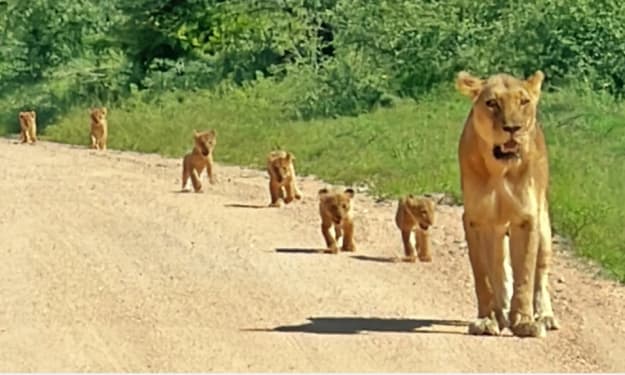
Tiny Lion Cubs Struggle To Keep Up With Mom
In the heart of the African savannah, life is a constant lesson for young animals. Few scenes are as endearing — or as heartwarming — as tiny lion cubs trying to keep pace with their mother. These little bundles of fur face a world full of challenges, from learning to hunt to avoiding dangers, all while depending on the guidance and protection of their experienced mom. Watching cubs wobble and tumble as they attempt to keep up with their mother reminds us that growing up, even in the wild, is a journey full of struggle, determination, and adorable missteps. The Early Days of Lion Cubs Lion cubs are born blind and helpless, usually in litters of two to six. For the first few weeks, they rely entirely on their mother for warmth, food, and safety. Even after opening their eyes and beginning to explore, the cubs are far from independent. The first months are crucial. Cubs learn social cues, hunting basics, and survival skills simply by watching their mother and the pride. But as anyone who has observed them knows, there’s often a huge gap between observation and action. Tiny cubs often struggle to match their mother’s pace, especially when she moves through long stretches of savannah or leads the family on patrols. A Mother’s Role in the Wild For a lioness, raising cubs is a full-time commitment. She hunts, defends her territory, and teaches her young, all while staying alert to predators such as hyenas, leopards, and even rival lions. The cubs, meanwhile, attempt to mimic her every move — often with clumsy yet charming results. A mother lion’s patience is remarkable; she frequently slows down, nudges them along, or stops to ensure no cub is left behind. These moments, while stressful for the tiny cubs, are vital learning opportunities. Struggling to Keep Up: Why It’s So Hard There are several reasons why tiny lion cubs have trouble keeping pace with their mother: Short Legs, Big Steps: Lion cubs’ legs are tiny and their coordination is limited, making it difficult to cover the same distance as an adult lioness. Curiosity: Cubs are naturally curious. A single butterfly or rustling bush can distract them, leaving mom to pause repeatedly. Energy Levels: Young lions tire quickly. Even with frequent naps, the cubs’ stamina is far lower than their mother’s. Learning Through Play: Play is not just fun; it teaches hunting, balance, and social skills. Running off to pounce on a sibling or chase an insect is all part of their education. Despite these challenges, the cubs’ determination to keep up demonstrates their resilience and growing understanding of the wild world. Lessons in Teamwork and Survival Every cub struggling to keep up is also learning crucial survival skills. The journey across the savannah is more than a test of speed — it’s a lesson in: Coordination: Cubs learn how to move efficiently across different terrains. Patience: They begin to understand the rhythms of adult life and the pace required for survival. Social Skills: Staying with the group teaches cubs how to interact with siblings and the pride, which is essential for their future roles. Observation: By following their mother, cubs study hunting techniques, territorial behavior, and predator awareness. Even the moments when cubs stumble or lag behind are essential for their development. These experiences prepare them for independence, which comes sooner than many might expect. The Cutest Moments in the Wild Anyone who has watched tiny lion cubs knows that their struggles are often irresistibly cute. Video clips from wildlife reserves frequently show cubs toddling along, tumbling over each other, or getting distracted mid-step. Observers often comment that these little stumbles reveal personality, determination, and playfulness, making them one of nature’s most heartwarming spectacles. While their mother is serious and focused, the cubs inject a sense of humor and lightness into life on the savannah. Why This Matters The struggles of lion cubs aren’t just adorable — they’re vital for understanding wildlife behavior. Conservationists and animal behaviorists use these moments to study growth patterns, social structures, and survival strategies in lion populations. These observations also highlight the importance of preserving natural habitats. Cubs must learn in a safe environment to survive; habitat loss, poaching, and climate change make these early struggles even more dangerous. Protecting the African savannah ensures that future generations of lions can experience the same lessons and playful tumbles. The Road to Independence Within a year, these tiny cubs will be more agile, faster, and more confident. By the time they reach two to three years old, males may begin to leave the pride, while females often stay and become caretakers themselves. Every misstep, tumble, and lagging moment is part of the journey toward strength, coordination, and independence. Watching them now gives us a glimpse of the challenges they will overcome, and the survival skills they will carry for life. A Celebration of Motherhood Ultimately, these scenes remind us of the incredible bond between mother and cubs. Her patience, vigilance, and teaching are the foundations of their future. The cubs’ struggles highlight the trials of growing up, while their determination showcases the resilience and beauty of wildlife. For those observing, it’s a powerful lesson in care, guidance, and perseverance, not just in lions but in the natural world as a whole. Final Thoughts Watching tiny lion cubs try to keep up with their mother is both entertaining and enlightening. It’s a story of growth, struggle, and resilience — a reminder that even the fiercest creatures start small, learning step by step. These little lions capture hearts while teaching life lessons: patience, determination, teamwork, and the importance of guidance. As they tumble and waddle across the savannah, they show us that growth is a process, one adorable misstep at a time. For wildlife enthusiasts, animal lovers, and anyone enchanted by nature, these tiny cubs are proof that even in the wild, love, care, and persistence are universal truths.
By Aarif Lashari4 days ago in Earth
Chinese EVs Closing In on America After Canadian Tariffs Deal
The electric vehicle race is no longer just about climate goals or consumer choice — it has become a geopolitical contest. And in early 2026, a subtle but powerful move by Canada may have tilted the board. By agreeing to sharply reduce tariffs on Chinese electric vehicles, Canada has opened a door that the United States has worked hard to keep shut. While Chinese EVs are still largely barred from the American market, they are now edging closer than ever — not by crossing the border directly, but by entering through Canada. This development raises a pressing question: Are Chinese EVs closing in on America, and what does that mean for the future of North American auto markets? The Deal That Changed the Game Canada’s new agreement with China allows up to 49,000 Chinese-made electric vehicles per year to enter the Canadian market at a tariff rate of just over 6%, a dramatic drop from the previous 100% tariff that effectively blocked them. On paper, the quota seems small. In reality, it carries enormous symbolic and strategic weight. For years, both Canada and the United States aligned closely on keeping Chinese EVs out, citing concerns over unfair subsidies, national security, and the protection of domestic auto industries. This new deal marks a clear shift — and a divergence from U.S. policy. Canada didn’t make the decision in isolation. The EV tariff reduction was part of a broader trade reset with China, tied to agricultural exports such as canola and efforts to stabilize a strained economic relationship. Why Chinese EVs Matter So Much China is the undisputed leader of the global electric vehicle industry. Its manufacturers produce EVs at scale, often at prices Western automakers struggle to match. Brands like BYD, Nio, and Xpeng have already expanded aggressively into Europe, Southeast Asia, and parts of the Middle East. North America has remained one of the final fortified markets — until now. Chinese EVs are appealing not just because they’re cheaper, but because they’ve rapidly improved in quality, range, and technology. For consumers priced out of North American and European EV models, Chinese vehicles offer something rare: affordability without sacrificing features. Canada’s decision gives Chinese automakers their first legitimate foothold in North America — and footholds tend to grow. Why the U.S. Is Nervous The United States still enforces a 100% tariff on Chinese EV imports, making them effectively unsellable in the American market. But Canada’s move has triggered concern in Washington. U.S. officials argue that Chinese EVs entering Canada could indirectly pressure American markets, influence supply chains, and weaken Washington’s leverage in future trade negotiations. There’s also a political dimension. Both major U.S. parties have framed Chinese dominance in EVs as a strategic threat — not just to auto jobs, but to technological leadership. Modern EVs collect vast amounts of data, and lawmakers have raised concerns about cybersecurity and foreign data access. While Chinese EVs aren’t rolling onto American roads yet, their presence just across the border changes the conversation. Canada’s Risk — and Opportunity Inside Canada, the reaction has been mixed. Automotive hubs like Ontario worry that opening the market could undermine domestic manufacturing and strain relations with the U.S., Canada’s largest trading partner. Some leaders have called the deal “lopsided,” warning it could cost jobs if American retaliation follows. Others see opportunity. A more competitive EV market could lower prices for Canadian consumers and accelerate EV adoption. It may also attract Chinese investment into Canada itself — including factories, battery plants, and supply chain partnerships. If Chinese automakers choose to build in Canada rather than simply export to it, the country could position itself as a bridge between Chinese EV innovation and North American demand. That balancing act — between economic opportunity and political risk — defines Canada’s strategy. Are Chinese EVs Really ‘Closing In’ on America? For now, the answer is: not directly — but strategically, yes. Chinese EVs sold in Canada won’t automatically flood the U.S. market. Regulations, trade rules, and tariffs still stand in the way. But proximity matters. Supply chains overlap. Consumer awareness spreads. Manufacturing footprints expand. There’s also the possibility of a workaround: Chinese companies could eventually build EVs in North America to bypass tariffs altogether. This idea has already been floated — but it faces fierce resistance from U.S. lawmakers and unions. Still, history shows that once a global industry leader gains regional access, momentum often follows. What This Means for Consumers For Canadian buyers, the impact could be immediate: more choice and lower prices in an EV market that has long been criticized for being expensive and limited. For American consumers, the effect will be indirect — at least at first. But increased competition could eventually pressure U.S. automakers to reduce prices, improve features, and accelerate innovation. The larger question is whether North America wants competition or insulation — and how long insulation can realistically last in a globalized EV economy. The Bigger Picture: A Global EV Power Shift Canada’s tariff deal reflects a broader reality: China’s dominance in electric vehicles is reshaping global trade, whether governments like it or not. Europe is already grappling with an influx of Chinese EVs. Emerging markets are embracing them. And now, North America has its first real crack in the wall. This isn’t just about cars. It’s about who controls the future of clean transportation, supply chains, and industrial policy. Final Thoughts Chinese EVs aren’t driving down American highways yet — but after Canada’s tariff deal, they’re closer than ever. This move doesn’t spell immediate disruption, but it does signal a shift. One country has decided that economic pragmatism outweighs political alignment. And in doing so, Canada may have opened the door to a new phase of EV competition in North America. Whether that door swings wider — or slams shut — will depend on how the U.S., automakers, and consumers respond. One thing is certain: the EV race just entered a new chapter.
By Muhammad Hassan6 days ago in Earth
📢 Raise Your Voice Thread: 01/22/2026
Our “Raise Your Voice Threads” are hosted most alternating Thursdays at 12PM ET to offer creators more avenues to uncover exceptional stories on Vocal. As we are continuously searching for fresh creators and inspiring stories, this thread provides an opportunity to exchange and discuss the stories that have moved and motivated us on Vocal.
By Raise Your Voice by Vocala day ago in Resources



Comments
There are no comments for this story
Be the first to respond and start the conversation.