
The Rift Beneath: Africa's Awakening Earth
Unveiling the Secrets Behind Africa’s Growing Continental Split

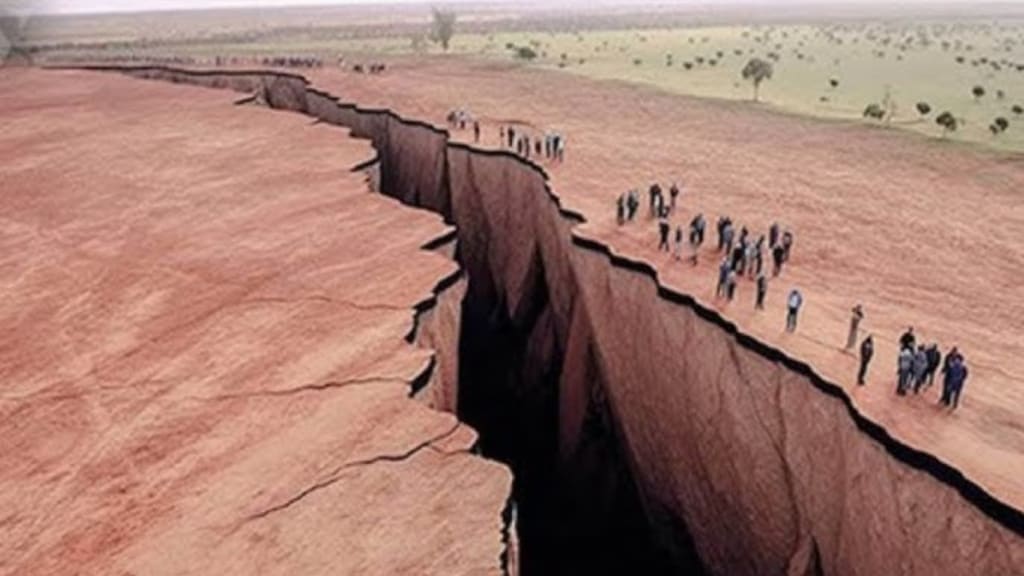
In the heart of East Africa, a strange phenomenon had begun to stir the land—a growing crack tearing through fields, roads, and villages. It began quietly, almost imperceptibly, in the Great Rift Valley, but soon it would demand the world's attention.
For centuries, the African continent had appeared calm on the surface. Its plains, deserts, and jungles held stories of ancient civilizations, diverse cultures, and natural beauty. Yet beneath the earth, forces were brewing—forces so powerful that they could reshape the very structure of the continent.
In 2018, near the town of Mai Mahiu in Kenya, the earth split. A massive crack, stretching several kilometers and several meters deep, appeared overnight. Roads crumbled. Homes were swallowed. Panic spread among the people, who feared an earthquake or something even worse. The event sparked headlines around the world: "Is Africa Splitting in Two?"
Geologists and seismologists rushed to investigate. Dr. Amina Njoroge, a Kenyan geologist from the University of Nairobi, had been studying the East African Rift for years. She believed this was only the beginning of a far greater transformation. "The continent is alive," she told reporters. "What we are witnessing is the slow, powerful process of continental drift in real time."
The East African Rift System, stretching from the Afar Triangle in Ethiopia down to Mozambique, is a complex zone where tectonic plates are pulling apart. Over millions of years, it has formed deep valleys, volcanic mountains, and hot springs. But now, the pace of change seemed to be accelerating.
Satellite data confirmed Dr. Amina’s theories. The Nubian Plate (larger part of the African Plate) and the Somali Plate (a smaller, eastern section) were moving apart at a rate of about 6–7 millimeters per year. Though the rate was slow by human standards, in geological time it was dramatic. In perhaps 5 to 10 million years, this rifting could create a new ocean, splitting the Horn of Africa from the mainland and forming a new island continent.
But for the people living in the Rift Valley, the science was overshadowed by fear. In villages like Suswa and Narok, residents faced daily uncertainty. Earthquakes became more common. Steam hissed from cracks in the ground. Once-fertile farmlands turned into fractured terrain. Stories began to spread—legends of an angry earth spirit punishing humanity, of a god beneath the crust waking from a long slumber.
Amina, determined to help, organized community meetings. She brought maps, charts, and models, showing people the tectonic forces at work and teaching them how to adapt. Her mission was to turn fear into understanding, and understanding into resilience.
But her work wasn't without obstacles. Politicians, wary of panic, downplayed the risks. Developers ignored geological warnings and built infrastructure atop fault lines. And some religious leaders resisted the scientific explanation, insisting that divine intervention was the cause.
Then came the eruption.
In 2027, Mount Longonot—an ancient stratovolcano near Nairobi—erupted violently after centuries of dormancy. Lava flowed down its slopes, ash darkened the sky, and thousands were forced to flee. The eruption didn’t cause mass casualties, thanks to early warnings, but it confirmed what scientists had feared: the Rift was becoming more active, and time was running out to prepare.
The eruption jolted the world into action. International scientists joined forces with African experts to study the Rift more deeply. Governments launched new initiatives to monitor seismic activity and build earthquake-resistant infrastructure. Documentaries, school programs, and global awareness campaigns brought the hidden story of Africa's awakening earth to the world stage.
As the years passed, the people of the Rift Valley adapted. They planted stronger crops, reinforced homes, and built communities centered around safety and science. The rift continued to grow, slowly, silently carving a new future for the continent.
And Dr. Amina? She became a hero not just in Kenya, but around the world—a symbol of how knowledge, courage, and unity could transform fear into strength.
The story of Africa's splitting land is not just one of destruction. It is a story of birth, of change, of evolution. Beneath the soil, beneath the cities, something ancient and powerful stirs. And while the earth moves in silence, its message is loud and clear: nothing stays the same forever. Even a continent must one day be reborn.
About the Creator
Mati Henry
Storyteller. Dream weaver. Truth seeker. I write to explore worlds both real and imagined—capturing emotion, sparking thought, and inspiring change. Follow me for stories that stay with you long after the last word.
Keep reading
More stories from Mati Henry and writers in Earth and other communities.
Alone in the Green Abyss: One Man’s Survival in the Amazon
The rain was relentless, beating down like a drum on the canopy overhead. Underneath, drenched and shivering, stood a lone figure—Daniel Cruz. A 32-year-old wildlife photographer, Daniel had dreamed for years of documenting the untouched beauty of the Amazon Rainforest. He never imagined that what started as an expedition would turn into a desperate fight for survival.
By Mati Henry 8 months ago in Earth
Greenland: New Shipping Routes, Hidden Minerals – and a Frontline Between the US and Russia?
Once seen as a remote and largely isolated Arctic territory, Greenland is rapidly emerging as a focal point of global geopolitics. Climate change, melting ice, and technological advances are transforming the island into a strategic hub defined by new shipping routes, vast mineral resources, and growing rivalry between major powers, particularly the United States and Russia. As the Arctic opens up, Greenland’s geographic position and untapped potential are pushing it to the center of international attention, raising questions about security, sovereignty, and sustainable development. Melting Ice and the Opening of New Shipping Routes One of the most visible impacts of climate change in the Arctic is the reduction of sea ice, which is making previously inaccessible waters navigable for longer periods each year. New Arctic shipping routes, including passages near Greenland, promise shorter travel times between Europe, Asia, and North America. Compared to traditional routes like the Suez Canal, Arctic pathways can reduce shipping distances by thousands of kilometers, cutting fuel costs and emissions. For global trade, this could be transformative. Greenland’s coastal waters are increasingly important as potential transit corridors and support hubs for these routes. However, the expansion of Arctic shipping also raises concerns about environmental risks, maritime safety, and the lack of robust emergency infrastructure in the region. Hidden Mineral Wealth Beneath the Ice Beyond shipping, Greenland holds significant reserves of critical minerals, many of which are essential for modern technologies and the global energy transition. These include rare earth elements, lithium, graphite, uranium, and other strategic resources used in electric vehicles, wind turbines, batteries, and defense systems. As demand for these materials grows, Greenland is being viewed as a potential alternative to existing supply chains dominated by a small number of countries. This has increased interest from Western governments seeking to diversify mineral sourcing and reduce strategic dependencies. However, mining in Greenland is controversial. Local communities and policymakers must balance economic opportunities with environmental protection and cultural preservation. Greenland’s harsh climate and fragile ecosystems make resource extraction both technically challenging and politically sensitive. The United States’ Strategic Interest in Greenland The United States has long considered Greenland strategically vital, largely due to its location between North America and Europe. The US already maintains a military presence at Pituffik Space Base (formerly Thule Air Base), which plays a key role in missile warning systems and space surveillance. In recent years, Washington has renewed its focus on Greenland, emphasizing Arctic security, infrastructure investment, and cooperation with Denmark, which oversees Greenland’s foreign and defense policy. US interest is driven by several factors: protecting transatlantic security routes, countering rival powers in the Arctic, and ensuring access to critical minerals. Greenland is increasingly viewed as a frontline in maintaining Western influence in the High North. Russia’s Arctic Ambitions Russia, meanwhile, sees the Arctic as central to its economic and military strategy. It has invested heavily in Arctic military bases, icebreaker fleets, and energy projects, particularly along its northern coastline. Although Greenland is geographically distant from Russia’s main Arctic territories, Moscow closely monitors developments there. The island’s proximity to key Arctic sea lanes and North Atlantic routes makes it strategically relevant in any broader confrontation between Russia and NATO. As tensions between Russia and the West remain high, Greenland’s location places it near the intersection of competing security interests, increasing its geopolitical significance. Greenland Between Global Powers The growing attention from major powers puts Greenland in a delicate position. While the island seeks greater economic independence and development, it must navigate complex relationships with Denmark, the United States, and other international actors. Greenland’s government has emphasized the importance of maintaining control over its resources and ensuring that development benefits local populations. At the same time, geopolitical competition risks turning Greenland into a strategic chessboard rather than a partner in decision-making. This balancing act is becoming more difficult as Arctic competition intensifies. Environmental and Social Challenges Greenland is on the front lines of climate change. Melting ice sheets contribute to global sea-level rise, while local communities face changes to traditional livelihoods such as fishing and hunting. The expansion of shipping and mining could bring jobs and infrastructure, but it also threatens fragile ecosystems and raises concerns about pollution, habitat disruption, and long-term sustainability. Any future development in Greenland will require careful regulation, international cooperation, and meaningful engagement
By Aarif Lasharia day ago in Earth
Filipino Rescuers Detect “Signs of Life” in Garbage Avalanche That Killed 4 and Left Dozens Missing
In the early hours following a devastating garbage avalanche in the Philippines, rescuers reported detecting “signs of life” beneath tons of waste, igniting a fragile sense of hope amid widespread grief and uncertainty. The deadly incident, which claimed at least four lives and left dozens missing, has drawn national attention to the dangers faced by communities living near massive waste disposal sites.
By Aqib Hussain7 days ago in Earth


Comments
There are no comments for this story
Be the first to respond and start the conversation.