
The Powder Keg Ignites: A Story of Ambition, Alliances, and the Road to World War I
How Europe’s Glory, Grudges, and Guns Turned a Regional Crisis into a Global Inferno

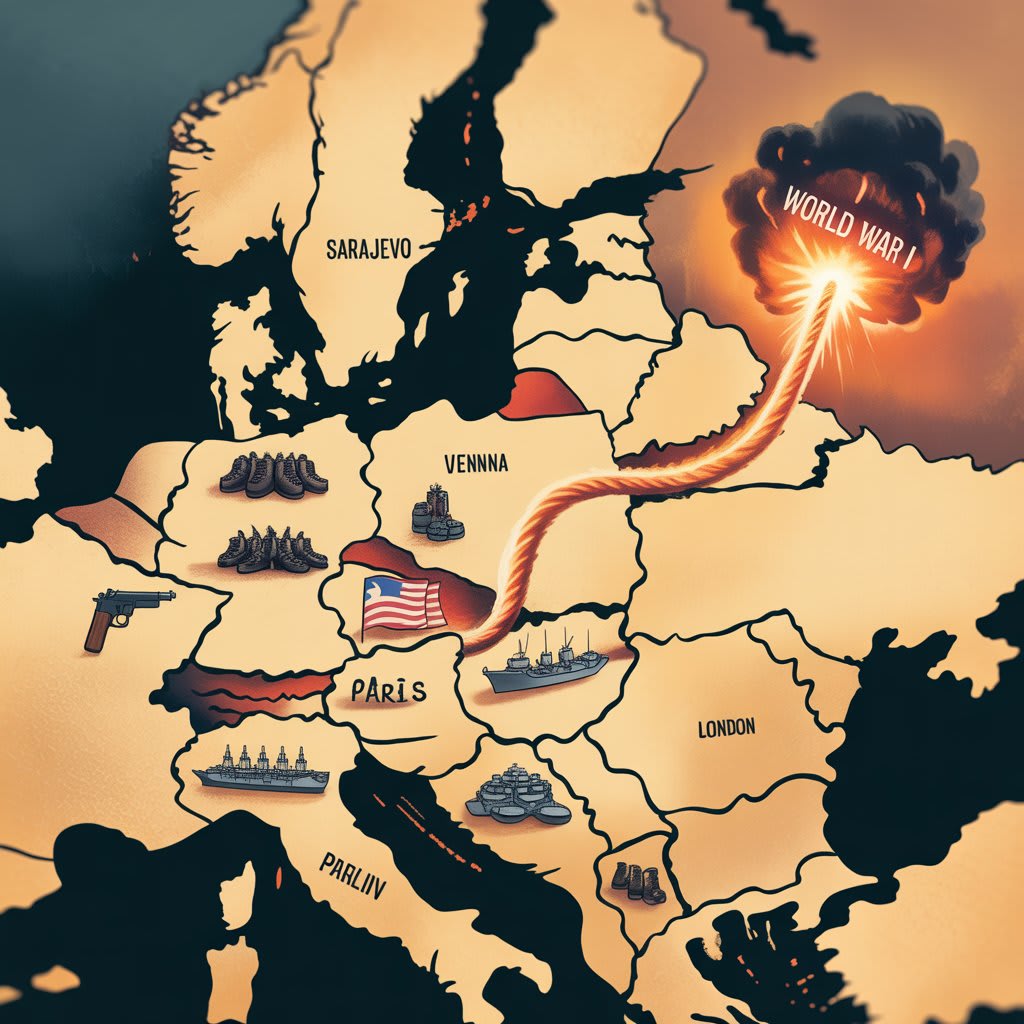
Prologue: A Peaceful Continent Beneath a Boiling Surface (1890–1905)
At the turn of the 20th century, Europe glittered like a crown under the sun. Its empires were vast, its monarchs grand, and its cities vibrant. There was a sense of triumph in the air—science, industry, and art flourished. Yet, behind the grandeur, whispers of tension echoed across courts and capitals. Beneath the illusion of peace lay old grievances, new ambitions, and a web of treaties waiting to be tested.
In Berlin, Kaiser Wilhelm II looked east and west with growing anxiety and ambition. In Vienna, the aged Emperor Franz Joseph ruled over a patchwork empire of Austrians, Hungarians, Slavs, and others who increasingly dreamed of independence. In Paris, leaders simmered with resentment over the loss of Alsace-Lorraine to Germany in the Franco-Prussian War of 1870. In London, imperial pride and naval superiority were matched only by its dread of German ascendancy. And in the Balkans, the crumbling Ottoman Empire left a vacuum of chaos and opportunity.
Europe, though not at war, was bristling with weapons—and words.
Chapter 1: The Alliance Trap – Friendships Forged in Fear
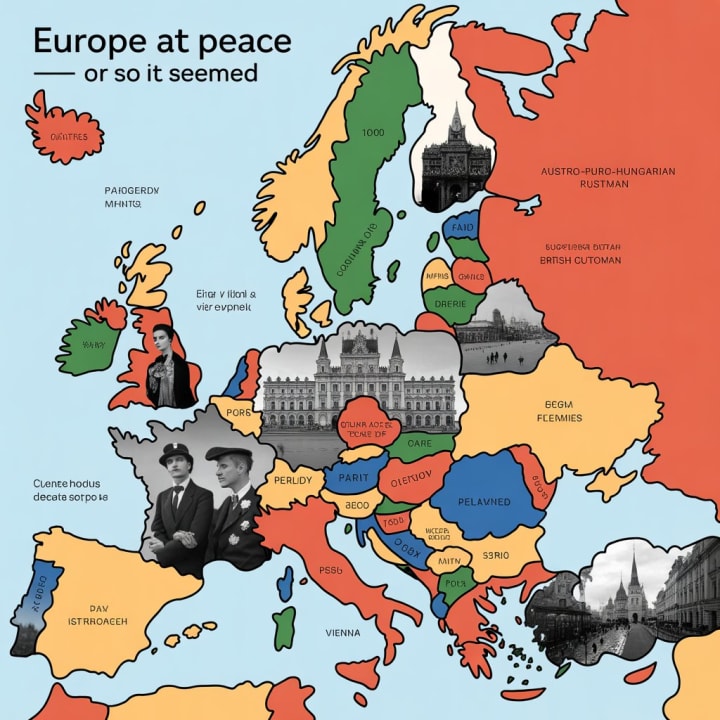
The decades leading to 1914 were marked by a diplomatic game of chess. Alliances formed not out of trust, but fear.
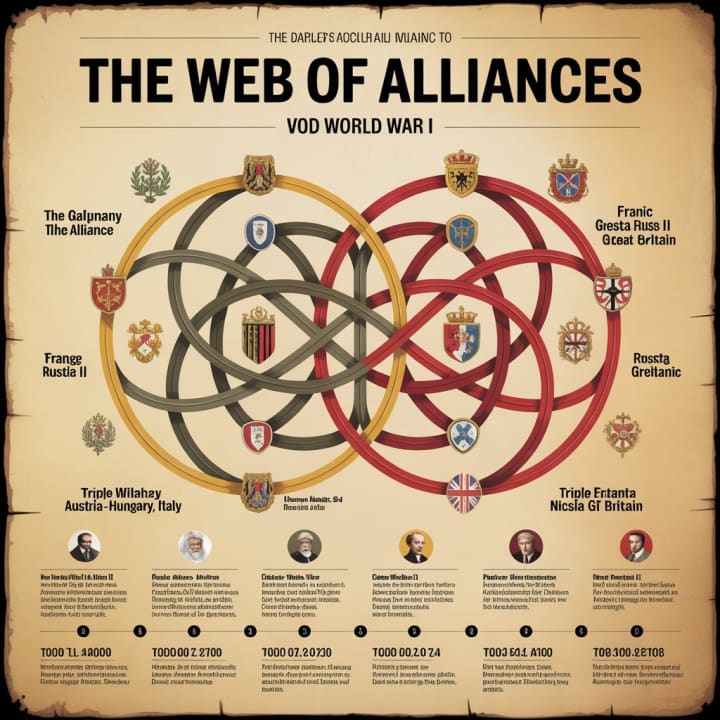
Germany, unified in 1871 under Otto von Bismarck, was wary of being surrounded. To prevent this, Bismarck skillfully formed the Triple Alliance with Austria-Hungary and Italy. These nations pledged mutual defense, but their interests were often at odds.
To counterbalance this bloc, France, still bitter from its humiliation in 1871, allied with Russia in 1894. Britain, after decades of diplomatic isolation, joined them in the Entente Cordiale with France in 1904 and later with Russia in 1907. Thus, the Triple Entente was born.
By 1910, Europe was divided into two armed camps. A spark would be enough to ignite an inferno.
Chapter 2: The Arms Race – Preparing for the War No One Wanted
The alliances were not just on paper. Nations began arming themselves at unprecedented levels. Germany and Britain, once friendly, became locked in a naval arms race. Germany built dreadnoughts—massive, cutting-edge warships—and Britain responded in kind. On land, armies swelled. Military spending doubled between 1900 and 1914.
Every European power created detailed war plans. Germany’s Schlieffen Plan was designed to defeat France quickly before Russia could mobilize. France had Plan XVII, calling for a bold offensive into Alsace-Lorraine. Russia’s mobilization timetable was so rigid that once started, it could not be halted. The machinery of war had been built, and its levers were waiting.
Chapter 3: The Balkan Tinderbox – Nationalism in the Shadows of Empires
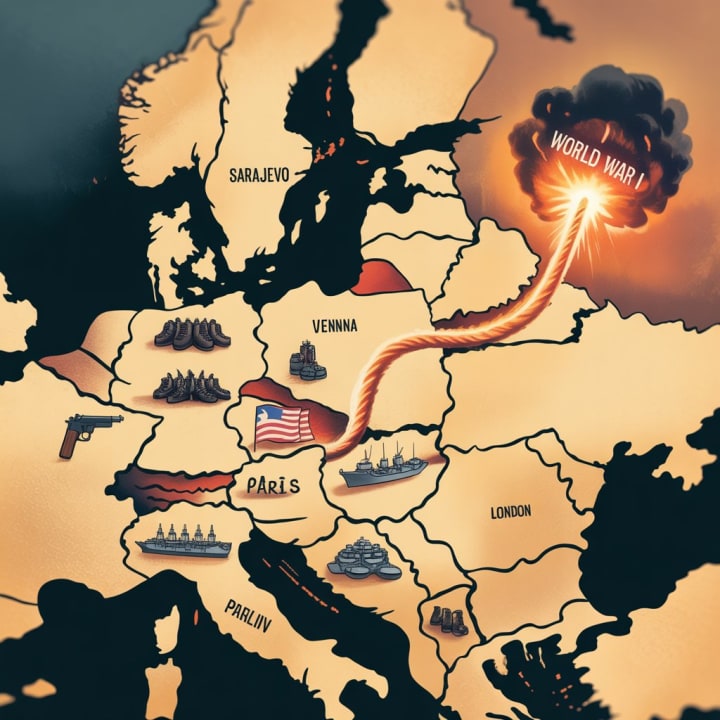
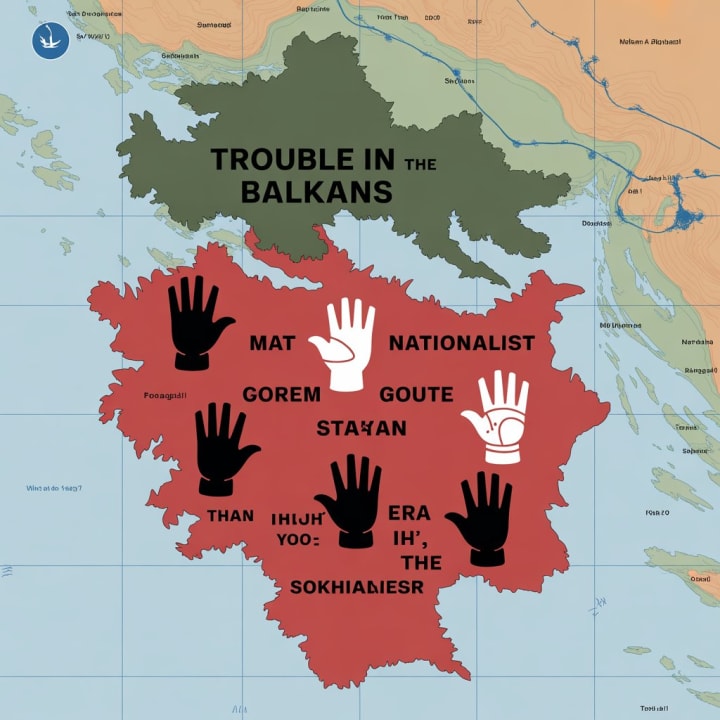
In southeastern Europe, the Balkans were a region of explosive nationalism. The once-powerful Ottoman Empire had been pushed out of much of the region, creating a power vacuum.
Serbia, a small Slavic kingdom, dreamed of uniting all South Slavs into a “Greater Serbia.” This dream put it in direct conflict with Austria-Hungary, which controlled many Slavic peoples in Bosnia and Herzegovina.
In 1908, Austria-Hungary annexed Bosnia, angering Serbia and Russia. The move was legal but provocative. Tensions soared. Then came the Balkan Wars (1912–1913), which further destabilized the region. Serbia emerged stronger and more ambitious, and Austria-Hungary more determined to stop its rise.
In this volatile region, bullets carried ideologies.
Chapter 4: The Spark – Sarajevo, June 28, 1914
The moment history turned happened on a summer morning in Sarajevo. Archduke Franz Ferdinand, heir to the Austro-Hungarian throne, was on a goodwill visit to Bosnia. His presence was seen as an insult by Slavic nationalists.
Among the crowd that day was a young man named Gavrilo Princip, a member of the Serbian-backed group Black Hand. When the Archduke’s motorcade made a wrong turn, Princip seized the chance. He stepped forward, raised his pistol, and fired.
Franz Ferdinand and his wife Sophie were dead within minutes.
Chapter 5: The Ultimatum – Diplomacy or Destruction?

Austria-Hungary, humiliated and enraged, issued an ultimatum to Serbia on July 23, 1914. The demands were intentionally harsh—inspect Serbian institutions, suppress anti-Austrian propaganda, and allow Austrian officials into Serbia.
Serbia accepted most demands but rejected the intrusion on its sovereignty. Austria declared war on July 28.
What followed was a catastrophic cascade:
July 30: Russia mobilized to protect Serbia.
August 1: Germany declared war on Russia.
August 3: Germany declared war on France.
August 4: Germany invaded Belgium to reach France.
August 4 (later): Britain declared war on Germany in defense of Belgian neutrality.
In a week, Europe went from peace to total war.
Chapter 6: A World Drawn In – From Local Crisis to Global Conflict
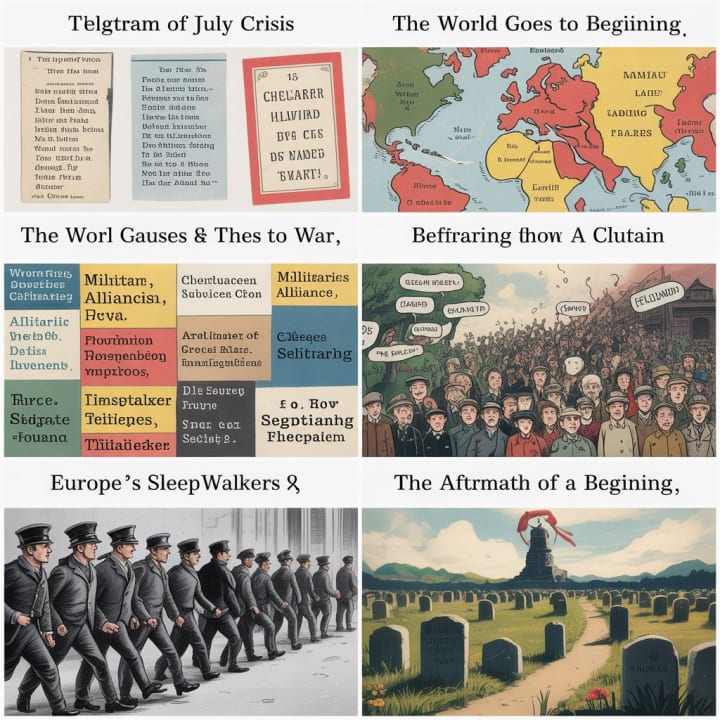
The war was not limited to Europe. Because of colonial empires, it soon engulfed the globe.
Britain called on its dominions—Canada, Australia, New Zealand, India.
Japan joined the Allies, eyeing German possessions in the Pacific.
The Ottoman Empire joined the Central Powers (Germany and Austria-Hungary), opening fronts in the Middle East.
Italy, despite its alliance, joined the Allies in 1915, lured by promises of territory.
What had begun as a regional assassination became World War I—The Great War.
Chapter 7: Why It Happened – The Deeper Causes Behind the Chaos
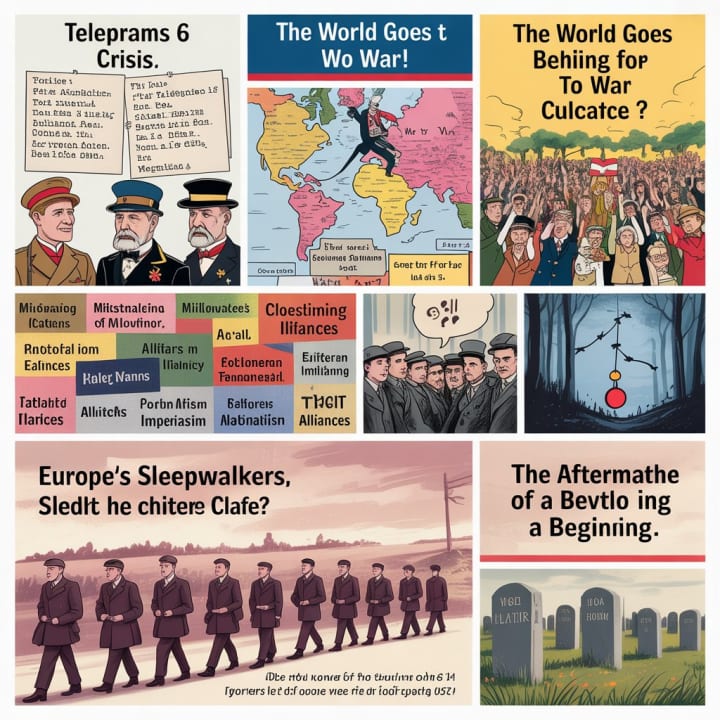
Historians agree the war had multiple, interconnected causes:
Militarism – The glorification of war and massive military build-ups made conflict seem inevitable and even desirable.
Alliances – What should have been a local war spiraled due to entangled treaties.
Imperialism – Competition for colonies and global dominance added tension.
Nationalism – Ethnic pride, hatred, and dreams of independence destabilized multi-ethnic empires.
Poor Leadership – Leaders underestimated the scope and consequences of war.
Inflexible War Plans – Once mobilizations began, the gears could not be stopped.
No single nation bore all the blame. But together, they created a system bound for disaster.
Epilogue: The War to End All Wars – Or the War That Made the 20th Century?
World War I lasted four years and claimed over 16 million lives. Empires fell—Germany, Austria-Hungary, the Ottomans, and Russia. New nations rose. Old grudges remained.
And the seeds of the next, even greater war, were sown in the peace that followed.
What began with a bullet in Sarajevo became a world shattered.
About the Creator
AFTAB KHAN
SUBSCRIBE ME AND READ STORY
Storyteller at heart, writing to inspire, inform, and spark conversation. Exploring ideas one word at a time.
Writing truths, weaving dreams — one story at a time.
From imagination to reality
Keep reading
More stories from AFTAB KHAN and writers in Earth and other communities.
"The Pendulum of Power: A Nation at the Crossroads"
By: [Aftab khan] Introduction In the autumn haze of November 2024, the United States stood once again at the edge of its political precipice. An election cycle marked by fierce rhetoric, shifting alliances, and generational divides had just concluded. For some, it marked a victory for progress. For others, it was the unraveling of a nation they no longer recognized. Beneath the surface of ballots and campaign slogans lay a deeper truth: America was no longer simply divided—it was fractured, recalibrating its identity in real-time.
By AFTAB KHAN6 months ago in Earth
US Lawmakers Arrive in Copenhagen to Counter Trump’s Greenland Threats
In a high-stakes diplomatic maneuver, a delegation of U.S. lawmakers recently arrived in Copenhagen to discuss Greenland’s future, aiming to counteract the aggressive rhetoric and territorial ambitions expressed by former President Donald Trump. The visit comes amid rising concerns over Greenland’s strategic importance in the Arctic and the implications of any unilateral moves by the United States. For Denmark, Greenland’s autonomous territory, the presence of U.S. lawmakers underscores both Washington’s interest in Arctic security and the need to maintain strong transatlantic ties. For the United States, the visit signals a delicate recalibration of policy following Trump’s controversial proposals regarding Greenland, including his infamous attempt to buy the island outright during his presidency. Why Greenland Matters Geopolitically Greenland is more than a frozen expanse of ice; it is a geopolitical prize. Strategically located between North America and Europe, Greenland is key to: Arctic shipping routes that are becoming increasingly navigable due to melting ice Natural resources, including rare earth minerals, oil, and gas reserves Military and surveillance installations, notably the Thule Air Base, which is critical to U.S. missile warning systems and space surveillance The Arctic region is warming faster than any other part of the planet, making Greenland both a resource hub and a potential flashpoint for international competition. Trump’s proposals had alarmed Denmark and other NATO allies, raising questions about the United States’ long-term commitment to respecting international norms and allied sovereignty. The Lawmakers’ Mission The delegation, composed of senators and representatives from both political parties, is tasked with: Reassuring Denmark that the U.S. government respects Greenland’s autonomy Discussing security cooperation, particularly regarding Arctic defense and NATO commitments Exploring economic partnerships that benefit Greenland while maintaining regional stability Officials emphasize that this visit is not about reversing Trump’s statements retroactively, but about ensuring that future U.S. policy reflects diplomatic consensus rather than unilateral ambition. Denmark’s Response Denmark has maintained a firm stance on Greenland’s sovereignty, consistently stating that the island is not for sale. Danish leaders have welcomed the U.S. delegation as a positive step toward strengthening trust and clarifying intentions. Copenhagen also hopes to use the opportunity to reinforce cooperative approaches to Arctic security, particularly in light of growing Russian and Chinese interest in the region. For Denmark, maintaining strong relations with the United States — while safeguarding Greenland’s autonomy — is a balancing act that requires careful diplomacy. Greenland’s Perspective Greenlanders themselves are increasingly vocal in the debate over their future. Many support greater economic independence and political autonomy, and local leaders insist that Greenlanders should have the final say over any decisions affecting their land and resources. The U.S. delegation’s visit highlights the need to consult Greenlandic authorities directly, rather than negotiating solely with Denmark. This approach is seen as a step toward more inclusive, respectful diplomacy, which acknowledges Greenland’s status as more than just a strategic asset. The Role of NATO and Transatlantic Relations Trump’s proposals regarding Greenland strained transatlantic relations, raising concerns among NATO members about the reliability of U.S. commitments. The arrival of bipartisan lawmakers in Copenhagen aims to reaffirm NATO solidarity and demonstrate that U.S. policy is consistent with alliance obligations. By engaging Denmark directly, Congress seeks to prevent miscommunication and maintain stability in a region that is increasingly vital for global security. Analysts note that Greenland’s location provides the United States with a critical vantage point for Arctic monitoring and missile defense, making cooperative relations essential. Global Implications The Greenland issue has broader consequences for international geopolitics and Arctic governance. Key points include: Resource security: Greenland’s rare earth minerals are essential for electronics, renewable energy, and defense technologies, making control and access highly strategic. Climate change and navigation: Melting ice is opening new shipping lanes, which could shift global trade patterns and increase competition for influence. Power dynamics in the Arctic: Russia and China have also shown growing interest in the Arctic, prompting the United States and Europe to strengthen alliances and prevent unilateral exploitation. The lawmakers’ visit signals to the international community that the U.S. is committed to diplomatic solutions rather than transactional or coercive strategies. Challenges Ahead Despite the visit’s diplomatic intent, challenges remain: Political polarization in the U.S.: Future administrations may have different approaches to Greenland, raising uncertainty about long-term commitments. Geopolitical competition: Russia and China continue to advance their presence in the Arctic, complicating cooperative efforts. Local autonomy: Greenlandic voices must be prioritized, or any policy may face resistance at the local level. Successfully navigating these challenges will require transparent dialogue, careful planning, and sustained international cooperation. The Path Forward The visit of U.S. lawmakers to Copenhagen is a cautionary and corrective measure. It signals that while Greenland is strategically important, it is not a bargaining chip. Future cooperation will likely focus on: Strengthening Arctic security frameworks Promoting economic development for Greenlanders Maintaining stability in U.S.-European relations Ensuring that Greenlandic voices remain central to decision-making This proactive approach reflects a broader understanding that diplomacy, not unilateral action, is essential in regions of high strategic value. Final Thoughts Greenland has moved from the margins of global attention to the forefront of geopolitical strategy and climate concern. The arrival of U.S. lawmakers in Copenhagen underscores the importance of measured, inclusive diplomacy in the Arctic, contrasting sharply with the impulsive rhetoric that characterized Trump’s Greenland proposals. As nations navigate the Arctic’s emerging opportunities and challenges, Greenland’s sovereignty and the voices of its people will remain central to regional stability, global security, and international cooperation. The lawmakers’ visit represents a step toward rebuilding trust, reinforcing alliances, and charting a sustainable path forward for one of the planet’s most strategically vital territories.
By Muhammad Hassan4 days ago in Earth



Comments
There are no comments for this story
Be the first to respond and start the conversation.