


The poetry of the cosmos is an ethereal dance of celestial bodies, each star, planet, and comet tracing verses in the vastness of the universe. It's a melody written in light, shaped by the infinite, and sung by the galaxies. The cosmos speaks in the language of physics, but for those attuned to its rhythm, it carries the poetry of creation, destruction, and rebirth.
The universe, in its magnificent expanse, tells stories older than time itself. Stars are born in the great clouds of gas and dust, their lives playing out as fiery sonnets that burn across the sky. They rise, shine, and eventually fall, creating supernovas that explode in dazzling bursts, only to leave behind remnants that form the seeds for new stars and planets. These celestial beings, in their brilliant cycles, are the verses that tell of beginnings, endings, and infinite possibilities. Their deaths are not tragic but are a necessary part of the cosmic cycle, like the conclusion of one poem that makes space for the creation of another.
Each galaxy is a stanza, each planet a word in this grand, universal sonnet. The rhythm of the cosmos is felt in the orbits of the planets, the steady pulse of pulsars, the quiet hum of black holes, and the fleeting trails of comets. It’s as if the entire universe is a poem written in an ancient script that we are still trying to decipher. We stand on Earth, gazing up at the stars, wondering about the meaning behind it all, as if seeking the hidden verses that connect us to the grand narrative.
The poetry of the cosmos is not confined to light years or the cold expanse of space—it is woven into the very fabric of our existence. Every atom in our bodies, every heartbeat, every breath we take carries the energy of the stars. We are stardust, formed from the remnants of ancient supernovae that scattered their seeds across the universe, and in this way, we are part of the eternal poem of the cosmos. It is a reminder that we are not separate from the universe, but deeply interconnected with it. Our existence is a verse in a poem that spans the beginning of time and stretches into the unknown future.
As the moon waxes and wanes, it speaks in subtle rhymes, casting shadows upon the Earth that shift with the passage of time. The tides rise and fall in harmony with its rhythm, a reminder that the universe has a steady pulse, a beat that moves not just the stars, but all things within it. The Earth itself, rotating on its axis, is a poetic metaphor for balance and movement, the dance between light and dark, day and night, summer and winter. It is a cycle that we witness every year, yet each time it feels as if we are witnessing it for the first time, as if the cosmos itself is constantly writing and rewriting its verses.
Beyond the visible stars, there are the invisible forces that shape our universe: gravity, dark matter, dark energy. They are the unseen ink of the cosmic poem, giving form and direction to the galaxies, stars, and planets. We may not fully understand them, but their presence is undeniable. These invisible forces remind us that the true beauty of the cosmos lies not only in what we can see but in what we cannot yet comprehend. The vastness of the unknown is itself a line in the poem, a line that keeps unfolding, expanding, and inviting us to explore deeper.
In the silence of space, the poetry of the cosmos calls to us, urging us to look beyond the physical world and discover the deeper meanings embedded in the stars. It is a reminder that we are part of something much greater than ourselves, that our lives are but brief moments in the unfolding poem of the universe. And yet, in these moments, we find meaning, beauty, and connection to the infinite.
The poetry of the cosmos is not just a work of art; it is a reflection of existence itself. It is a celebration of life, of time, of change, and of the constant mystery that surrounds us. As we look up at the stars, we are reading the verses of a poem that has no end, only an eternal unfolding. Each of us, in our own way, is a line in that poem, and together, we create a cosmic symphony—a song of life that echoes through the universe for all eternity.
About the Creator
Badhan Sen
Myself Badhan, I am a professional writer.I like to share some stories with my friends.
Keep reading
More stories from Badhan Sen and writers in Earth and other communities.
Science & Technology
Science and technology are the driving forces behind the rapid changes in our world. From the early days of humanity, where fire and the wheel shaped civilizations, to the cutting-edge advancements in fields like artificial intelligence, quantum computing, and genetic engineering, the relationship between science and technology continues to transform how we live, work, and interact with our environment. This dynamic duo holds the potential to solve some of humanity's most pressing challenges, while also presenting new questions and ethical dilemmas. Let's take a closer look at some key areas of progress.
By Badhan Sen11 months ago in Earth
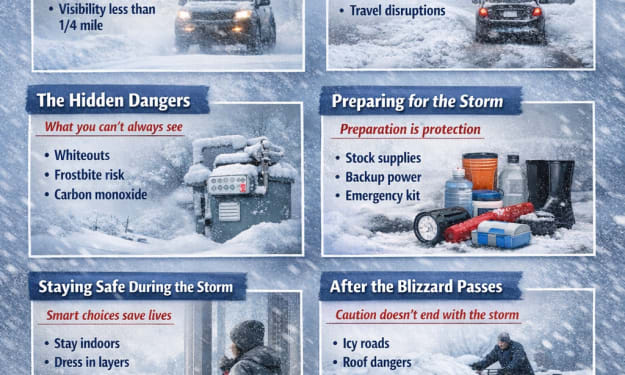
Blizzard Warning. When Winter Turns Dangerous
What Is a Blizzard Warning? Not just snow, but a storm A blizzard warning is issued when heavy snowfall combines with powerful winds, creating near-zero visibility and dangerously cold temperatures. These conditions can last for several hours or even days. Unlike a simple snowstorm, a blizzard doesn’t only cover the ground in white—it creates chaos. Meteorologists usually declare a blizzard warning when winds reach at least 35 miles per hour and visibility drops below a quarter of a mile due to blowing snow. These storms are often accompanied by freezing temperatures, making frostbite and hypothermia serious risks.
By Hamd Ullah2 days ago in Earth
My New Book is Finally Here
My poetry collection Beautiful and Brutal Things is done. It's actually done and finally published over 270 pages. Over a year of my life went into this book. More than a year, really. Long days at my computer, sometimes seven days a week because I couldn't stop even when I probably should have. Then two months of editing that felt harder than the writing itself. But it's finished, and I'm still standing, and the book is real.
By Tim Carmichael6 days ago in BookClub



Comments
There are no comments for this story
Be the first to respond and start the conversation.