

1. The Vanishing
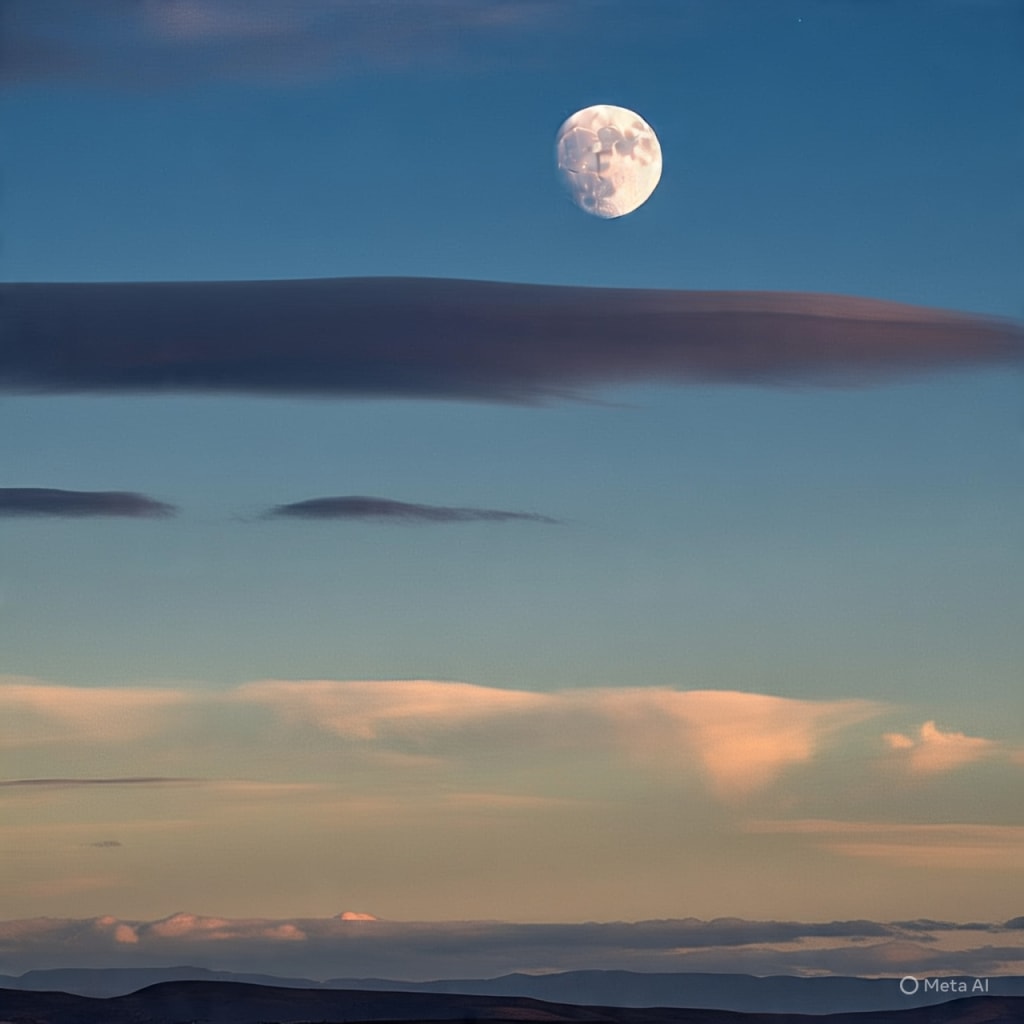
No one saw it happen. One moment the Moon hung full and silver above the horizon; the next, it was gone—without a sound, without a flash, without even the courtesy of a farewell glimmer. Just… vanished.
For the first few minutes, humanity didn’t notice. City lights glared too brightly, lovers kissed under neon signs, and astronomers assumed it was a freak cloud cover. But then the panic spread across the globe like wildfire as observatories confirmed the impossible.
"The Moon is missing," a trembling voice said during the emergency press conference. "It’s… it’s no longer in orbit."
Across continents, people stared upward at the empty sky where the Moon had always been. The darkness looked deeper. Emptier. As if something essential had been torn out of the sky—and out of us.
2. Earth Trembles
The effects were not immediate, but they came faster than anyone anticipated. The tides were the first to misbehave. Normally predictable waves rose erratically, flooding coastlines that had never seen such sudden surges. Ports were swallowed, and fishers found themselves adrift in waters that pulled and twisted in unnatural ways.
Then came the instability.
Without the Moon’s stabilizing gravitational pull, Earth’s axial tilt began to wobble. Not wildly—not yet—but enough to send scientists into a frenzy. Weather patterns grew unpredictable, with winter suddenly bleeding into what should have been summer in the Southern Hemisphere. Ocean currents shifted, displacing warm water in places used to the cold, and vice versa.
In coastal villages, elders whispered of ancient legends—tales from long before science, of gods who had once thrown the Moon into the sky to calm the Earth’s rage. Perhaps the gods had taken it back.
"Humanity was never meant to be without the Moon," one Inuit elder told a Canadian reporter. "It is the Earth’s heart in the sky."
3. In the Absence of Light
The psychological toll followed soon after.
Night became oppressive. It wasn’t merely dark; it was hollow. The kind of darkness that pressed against windows and whispered through cracks in doors. Crime rose sharply in urban areas. Emergency services were overwhelmed. Cities that had already battled with insomnia now found their people even more restless, disturbed by the unnatural stillness of moonless nights.
In the countryside, animals reacted in strange ways. Wolves howled endlessly, confused by the absence of their celestial companion. Birds failed to navigate, flying in erratic loops or crashing into mountains. Sea turtles, emerging to nest on beaches, were disoriented by the moonless tides and laid their eggs in fatal zones.
And humans, too, grew strange. Therapists and mental health professionals noted a spike in anxiety, disassociation, and paranoia. Some claimed they could feel something watching from the sky, as if the space once occupied by the Moon now served as a portal for something else—something unknowable.
Religious groups declared the disappearance a sign of the apocalypse. Others saw opportunity: cults began to form, worshiping the darkness, claiming the Moon had been taken as punishment or as a test.
4. Whispers in the Dark
In a mountain observatory in Chile, a group of scientists ran simulations. They tried to predict Earth’s long-term future without the Moon. What they found chilled them.
Without the Moon’s pull, Earth’s tilt could fluctuate by as much as 45 degrees over the next few thousand years—enough to destabilize the climate beyond recognition. Ice ages could come and go in decades instead of millennia. Seasons would warp. Ecosystems would fail. Humanity would need to adapt faster than biology could manage.
Worse still, Earth's rotation had already begun to change. Without the Moon’s gravitational drag, days were growing slightly shorter. Not enough to notice—yet. But in a few years, the difference could be felt in the body, in the mind. Circadian rhythms would break down. Sleep disorders would increase. Jet lag would become permanent.
And then there were the whispers—literal ones.
Radio astronomers monitoring deep space frequencies began picking up an odd signal shortly after the Moon vanished. It wasn’t alien in the sci-fi sense, but it was… patterned. Some argued it was background radiation warped by the Moon's absence. Others suggested it had always been there—just masked by the Moon’s presence.
Or perhaps, as one fringe researcher speculated, the Moon wasn’t just a celestial body. Perhaps it was a shield.
And now it was gone.
5. The Beginning or the End
Governments initiated programs. Artificial satellites were proposed to replicate the Moon’s gravitational influence. Giant orbital reflectors were designed to bring soft light to the darkest hours. But none could replace the intricate role the Moon played in Earth’s delicate balance.
Children born after the disappearance would grow up without ever seeing a full Moon. Poets and songwriters mourned. Nighttime festivals faded. The old myths felt more like truths now.
Yet amid the fear and instability, something else began to take root: resilience.
Communities found new ways to organize, adapting to the erratic tides and twisted seasons. Farmers became meteorologists, reading subtle clues in wind and cloud to guess at the new rhythms of the planet. Art flourished—not in defiance, but in remembrance. Painters filled canvases with their memories of the Moon. Musicians wrote haunting lullabies for an absent satellite.
And on a quiet night, in a garden where moonflowers refused to bloom, a little girl asked her grandmother, “Where did it go?”
The woman looked up at the blank sky, eyes wet with memory. “Maybe it went home,” she said. “Maybe it got tired of watching us forget how lucky we were.”
The girl didn’t respond. She only stared upward, as if willing something to return.
Epilogue
Years passed. Humanity endured. The planet groaned under the strain, but it held—bent but not broken.
Then, on a night like any other, without fanfare or warning, a silver sliver appeared on the horizon. Tiny, perfect, unmistakable.
The Moon was back.
No one knew how. No one dared to ask why.
Some fell to their knees and wept. Others held their breath, unsure if it was real. Scientists were baffled, their models shattered.
But in every corner of Earth, people looked up in awe. For the first time in years, the night didn’t feel so hollow. It felt complete. Whole.
Whether it had left to remind us of something, or to protect us from something worse, no one could say. But everyone knew one thing:
We would never take it for granted again.
About the Creator
Julia Christa
Passionate writer sharing powerful stories & ideas. Enjoy my work? Hit **subscribe** to support and stay updated. Your subscription fuels my creativity—let's grow together on Vocal! ✍️📖
Keep reading
More stories from Julia Christa and writers in Earth and other communities.
Romance in university
Chapter One: The First Hello The University of Lagos bustled with life—lecturers’ footsteps echoing down corridors, debates spilling from classrooms, and friendships blooming in sunlit courtyards. Among the noise, Seyi thrived in his quiet bubble. A second-year philosophy student, Seyi was known more for his thoughtful essays than for conversation. He often sat alone in class, headphones in but rarely playing music, just buffering the world.
By Julia Christa7 months ago in Fiction
Man Shot Dead by Police After Aiming Bow and Arrow at Officers
A man has been shot dead by police after allegedly aiming a bow and arrow at officers, authorities have confirmed. The fatal encounter has triggered public debate over police use of force, crisis response protocols, and how law enforcement handles situations involving unconventional weapons.
By Aarif Lashari3 days ago in Earth



Comments
There are no comments for this story
Be the first to respond and start the conversation.