
The Moon: A Mysterious Companion
Recent studies have found frozen water in the Moon

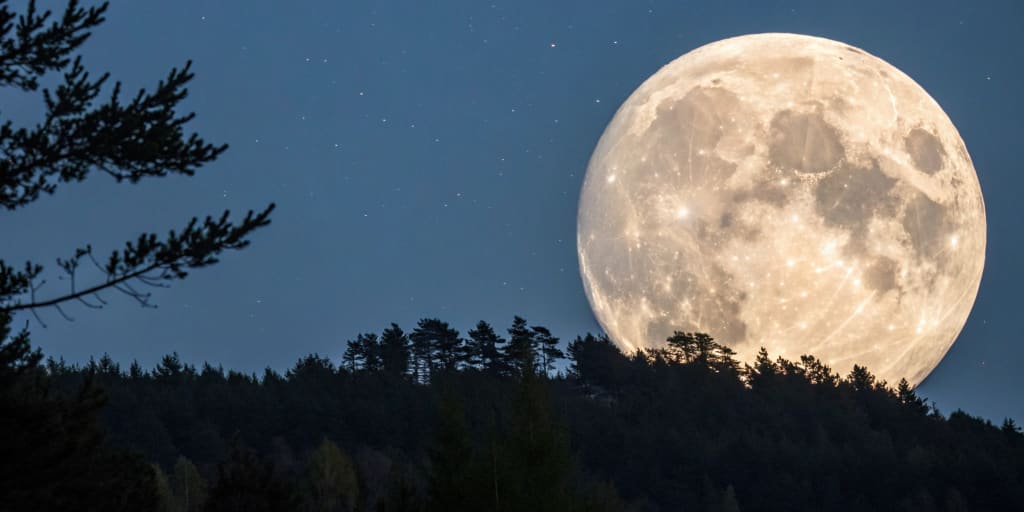
The Moon—one of the most familiar and captivating objects in the night sky. Since childhood, we’ve heard countless stories, poems, and songs inspired by it. However, the Moon is not just a subject of imagination; it is a scientific wonder as well. Every fact we learn about the Moon opens a new door to understanding space. In this article, we’ll explore the Moon’s formation, history, scientific features, and modern research related to it.
Origin and Structure of the Moon
Scientists believe that the Moon was formed about 4.5 billion years ago. The "Giant Impact Hypothesis" is the theory that is generally accepted. According to this theory, a Mars-sized celestial body named Theia collided with the early Earth. The debris from this massive impact eventually came together to form the Moon.
The Moon has three main layers—core, mantle, and crust. Its core is composed of iron, though it is not as active as Earth's. The crust primarily contains oxygen, silicon, magnesium, iron, and calcium.
Scientific Features of the Moon
Diameter and Distance:
The Moon’s diameter is about 3,474 km, which is roughly one-fourth the size of Earth. The average distance between the Earth and the Moon is around 384,400 km.
Light and Brightness:
The Moon doesn’t have its own light. Actually, sunlight reflected off the Moon's surface is what we see as light. Gravitational Force:
The Moon’s gravity is about 1/6th of Earth’s. That means if you weigh 60 kg on Earth, you would weigh only 10 kg on the Moon!
Air and Water:
There is no dense atmosphere on the Moon. However, recent studies have found frozen water in the Moon’s polar regions. This discovery is crucial for future space missions.
Human Exploration of the Moon
Humans have been fascinated by the Moon for centuries. However, on July 20, 1969, history was made when Neil Armstrong became the first human to walk on the Moon during NASA’s Apollo 11 mission. His famous words were:
“That's one small step for man, one giant leap for mankind.”
After that, a total of 12 astronauts landed on the Moon between 1969 and 1972. No human has visited since then, but efforts are ongoing.
Modern Research and Future Plans
Currently, organizations from China and Japan as well as NASA, ESA, ISRO—India's space agency—are actively researching the Moon. NASA’s Artemis Mission aims to send humans back to the Moon by 2026.
India’s Chandrayaan-3 made history by successfully landing near the Moon’s south pole.
There are also plans to build a "Moon Base" in the future where astronauts can live, conduct research, and prepare for deeper space missions—like those to Mars.
Impact and Importance of the Moon
The Moon is not just a beautiful object in the sky; it plays a vital role in our lives. Its gravitational pull is responsible for the tides on Earth. Our calendars, religious events, and even agricultural cycles are all regulated by the Moon. Conclusion
Our closest celestial neighbor is the Moon. Its beauty touches our hearts, and its scientific significance sparks our curiosity. Research on the Moon is guiding us toward future advancements in technology, energy, and space exploration. Let our love and curiosity for the Moon grow alongside our scientific understanding—because the Moon has much more to teach us.
About the Creator
Fahim Rahman
I write to ignite thought and emotion. From immersive fiction that transports readers to new worlds, to sharply crafted essays and informative pieces that unpack real-life complexities.
Keep reading
More stories from Fahim Rahman and writers in Earth and other communities.
"The Reflection"
Emma had just moved into the old Victorian house on the outskirts of Raven Hollow. It was cheap, too cheap for its size. Her friends warned her about the town’s rumors: disappearances, strange lights in the woods, and "the house that watches." But she didn’t believe in ghosts.
By Fahim Rahman9 months ago in Horror
Australia Horticulture Market: Climate-Smart Farming, Innovation & Food Security
Australia Horticulture Market Overview Australia’s horticulture market plays a vital role in the nation’s food system, rural economy and export portfolio. According to IMARC Group, The Australia horticulture market size reached USD 20.2 Billion in 2025. Looking forward, the market is projected to reach USD 33.4 Billion by 2034, exhibiting a growth rate (CAGR) of 5.75% during 2026-2034. This steady growth reflects rising domestic demand for fresh produce, expanding export opportunities, and increased investment in climate-resilient and sustainable farming practices.
By Amyra Singh7 days ago in Earth




Comments
There are no comments for this story
Be the first to respond and start the conversation.