
The Marvels of Our Interconnected Oceans: Exploring the Mysteries of the Deep
Why the Atlantic and Pacific ocean refuse to merge
Introduction
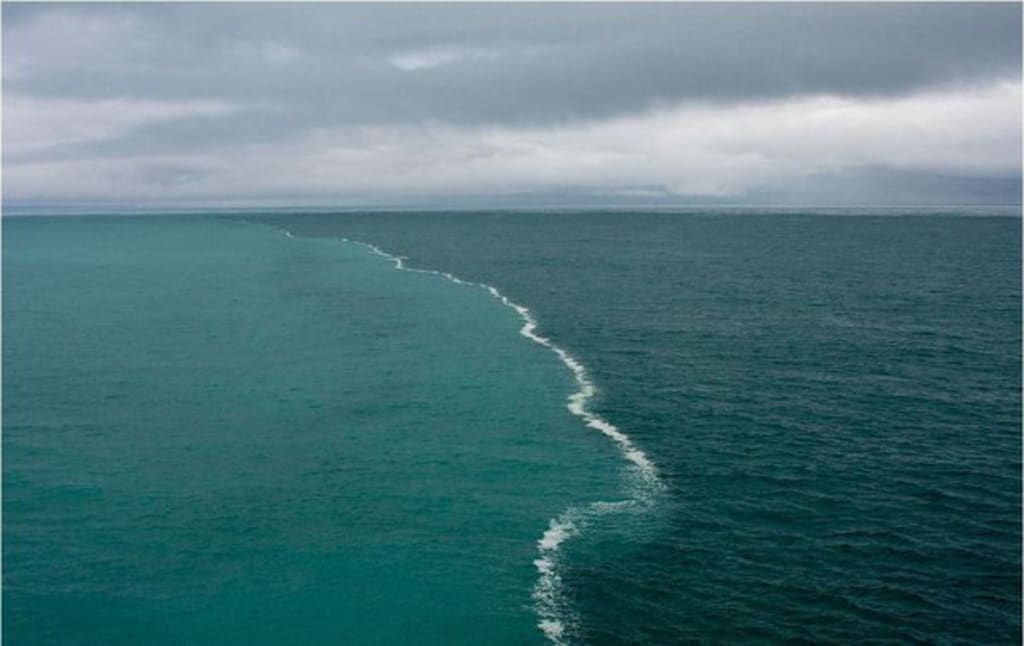
Have you ever seen those captivating images of ships sailing through a peculiar line of water where one side appears dark blue and clear while the other side is greenish and salty-looking? Some have claimed that these footage show the boundaries between oceans, suggesting that water defies its own laws by not mixing well. However, the truth is far more fascinating.
Our planet is predominantly covered by water, with over 70 percent of its surface engulfed in H2O. Two of the largest bodies of water, the Pacific and Atlantic Oceans, are constantly mixing and mingling, regardless of the borders we've drawn on our maps. Let's dive into the interconnected nature of these oceans and explore their unique characteristics.
The Pacific and Atlantic Oceans: A Never-ending Dance Party
While the Pacific Ocean takes the crown as the largest and deepest ocean on the planet, surpassing even the Grand Canyon in depth, the Atlantic Ocean holds its ground as the second-largest. Each ocean possesses its distinct set of characteristics. For instance, the salinity of the Atlantic Ocean is higher compared to the Pacific and Indian Oceans. Furthermore, the Red Sea and the Mediterranean are even saltier due to the limited flow of lower salinity waters from the deep sea and faster evaporation rates than rainfall.
Cape Horn: Where the Pacific and Atlantic Meet
Located at the southernmost tip of South America, Cape Horn serves as the meeting point of the Pacific and Atlantic Oceans. It is also the site of a powerful current that transports water from west to east, displacing volumes from the Pacific into the Atlantic. Navigating around Cape Horn is notoriously treacherous, and countless brave sailors have faced the dangers of this turbulent voyage.
The Two-toned Ocean Illusion: A Closer Look
You might have come across images or videos showing two differently colored types of water seemingly existing side by side. However, this phenomenon does not indicate the collision between the Pacific and Atlantic Oceans. In reality, it is caused by fresh water filled with sediment encountering dark, salty water from the ocean.
The Colors of the Ocean: A Symphony of Hues
The ocean's diverse shades of blue have captivated human imagination for centuries. In truth, the water that covers our planet is clear. The perception of blue color arises when the water is deep enough that light isn't reflected off the bottom. Sunlight can be absorbed or reflected by water molecules as it enters the ocean, scattering shorter wavelengths and giving the ocean its blue color. The longer wavelengths, on the other hand, are absorbed closer to the surface. Additionally, the color of the ocean can be influenced by the bottom's particles, such as white sand or rocks, creating stunning turquoise hues in specific areas.
Ocean Health and Phytoplankton: A Delicate Balance
The health of the ocean can be observed through its color. Suspended particles, contaminants, and tiny organisms contribute to the ocean's hues, resembling a doctor examining a patient's vital signs. One crucial element in the ocean's color palette is phytoplankton. These microscopic plants, powered by chlorophyll and sunlight, make up about half of the oxygen needed on our planet.
Unveiling the Underwater Mysteries
While we have made significant progress in mapping the sea floor, with approximately 20 percent mapped using high-tech sonar systems, there is still much left to explore. Scientists estimate that the ocean may house up to a million different species, with the majority yet to be discovered. The ocean continues to hold its mysteries, awaiting our curiosity and exploration.
Conclusion
The interconnectedness of our oceans is a marvel to behold. The Pacific and Atlantic Oceans, along with their unique characteristics, dance and mingle, defying the imaginary boundaries we impose. The two-toned ocean illusion, the myriad shades of blue, and the unseen wonders of the deep are all reminders of the vastness and intricacy of our planet's water systems. As we continue to unravel the secrets of the ocean, let us embrace the opportunity to explore and protect these awe-inspiring realms that hold the key to our planet's health and future.
About the Creator
Keep reading
More stories from Loyal Kenneth and writers in Earth and other communities.
Unraveling the Mysteries: Did Nikola Tesla Discover the Secrets of the Great Pyramids?
Introduction: Nikola Tesla, the brilliant inventor and electrical engineer, is renowned for his groundbreaking contributions to technology. While many are familiar with Tesla's remarkable achievements, such as his work on alternating current and wireless transmission of electricity, few may know about his fascination with the ancient wonders of the world. In particular, Tesla believed that the Great Pyramids of Egypt held hidden secrets, and he dedicated considerable time and effort to unraveling the mysteries surrounding these ancient structures. In this article, we will explore Tesla's theories and their impact on our understanding of the pyramids.
By Loyal Kenneth3 years ago in Earth
the largest fire in Poland in the 21st century
A fire that for several days turned the largest national park into a scorched wasteland Spring 2020 in Biebrza National Park was supposed to look like it does every year. Vast marshes and peat bogs were beginning to revive after winter, and the Biebrza Valley was filling with the sounds of birds returning to breed. This unique area, considered one of the most valuable natural regions in Europe, suddenly became the scene of the largest fire in Poland in the 21st century. The fire, which broke out in April, consumed thousands of hectares of protected nature and left behind a landscape of devastation.
By Pożarnictwo a day ago in Earth
I Spoke to Astrophysicists About Starlink’s Expansion: The Doomsday Scenario Keeping Them Up at Night
SpaceX’s Starlink project has captured headlines for its ambitious goal: provide high-speed internet across the globe by deploying thousands of low-Earth orbit satellites. While the idea of connecting remote communities is exciting, astrophysicists and space experts are sounding the alarm about a growing doomsday scenario that could threaten both space exploration and our ability to observe the night sky. After speaking to several astrophysicists, it’s clear that Starlink’s expansion, if unchecked, could dramatically alter Earth's orbital environment, disrupt astronomical observations, and even increase the risk of space debris collisions. Here’s what experts are warning the public about. The Scale of Starlink’s Expansion As of now, SpaceX has launched over 4,000 Starlink satellites, with plans to deploy tens of thousands more in the coming years. Each satellite orbits at altitudes between 340 km and 1,200 km, which places them in the low-Earth orbit region used by countless other satellites and scientific missions. Astrophysicists point out that this rapid proliferation is unprecedented. Dr. Lisa Montez, an astronomer specializing in satellite impacts on optical telescopes, told me, “We are looking at a situation where the density of satellites is increasing faster than anyone has fully planned for. This is uncharted territory.” The problem isn’t just the sheer number of satellites—it’s the concentration in specific orbital bands, which makes collisions more likely and complicates orbital management. The Night Sky Is at Risk For centuries, humanity has marveled at the stars, studying the cosmos to better understand our place in the universe. But astrophysicists warn that Starlink is dramatically altering the night sky, making it more challenging to conduct research and enjoy unpolluted stargazing. Every time a telescope captures an image, the reflective surfaces of Starlink satellites can leave streaks of light, masking or distorting the data. “Even a single bright satellite passing through a telescope’s field of view can ruin an entire night of observation,” Dr. Montez explains. Observatories around the world are already noticing the impact. The Vera C. Rubin Observatory in Chile, set to be one of the most advanced facilities for studying dark matter and the evolution of galaxies, may see thousands of Starlink satellites crossing its field of view nightly, potentially reducing the quality of its data and increasing processing costs. The Doomsday Scenario: Space Debris Beyond observations, astrophysicists are increasingly concerned about space debris, which could trigger a cascading chain reaction known as Kessler Syndrome. This occurs when collisions between satellites produce debris that then hits other satellites, creating more debris in an accelerating feedback loop. Professor Rajesh Patel, a space environment specialist, told me, “If a few hundred Starlink satellites collide, it could create tens of thousands of fragments. That would threaten other satellites, international space missions, and even human spaceflight.” Space debris doesn’t just float harmlessly—it travels at speeds over 28,000 km/h, enough to destroy functional satellites or damage spacecraft. With tens of thousands of Starlink satellites planned, the potential for catastrophic collisions is growing, especially since low-Earth orbit is already crowded. Mitigation Efforts and Controversies SpaceX has acknowledged these concerns and claims to implement collision avoidance protocols, using automated systems to maneuver satellites out of harm’s way. The company also plans for satellites to deorbit at the end of their lifespan, burning up in the atmosphere. However, experts argue that these measures may not be enough. Automated systems can fail, and human error or unexpected orbital dynamics could still lead to accidents. Furthermore, the sheer number of satellites makes it difficult to track and manage each one effectively, particularly as other private companies and nations plan similar mega-constellations. Dr. Montez adds, “Even if every satellite works perfectly, the night sky is already changing. The aesthetic and scientific impacts are immediate, whereas collision risks are looming but potentially devastating.” Broader Implications for Humanity The expansion of Starlink raises ethical and regulatory questions. Who has the right to fill low-Earth orbit? How much impact on astronomy and scientific research is acceptable for the sake of global internet coverage? International regulatory bodies like the United Nations Office for Outer Space Affairs (UNOOSA) and the Federal Communications Commission (FCC) have some oversight, but critics argue that global coordination is lagging behind corporate launches. Without international agreements and enforceable regulations, the sky could become a congested and hazardous environment, impacting both science and commerce. Astrophysicists emphasize that this isn’t just a matter of aesthetics. The ability to observe celestial phenomena affects climate science, space weather monitoring, and tracking near-Earth objects. If observations are increasingly compromised, our understanding of Earth and space could suffer. What Can Be Done? Experts suggest several strategies to mitigate risks: International Coordination: Global treaties or agreements to regulate satellite density and orbital placement. Reflectivity Reduction: Coating satellites to reduce brightness and their impact on telescopes. Enhanced Tracking Systems: Better monitoring of orbital debris and automated collision avoidance. Selective Deployment: Careful planning to avoid overcrowding specific orbital bands. While SpaceX is implementing some of these solutions, astrophysicists argue that industry self-regulation is insufficient. They advocate for a coordinated international approach to protect both scientific research and long-term orbital sustainability. Conclusion The expansion of Starlink represents a remarkable technological achievement, promising global internet access and unprecedented connectivity. Yet it also highlights the unintended consequences of space commercialization, including the potential for a cluttered sky, disrupted astronomy, and catastrophic space debris collisions. Astrophysicists remain vigilant. They warn that without careful oversight, humanity could face a doomsday scenario in low-Earth orbit, jeopardizing scientific discovery and space safety for generations. As we continue to celebrate innovations like Starlink, it’s crucial to remember that the sky belongs to all of us—scientists, enthusiasts, and everyday observers alike. Balancing technological progress with environmental stewardship of space may be one of the most critical challenges of the 21st century.
By Muhammad Hassan3 days ago in Earth



Comments
There are no comments for this story
Be the first to respond and start the conversation.