
The Last Song of the Amazon
A Journey into the Heart of a Dying Forest

The air was thick, heavy with the scent of damp earth and unseen life. Elena adjusted her backpack and stared upward at the canopy that seemed to swallow the sky. Here, in the depths of the Amazon, sunlight was a rare visitor, only breaking through in narrow golden shafts that illuminated drifting particles of mist and pollen.
The Amazon wasn’t silent. It was alive in a way no city could ever be. Frogs croaked in hidden pools, cicadas whined in a steady rhythm, and distant birds called out in a chaotic harmony. To most, it was noise. To Elena, an ornithologist who had spent her life studying birdsong, it was music.
But she hadn’t come for the usual symphony. She had come chasing a legend—the Bird of the Last Dawn.
It was said to sing only when the forest itself was in peril. No photograph existed, no official record. Some dismissed it as folklore whispered by shamans and passed through generations. But Elena believed legends often held truths waiting to be uncovered.
Her guide, Joao, was a wiry old man with eyes as sharp as a hawk’s. He had lived in the forest his entire life, watching it change, shrink, and bleed from the steady advance of human greed. His machete swung methodically as they carved a path through vines and undergrowth.
“People don’t come back the same,” Joao said one evening as they rested by the fire. His Portuguese carried the weight of sorrow. “This forest… it changes you. Or it takes you.”
Elena smiled faintly, trying to mask her unease. “Then I hope it changes me.”
For three days, they trekked deeper. Elena recorded the guttural calls of howler monkeys, the hiss of hidden snakes sliding through the underbrush, and the hypnotic tapping of woodpeckers. She filled her journal with notes, sketches, and observations. But at night, the atmosphere shifted.
The forest, so loud in the day, grew oppressively quiet after dusk. The usual chorus of frogs and insects dimmed until only the crackle of the campfire remained. It was as if the trees themselves were listening, holding their breath.
On the fourth night, it happened.
Elena woke to a sound unlike any she had ever heard. A song so hauntingly beautiful it seemed woven from grief itself. It wasn’t loud, but it pierced the silence, rising and falling with aching clarity. Her chest tightened, and tears sprang to her eyes before she understood why.
Joao stirred and froze. His expression hardened. “It sings,” he whispered, almost fearful. “It sings because it knows.”
They rose at dawn, following the sound. The journey took them beyond Joao’s familiar trails, into a place scarred by human hands. Trees lay fallen like corpses, their roots exposed to the blistering sun. The scent of charred wood lingered where fire had chewed through the land. Chainsaw marks scarred trunks, and the once-lush jungle lay open and wounded.
Elena’s heart sank. This was the edge of deforestation, a battlefield between greed and life.
And then she saw it.
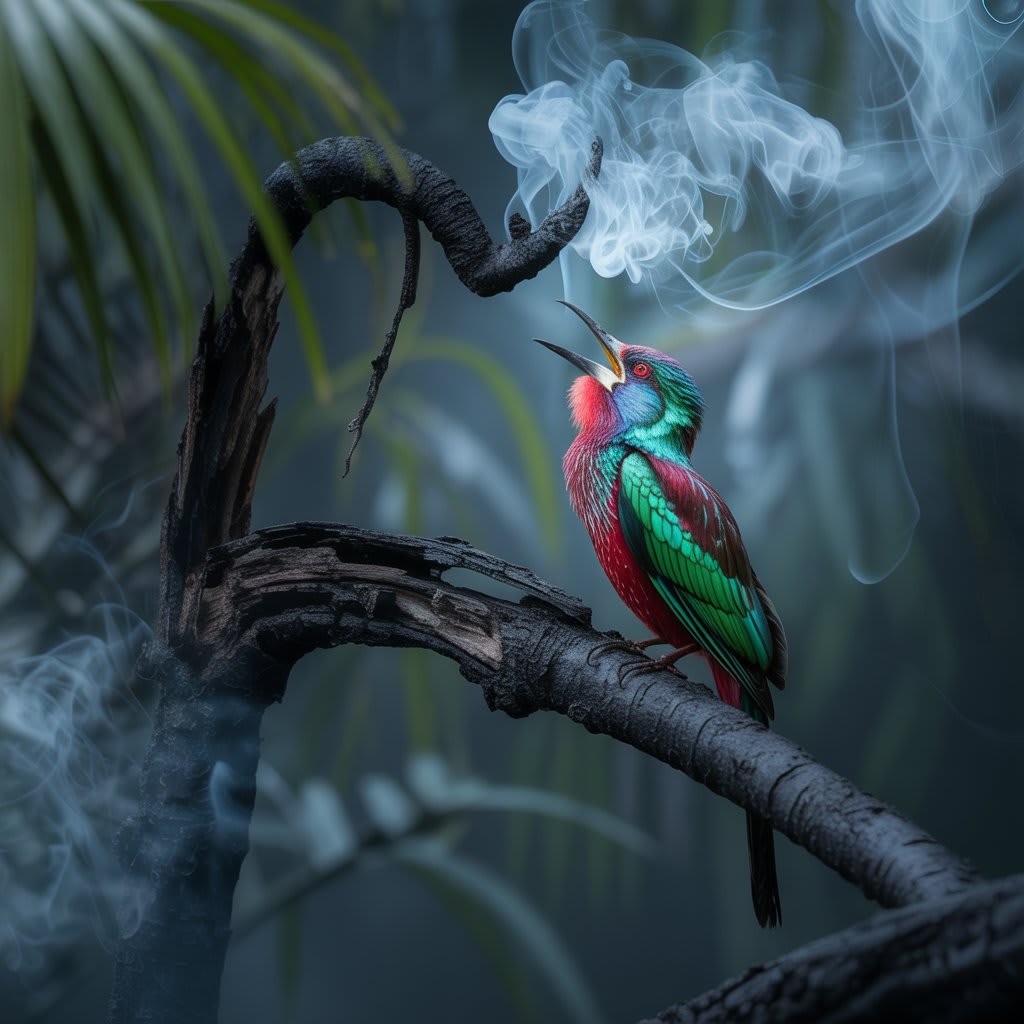
Perched on a lone surviving branch was a bird unlike any she had ever documented. Its feathers shimmered with emerald, gold, and crimson, glowing as if lit from within. Its small frame seemed fragile against the devastation around it. But when it sang again, its voice carried the weight of an ancient sorrow, echoing across the broken forest.
Elena’s hands trembled as she lifted her recorder. Every instinct told her this was the discovery of a lifetime—the kind that could make careers and rewrite scientific journals. But as the bird’s song reached her ears again, she lowered the device.
This was not a discovery meant to be caged by science. This was a plea.
She turned to Joao, whose face was lined with grief. “How long… has it been singing?” she asked.
“Only when the forest suffers,” he replied. “When the chainsaws come, when the fires burn. It is the forest’s voice. A warning. A cry for help.”
They stayed until dusk, listening. Each note seemed to carve itself into Elena’s heart, and she realized she would never hear anything more important in her lifetime.
When she returned to the city, Elena made a choice. She didn’t send the recording to journals or universities. Instead, she played it for schools, communities, and activists. She carried the story with her, telling it not as a scientist but as a witness.
Children wept. Politicians shifted uneasily. Strangers, who had never cared for the Amazon, suddenly felt its loss. The song spread, not as evidence, but as a story that touched something raw and human.
The Bird of the Last Dawn was never photographed, never captured, never caged. Some doubted it existed at all. But Elena knew. She had heard the forest sing.
And perhaps, just perhaps, if enough people listened, the song would not be its last.
About the Creator
Umar Ali
i'm a passionate storyteller who loves writing about everday life, human emotions,and creative ideas. i believe stories can inspire, and connect us all.
Half of World’s CO2 Emissions Come From Just 32 Fossil Fuel Firms, Study Shows
A groundbreaking new study has revealed that 32 fossil fuel companies are responsible for half of global carbon dioxide emissions since the industrial era began. The findings highlight the outsized influence of major oil, gas, and coal producers on climate change, and raise urgent questions about accountability, regulation, and the transition to cleaner energy.
By Aarif Lashari6 days ago in Earth
“Do Not Copy This Site’s Content”: Why Originality Matters More Than Ever in the Digital Age
“Do not copy this site’s content.” It’s a warning most internet users have seen countless times, often at the bottom of webpages or buried in terms and conditions. Many scroll past it without a second thought. But in today’s digital world, that simple sentence carries far more weight than people realize.
By Muhammad Hassan2 days ago in Earth




Comments
There are no comments for this story
Be the first to respond and start the conversation.