
The Last Flash of Mankind
When the Light Came, We Closed Our Eyes Forever

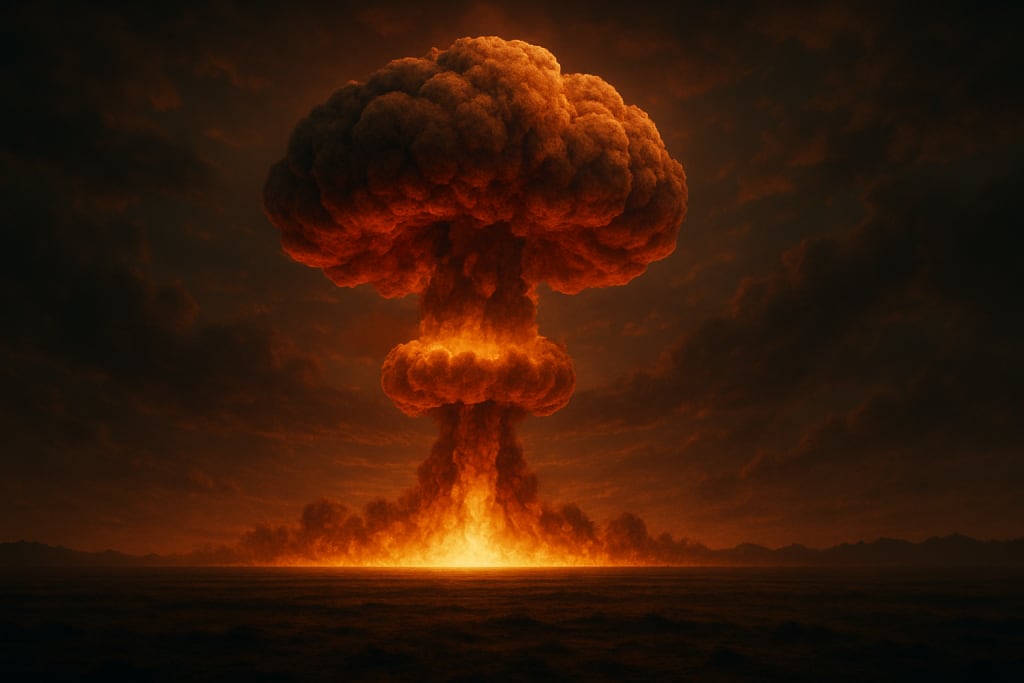
I. The Hour Before
The world didn’t end with a scream.
It ended in a moment of unnatural beauty.
In the New Mexico desert, at a site known only by coordinates, the final preparations were underway. The sand was still cool underfoot, the air thin with anticipation. The bomb sat silent — not yet alive, but humming with potential like a beast asleep.
Dr. Eliot Ravner checked his pocket watch. 5:19 a.m.
Ten minutes until the test. Ten minutes until humankind stepped across a line it could never return from.
He turned to look at the others. They were scientists, soldiers, engineers. Many were barely past thirty. All were exhausted. Some shook hands nervously, others smoked. No one spoke about what they were really about to do.
They had debated whether it would ignite the atmosphere, burn the oxygen, tear a hole into the quantum fabric of reality. But they went ahead anyway. Because humanity always asked, "Can we?" and rarely paused at "Should we?"
Dr. Ravner glanced once more at the metal sphere beneath the tower.
“I’ve done this,” he whispered to himself, not proudly.
---
II. Ground Zero, Miles Away
In the nearby town of Los Trigos, Hana Alvarez stirred awake to her brother tugging at her sleeve. His face was lit with curiosity.
“Hana,” he whispered. “Look. The stars are shaking.”
She rubbed her eyes. The windows shimmered faintly. There was a stillness outside — not silence, but something deeper. The wind had stopped. The trees no longer moved.
Their mother was boiling water in the kitchen. She paused, looking up at the ceiling like she heard something none of them could.
A minute later, the ground trembled.
Not violently — but with purpose, like a warning.
And then, over the mountains, came the flash.
---
III. The Flash
At 5:29:45 a.m., the sky tore open.
It wasn’t lightning. It wasn’t fire. It was a second sun, blooming in an instant. White at its core, then gold, then red. It seared the horizon, casting shadows behind rocks and people alike. Skin burned in places no heat should’ve touched.
Animals dropped dead before they could flee. The nearby cactus fields turned to glass.
And then came the sound.
A wall of noise — miles wide and godless. It knocked men off their feet and shattered windows in towns they hadn’t even mapped.
In the observation post, the ground shook with such force that dust rained from the ceiling. One of the junior engineers vomited. Another dropped to their knees.
Dr. Ravner didn’t flinch.
He stared into the glow and muttered, “We’ve split the world in two.”
---
IV. Aftermath
For days, the desert smoked.
The cloud loomed above like a reminder — a finger pointed at the heavens, accusing them of watching.
Radiation crept outward, invisible and unforgiving. Plants wilted. Birds vanished. Men stationed too close to the site began coughing up blood within weeks. Their hair fell out in clumps.
No one was allowed to speak about what had happened.
The government called it a success. The military called it security. The scientists… didn’t call it anything. Some resigned. Some vanished into their research. A few ended their lives.
Dr. Ravner stayed.
He locked himself in the underground archive, reviewing data, watching the footage, listening to the geiger counters ticking like a funeral bell.
He wrote in his journal:
> “We mistook a fuse for a lamp. And now the hallway is burning.”
---
V. Years Later
It didn’t stop with one bomb.
Once the world saw what it could do, it became a race. Hiroshima. Nagasaki. Tests in the oceans. Detonations underground. In the Arctic. In jungles where nobody spoke the language of the blast.
Children began practicing “duck and cover” in schools. Families built bunkers in their backyards. Faith gave way to fear.
The mushroom cloud became a symbol — of strength, of terror, of madness.
And yet, life went on.
Somehow.
---
VI. The Ceremony
By the time Dr. Ravner was old, his eyes had dimmed but his mind had not. Every year, on July 16th, he made the pilgrimage back to the site. Now a dry monument, fenced in and hollow.
Others came too — survivors, students, pilgrims of guilt.
At exactly 5:29 a.m., they would all face west.
And for one minute, they closed their eyes.
No speeches. No music. No applause.
Just remembrance — for the moment when humankind blinked… and never saw the same again.
---
VII. The Last Entry
In his final journal, found on the desk beside his unmoving body, Dr. Ravner wrote:
> “The flash was not just the end of a war. It was the last moment we could pretend we didn’t know what we were capable of. Everything after… was denial or consequence.”
> “We thought we had unlocked godhood. But gods don’t need fallout shelters.”
> “The sky still remembers. Every thunderstorm whispers our name in warning.”
---
VIII. Epilogue
There are still stories.
Of a girl who watched the world brighten and dim in the same breath.
Of a scientist who outlived his invention, but not its echo.
Of a light so blinding it burned into memory, but never into wisdom.
The Last Flash of Mankind was not a single event —
It was a beginning.
A question left unanswered.
A match thrown into dry grass.
And a voice, somewhere beyond time, asking:
"If we knew how it would end…
Would we still have struck the match?"
About the Creator
Ahsan ali
Weaver of almosts and never-weres. I write where love fades, memories burn, and silence speaks. Every story begins with a heartbeat and ends in a shadow.
Nuclear Transmutation: The Accidental Dream of Making Gold
Picture a laboratory humming with quiet intensity, banks of instruments blinking in the low light, and somewhere inside a shielded reactor chamber, something almost magical is happening. An element is changing. One thing is becoming another. What was mercury is now, atom by atom, becoming gold.
By CurlsAndCommas5 days ago in Earth


Comments
There are no comments for this story
Be the first to respond and start the conversation.