
The Internet of Things: A Silent Revolution in Connectivity
How the IoT Is Transforming Industries, Environments, and Everyday Life in the Age of Smart Technology
Introduction
Imagine waking up in the morning and your coffee machine starts brewing as your alarm goes off. Your smartwatch tells you to move more today based on how well you slept, your car plots out the least congested route to work, and your fridge tells you you need milk. The Internet of Things (IoT) is rapidly transforming what used to sound like science fiction. More than just a buzzword, the Internet of Things is a fundamental technology that is slowly but surely reshaping the modern world. The Internet of Things (IoT) is at the center of a revolution that is making the world smarter, more efficient, and more responsive. This revolution includes smart cities, wearable health trackers, and connected homes. The Internet of Things (IoT) concept, its development, applications, advantages, drawbacks, and prospects for this vast network of connected devices are the subject of this article. ⸻
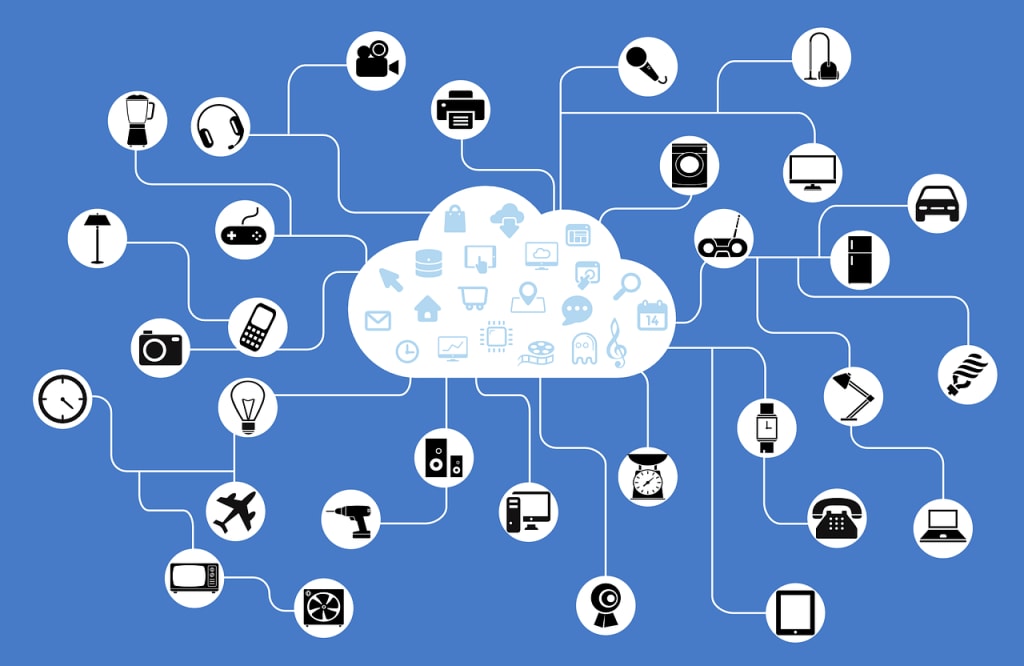
The Internet of Things: What is It? At its core, the Internet of Things refers to the interconnection of everyday physical devices to the internet, enabling them to collect, send, and receive data. These devices—often embedded with sensors, software, and network connectivity—can communicate with each other and with centralized systems without human intervention.
Some examples of IoT devices are: • Automated thermostats • Fitness monitors • Smart appliances
• Sensors used in industry • Autonomous vehicles • Medical equipment In essence, IoT turns passive objects into data-generating nodes in a network, creating an intelligent ecosystem of physical and digital convergence.
⸻
The Development of IoT 1. Initial Concepts Before the internet, machines were thought to be interconnected. Machine-to-machine (M2M) communication was one of the first concepts to emerge in the 1960s and 1970s thanks to the development of telemetry systems for use in manufacturing and military applications. 2. The Birth of IoT
Kevin Ashton came up with the term "Internet of Things" while working at Procter & Gamble in 1999. Ashton proposed using radio-frequency identification (RFID) to manage supply chains more effectively.
However, widespread broadband, cloud computing, and the proliferation of mobile devices set the stage for scalable, affordable connectivity in the late 2000s, when IoT didn't become mainstream. 3. The IoT ecosystem of today Over 75 billion devices will be connected to the internet by 2025, or more than nine devices per person worldwide. The modern IoT ecosystem includes:
• Hardware: Sensors, actuators, microcontrollers
• Connectivity: Bluetooth, Zigbee, 5G, LoRa, and Wi-Fi • Data Platforms: Cloud-based systems for storage, analytics, and visualization
• User Interfaces: Mobile apps, dashboards, voice assistants
⸻
Applications of IoT Across Sectors
1. Smart housing Smart home technologies offer comfort, convenience, and energy efficiency:
• Smart thermostats, such as Nest, learn about user preferences and optimize heating and cooling. • Voice assistants (Alexa, Google Home) control lighting, music, and appliances.
• Security systems integrate cameras, motion sensors, and smart locks.
2. IoT in healthcare and medicine IoT is revolutionizing patient care and medical operations:
• Wearables track heart rate, blood oxygen, sleep, and physical activity.
• Remote patient monitoring helps manage chronic conditions like diabetes and hypertension.
• Smart pills and ingestible sensors ensure medication adherence.
Improved access, lower costs, and improved outcomes may result from these technologies, particularly for elderly and remote patients. 3. Industrial Internet of Things IoT is used for operational efficiency and predictive maintenance in logistics, mining, and manufacturing industries: • Smart factories use sensors to monitor machinery health, reducing downtime.
• Supply chain visibility improves with real-time tracking of goods.
• Digital twins simulate physical processes using real-time data to optimize performance.
4. Smart Cities
IoT helps cities manage resources and infrastructure more efficiently:
• Traffic management systems reduce congestion with dynamic signals.
• Smart grids use consumption data to balance the load of electricity. • Environmental sensors monitor pollution, noise levels, and water quality.
5. Systems for Agriculture and Food Precision agriculture leverages IoT to maximize yields and minimize waste:
• Soil sensors monitor moisture, nutrients, and temperature.
• Drones and autonomous tractors gather and act on crop data.
• Livestock monitoring ensures animal health and productivity.
6. Transportation and Mobility
Safety and convenience are improved by connected vehicles and intelligent transportation systems: • Fleet management systems optimize routes and monitor driver behavior.
• Autonomous vehicles rely on IoT data from cameras, radar, and GPS.
• Smart parking apps help drivers locate spaces in congested areas.
⸻
Key Benefits of IoT
1. Efficiency and Automation
IoT enables automation of routine tasks, reducing human error and freeing up time for more complex decision-making.
2. Data-Driven Insights
IoT generates vast amounts of data that can be analyzed for trends, anomalies, and optimizations.
3. Cost reduction Energy optimization, inventory control, and predictive maintenance all reduce sector-wide operational costs. 4. Security and safety enhancements IoT can detect hazardous conditions in factories, monitor patient health in real time, and alert homeowners to potential break-ins.
5. Enhanced User Experience
IoT offers tailored experiences that feel intuitive and responsive, such as a personalized workout from a smart fitness band or mood lighting based on the time of day. ⸻
Challenges and Risks of IoT
Despite its benefits, IoT comes with significant challenges that must be addressed:
1. Privacy and safety IoT devices can be entry points for cyberattacks. Users frequently do not change their default passwords, and many do not have robust encryption. • Hacking risks can compromise personal data or infrastructure.
• Misusing data, especially biometric and location data, raises ethical questions. 2. Interoperability
IoT devices frequently struggle to integrate seamlessly due to the thousands of manufacturers and protocols. • Lack of standardization limits integration across platforms.
• Closed ecosystems can create “vendor lock-in.”
3. Scalability
Managing and updating millions of devices can be complex. Software updates, edge computing, and cloud infrastructure all need to be coordinated at scale. 4. Constraints on Power and Connectivity Battery life and connectivity remain major limitations for IoT devices, especially in remote or mobile environments.
5. Ethical and Regulatory Issues
Concerns over surveillance, autonomy, and accountability are growing as IoT devices play more central roles in everyday life.
• Who is responsible when an autonomous car crashes?
• In environments with ubiquitous sensors, how is consent managed? ⸻
The IoT's Role in Emerging Technologies IoT does not exist in isolation. Several key technologies are enhancing its capabilities: 1. Artificial Intelligence and Machine Learning
IoT data is processed by AI algorithms for autonomous action, anomaly detection, and predictive analytics. • Smart cameras use AI to recognize people or objects.
• Machine learning models power factories' predictive maintenance. 2. 5G Connectivity
The rollout of 5G will provide faster, more reliable, and lower-latency communication, enabling:
• Real-time control of autonomous vehicles
• High-density device networks in smart cities
• Higher data throughput for high definition video surveillance 3. Edge Computing
To reduce latency and bandwidth use, data is increasingly processed at the edge—closer to the source of generation.
• enables crucial applications to make decisions in real time. • Lowers the need for cloud data centers. 4. Blockchain for IoT
Blockchain can enhance IoT security and transparency:
• Ensures data integrity across distributed devices.
• Facilitates smart contracts for autonomous interactions.
• Protects supply chain data from tampering.
⸻
The Future of IoT
1. Hyper-Connected Environments
The future points toward an ambient intelligence model where smart environments anticipate and react to our needs:
• Homes that adjust settings based on mood and activity.
• Cities that re-route traffic or dim lights automatically.
• Hospitals where data flows seamlessly across devices, departments, and caregivers.
2. IoT in Space and Underwater
Satellite IoT and underwater sensor networks are expanding connectivity to previously unreachable regions—helping monitor ecosystems, weather, and logistics at a planetary scale.
3. Integration with Human Bodies
With the rise of bio-IoT, we’re seeing devices that integrate more closely with the human body:
• Implantable devices for glucose monitoring
• Prosthetics-controlling brain-computer interfaces • Emotion detection in real time for mental health care ⸻
Conclusion: The Promise and Responsibility of IoT
The Internet of Things is not a futuristic dream—it is here, now, shaping the world in ways both visible and invisible. It promises a more efficient, informed, and responsive society, but it also brings new responsibilities around ethics, security, and sustainability.
Governments, businesses, technologists, and citizens must work together to build IoT ecosystems that are not only innovative but also inclusive and secure. The question is not only what we can connect, but also why, how, and for whom, as we are on the verge of a world in which everything is connected.
About the Creator
Keep reading
More stories from Mahibul Mahtab Rumman and writers in Earth and other communities.
Sustainability: Building a Future That Lasts
Introduction The concept of "sustainability" encompasses a wide range of topics, including green technology, climate change, corporate responsibility, social justice, and more. While the concept might seem broad or even vague, its importance has never been more concrete. Sustainability offers a blueprint for creating lasting prosperity—for people and the planet—in a world marked by environmental degradation, rising inequality, and limited resources. The meaning of sustainability, its significance, its application across industries, the obstacles we face, and the path ahead are all examined in depth in this article. ⸻
By Mahibul Mahtab Rumman11 months ago in Earth
The Ghost Metal of Cyprus
She almost put it back. A geologist crouching in the dry scrubland outside Lakia, Cyprus, turned a small rock over in her hand and nearly dismissed it. The colour was wrong. Gold is not supposed to look like that. It was not yellow. It was not even close.
By CurlsAndCommas4 days ago in Earth




Comments
There are no comments for this story
Be the first to respond and start the conversation.