
The Hidden Reef Beside the Titanic
How a 20-Year Sonar Mystery Revealed a Thriving Deep-Sea Ecosystem
The Hidden Reef Beside the Titanic: A 20-Year Mystery Finally Solved
In 1998, while exploring the depths near the wreck of the RMS Titanic, a diver named Paul-Henry Nargeolet detected something unusual. His sonar picked up a massive, unexplained blip close to the most famous shipwreck in the world. The signal suggested a large object on the seafloor—something far bigger than debris—but its identity remained unclear.
For more than two decades, the mystery puzzled scientists. Was it another shipwreck? A strange geological formation? Or something entirely unexpected hidden in the darkness nearly two miles below the ocean’s surface?
The answer finally came in 2022.
A Reef in the Midnight Zone
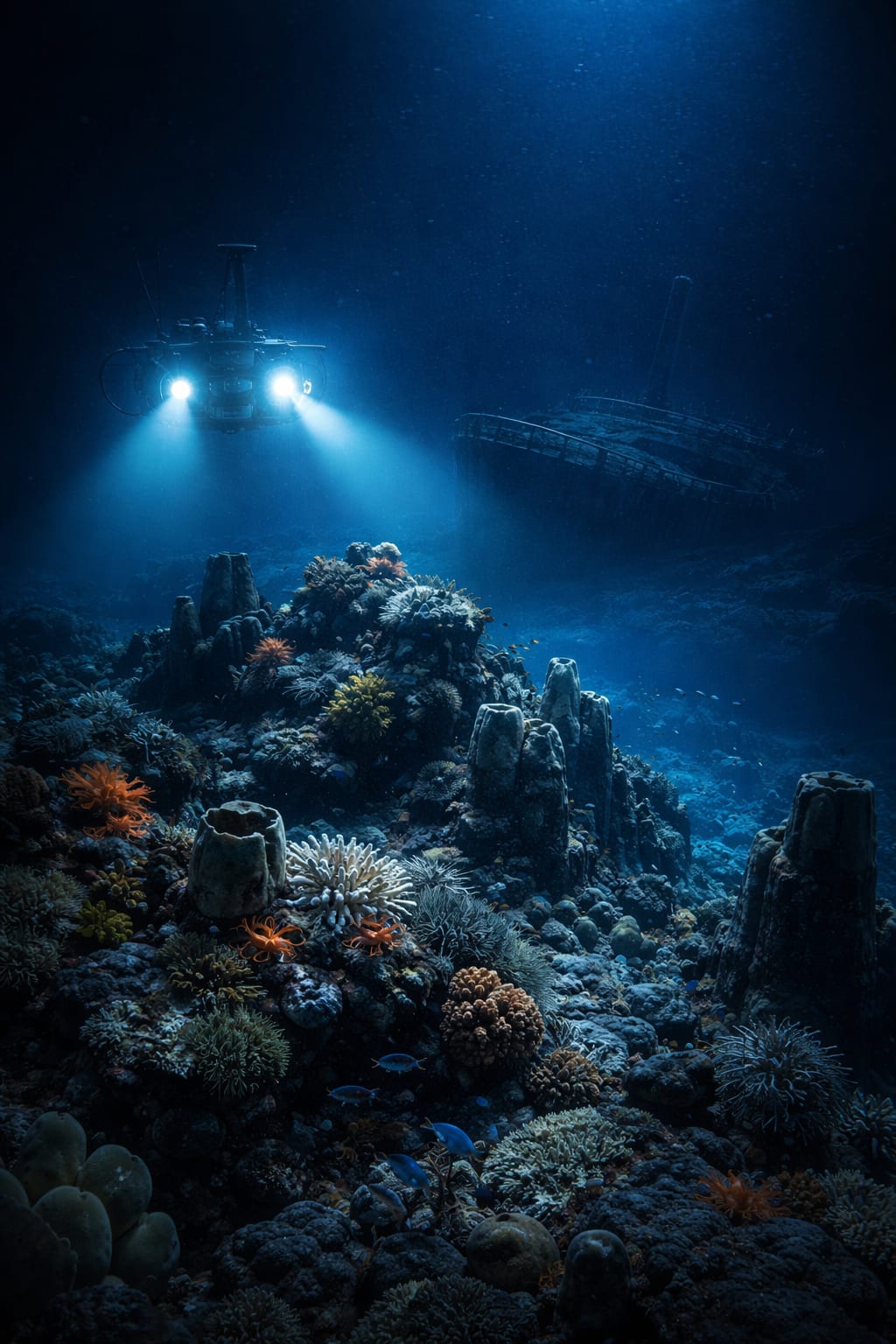
Nargeolet returned to the site with a team of researchers on a new expedition. What they discovered was astonishing: a vast deep-sea reef made up of volcanic basalt formations, sitting 9,514 feet below the surface. This reef—teeming with life—was the source of the mysterious sonar signal detected years earlier.
Despite the extreme depth, the reef was alive with sponges, corals, fish, lobsters, and other marine organisms clinging to the rugged basalt ridge. The team documented the site extensively, capturing photographs and video footage and collecting water samples for further study.
Scientists are now using computer models to understand how these organisms survive in such an inhospitable environment. The discovery may help solve a long-standing biological puzzle: how sponges and corals manage to spread across vast areas of the ocean floor. These organisms require solid surfaces to attach to, yet they are often found in muddy regions where such surfaces seem scarce. Understanding this process is critical for predicting how fragile deep-sea ecosystems may respond to environmental change in the future.
Another Mystery Still Lurking
Interestingly, this may not be the only secret hidden near the Titanic. Nargeolet has long noted another unexplained sonar blip located between the wreck and the newly discovered reef. He believes this second anomaly could be even larger than the reef itself and hopes to investigate it on a future expedition.
How the Titanic Broke Apart
The Titanic itself rests on the ocean floor in two massive pieces pointing in different directions. After the ship sank in 1912, its boilers—key indicators of the sinking path—were found about 600 feet east of the stern.
When the ship struck the seabed, the bow remained largely intact, but the stern was severely damaged. As it descended, trapped air inside the stern structure could not withstand the immense pressure, causing catastrophic implosions. Survivors of the disaster had reported seeing the ship split in half as it sank—claims that were initially dismissed but later proven correct. The vessel broke apart between its second and third funnels during the descent.
From collision to complete submersion, the Titanic sank in approximately 2 hours and 40 minutes. The iceberg breach allowed water to flood six of the ship’s sixteen watertight compartments. As water poured into the starboard side, the ship began to tilt forward and slightly to the right.
By midnight, water was spilling from damaged compartments into others. It flooded through anchor chain holes, and by 2:00 a.m., the bow was sinking rapidly while the stern’s propellers rose out of the water. As the bow slipped beneath the surface, the stern lifted to a steep angle—nearly 45 degrees.
The immense weight of the propellers placed unbearable stress on the ship’s midsection. The steel structure failed with a sound survivors described as resembling breaking china. By approximately 2:02 a.m., the bow and stern were connected only by the inner bottom structure. Minutes later, the bow—weighing roughly 16,000 tons—tore free.
The stern rose almost vertically before slowly sinking. By 2:20 a.m., it vanished beneath the surface.
The Final Descent
During the descent, the ship’s massive funnels were ripped away, dragging cables and debris with them. The forward mast collapsed, crashing onto the bridge area and likely destroying the wheelhouse where the ship had been steered.
The bow descended at roughly 23 miles per hour and struck the ocean floor nearly 30 minutes before the stern. The impact caused additional structural damage, collapsing decks and crushing areas around the bridge. The officer’s quarters and gym were badly deformed, with railings bent outward and walls pushed inward.
Some experts believe that when the bow suddenly stopped, a powerful downward surge of water slammed into the wreck, compounding the damage. Any evidence of the iceberg collision itself is now buried beneath layers of sediment.
Why the Titanic Is Still Dangerous to Visit
Exploring the Titanic remains extremely dangerous. Icebergs are still common in the region—1,515 drifted far enough south to enter major shipping lanes in 2019 alone.
Sunlight only penetrates about 3,300 feet below the surface. Beyond that lies the “midnight zone,” where total darkness reigns. Scientists descending to the wreck spend more than two hours traveling through pitch-black water before the seafloor suddenly appears in the glow of submersible lights. Visibility is limited to just a few feet, making navigation difficult even with detailed maps, accelerometers, and gyroscopes.
At the depth where the Titanic rests, water pressure is about 390 times greater than at the surface. Submersibles must be built with exceptionally thick walls to withstand these crushing forces.
Although deep-sea currents are generally weaker than surface currents, powerful benthic storms can occur. These underwater currents are capable of moving sediment and debris and are gradually reshaping the wreck site. Over time, scientists believe shifting sand and mud may eventually bury the Titanic entirely.
A Wreck Slowly Disappearing
After more than a century underwater, the Titanic is steadily deteriorating. Microbes are consuming the ship’s metal, forming rust-colored, icicle-like structures known as rusticles. These formations are accelerating the ship’s decay—especially in the stern, which scientists believe is breaking down roughly 40 years faster than the bow.
While the wreck collapses a little more each year, experts say it should remain largely recognizable for now—so long as it is left undisturbed.
Researchers have also found evidence of ancient underwater landslides in the area. These massive events sent huge volumes of sediment cascading down the continental slope, depositing layers up to 328 feet thick. The most recent of these occurred tens of thousands of years ago, and such events are considered extremely rare.
The Ocean Still Holds Secrets
Even after decades of exploration, the deep ocean surrounding the Titanic continues to surprise scientists. From hidden reefs to unexplained sonar anomalies, the wreck site is not just a monument to history—but a gateway to discoveries that may reshape our understanding of life in the deepest parts of the sea.
About the Creator
Keep reading
More stories from Lexi Wilburn and writers in Earth and other communities.
Earth’s Hidden Fires
The Black Scar of the Sahara and Other Fires That Shouldn’t Exist From high above, the Sahara Desert looks like a golden ocean—endless waves of sand broken only by scattered blue and green oases. But hidden among the dunes is something startling: a massive black region covering nearly 17,000 square miles. It’s so large it’s visible from space, yet it rarely appears in movies or documentaries. At first glance, it almost looks unnatural, as if something catastrophic happened there.
By Lexi Wilburnabout 8 hours ago in Earth
Pentagon Contractor Indicted Over Alleged Leak Tied to Raided Washington Post Reporter
A Pentagon contractor has been indicted in connection with an alleged leak tied to a Washington Post reporter, marking a significant escalation in the U.S. government’s scrutiny of leaks involving national security information. The case has raised questions about press freedom, government overreach, and the balance between security and transparency, stirring debates in political, legal, and journalistic circles. Background of the Case According to court documents, the Pentagon contractor is accused of disclosing classified or sensitive information to a Washington Post journalist, whose office was previously raided by federal authorities as part of a leak investigation. The allegations include: Transmitting sensitive information without authorization. Coordinating with journalists who may have used the material in published reports. Potentially compromising national security operations or personnel. Federal prosecutors allege that the contractor knowingly violated U.S. law by disclosing information protected under federal statutes governing classified material. The Washington Post Connection This case is closely linked to a prior federal raid on a Washington Post reporter, an unprecedented action that drew widespread criticism from journalists and press freedom advocates. The raid reportedly aimed to identify the source of leaks regarding sensitive military or defense operations. The indictment of the Pentagon contractor underscores the government’s ongoing efforts to identify and prosecute sources of classified leaks, even when they involve interactions with journalists. Critics argue that such investigations risk chilling investigative reporting and undermining the First Amendment. Legal Details of the Indictment While some details remain sealed due to the sensitive nature of the information, the indictment reportedly charges the contractor with: Unauthorized disclosure of national defense information. Conspiracy to leak classified material. Violation of federal secrecy and security laws. The contractor now faces potential penalties including prison time, fines, and the permanent loss of security clearance. The case will be closely watched by legal experts, media organizations, and policy analysts, as it could set important precedents for how leaks are investigated and prosecuted. Implications for Press Freedom Journalists and press freedom organizations have raised concerns over the broader implications of this case. Key issues include: Chilling effect on investigative journalism: If government employees fear prosecution for speaking to reporters, crucial stories may go unpublished. Source protection: Confidential sources are vital for reporting on matters of public interest, particularly regarding government and military operations. Transparency vs. security: Balancing the public’s right to know with national security interests remains a complex challenge. The Washington Post and other news outlets have emphasized that government actions should respect constitutional protections for press freedom, even when investigating leaks. Government’s Perspective From the government’s standpoint, the case highlights the risks posed by unauthorized disclosures of sensitive information. Officials argue that leaks can: Compromise ongoing military operations. Endanger personnel and intelligence assets. Undermine national security and international relations. Prosecutors assert that the Pentagon contractor acted knowingly and illegally, justifying the indictment as necessary to protect national interests. Previous Leak Cases and Context This indictment comes amid a series of high-profile leak investigations involving U.S. government employees, contractors, and journalists: Previous cases have involved classified defense documents, intelligence reports, and diplomatic cables. Some investigations resulted in prosecutions, while others sparked controversy over press freedom and government overreach. These cases often raise complex legal questions about the definition of classified information and the rights of journalists to report on public interest issues. Legal experts say this Pentagon contractor case may be one of the most significant yet, given its direct tie to a mainstream news outlet. Public and Media Reaction The indictment has elicited strong reactions from multiple sectors: Journalists: Press freedom advocates express concern that prosecuting sources of leaks could intimidate whistleblowers and reporters. Legal analysts: Experts are closely watching how the courts interpret laws governing classified material and the limits of government authority. Policy makers: Some lawmakers have emphasized the need for clearer guidelines on leaks and protections for investigative reporting. Civil liberties organizations have warned that aggressive leak investigations may inhibit government accountability, especially on issues involving national defense and public interest. Potential Outcomes and Next Steps The Pentagon contractor now faces trial proceedings, which may include: Pre-trial motions challenging the scope of evidence and the legality of the indictment. Examination of whether journalists’ communications can be implicated in legal proceedings. Decisions on sentencing if convicted, including potential prison time and fines. Observers predict that the case may also influence future government policies on leak investigations and employee handling of sensitive information. Why This Matters This case illustrates the delicate balance between national security and press freedom. Key takeaways include: Government employees and contractors must exercise caution when handling classified material. Journalists rely on confidential sources to report on matters of public interest. Legal and ethical frameworks must address both the risks of leaks and the protection of free speech. The outcome of this case could set legal precedents affecting not just defense contractors, but journalists, whistleblowers, and government transparency efforts. Final Thoughts The indictment of a Pentagon contractor over an alleged leak linked to a raided Washington Post reporter underscores the complex intersection of national security, law, and press freedom. While the government seeks to protect sensitive information, the case also raises questions about constitutional rights, transparency, and accountability. As proceedings unfold, this case will likely continue to be a touchstone in discussions about how the U.S. balances security concerns with the democratic imperative of a free press, and how future leak investigations are conducted
By Muhammad Hassan6 days ago in Earth
Franklin County Snow Emergency
Winter weather in Ohio can change quickly, and when heavy snow or ice hits, local governments rely on snow emergency levels to keep residents safe. One of the most searched winter questions each year is: what level is Franklin County snow emergency right now? Understanding how these emergency levels work—and how they compare with nearby counties like Delaware County—can help drivers, workers, and families make safer decisions during severe weather. This article breaks down everything you need to know about the Franklin County snow emergency, including how levels are determined, where to find updates, and what each level means for daily life. What Is a Snow Emergency in Franklin County? A snow emergency is declared when weather conditions make travel dangerous due to snow, ice, or freezing rain. In Franklin County, Ohio, officials monitor road conditions, weather forecasts, and accident reports before announcing a snow emergency level. The Franklin County snow level system is designed to limit unnecessary travel and reduce accidents. Each level comes with specific guidelines for residents and employers. Local media outlets, especially 10TV Weather, play a major role in communicating these updates to the public in real time. Snow Emergency Levels Explained To understand what level snow emergency is Franklin County Ohio, it helps to know what each level represents. Level 1 Snow Emergency A Level 1 advisory means roads are slippery, especially bridges and secondary roads. Drivers should use caution, reduce speed, and allow extra stopping distance. Travel is permitted No legal restrictions Increased risk on untreated roads At this stage, daily activities usually continue as normal, though delays are common. Level 2 Snow Emergency When conditions worsen, officials may declare a Level 2 snow emergency. This signals that roads are hazardous and travel should be limited to essential trips only. Driving is discouraged Only necessary travel is advised Accidents become more frequent During a Level 2, many schools, businesses, and government offices may close or operate on delays. This is often the level that sparks widespread concern across Franklin County. Level 3 Snow Emergency Level 3 is the most serious designation. Roads are extremely dangerous or impassable, and travel is legally restricted. Only emergency personnel should be on the roads Driving can result in citations or arrest Conditions pose serious safety risks A Level 3 snow emergency is rare but critical. When declared, residents are urged to stay indoors until conditions improve. How Franklin County Determines Snow Emergency Levels Officials rely on multiple factors before announcing a snow emergency: Snowfall totals and accumulation rates Ice formation and road treatment effectiveness Traffic accidents and emergency response delays Weather forecasts from meteorologists Agencies coordinate closely with weather services and local law enforcement. Reports from 10TV Weather often provide early insight into whether conditions may escalate. Comparing Franklin County and Delaware County Snow Emergencies Many Ohio residents commute between counties, which makes comparing alerts important. A Delaware County snow emergency may not always match Franklin County’s status. For example: Franklin County could be under a Level 2 while Delaware County remains at Level 1 Snow bands may impact northern counties more severely Timing of road treatment can differ Drivers should always check both counties before traveling. Conditions can change rapidly, especially during overnight storms. Where to Find Reliable Updates Staying informed is essential during winter storms. The most reliable sources for Franklin County snow emergency updates include: Franklin County Sheriff’s Office announcements Official county websites and social media pages Local news stations, especially 10TV Weather Emergency alert systems and local radio Searching phrases like what level is Franklin County or what level snow emergency is Franklin County Ohio during storms is common, but always rely on official sources for confirmation. How Snow Emergencies Affect Schools and Workplaces Snow emergency levels often influence closures and delays: Schools typically close at Level 2 or Level 3 Government offices may shut down during Level 2 Many employers follow county advisories However, private businesses may set their own policies, so employees should check with supervisors directly. Preparing for a Franklin County Snow Emergency Preparation can make a major difference during winter weather. Residents are encouraged to: Keep vehicles fueled and stocked with emergency supplies Monitor forecasts before storms arrive Avoid unnecessary travel during Level 2 or Level 3 emergencies Check on elderly neighbors when conditions worsen Simple planning can reduce stress and improve safety during severe winter events. Why Snow Emergency Levels Matter Snow emergencies are not just warnings—they are safety tools. Each Franklin County snow level helps emergency crews prioritize resources, reduce accidents, and protect lives. Ignoring advisories can put drivers and first responders at risk. Understanding the system allows residents to make informed, responsible decisions. Final Thoughts Winter in Ohio is unpredictable, but information makes it manageable. Knowing how the Franklin County snow emergency system works—and staying updated through trusted sources like 10TV Weather—can help you stay safe when conditions deteriorate. Whether you’re checking what level is Franklin County, comparing alerts with a Delaware County snow emergency, or planning your commute, awareness is your best defense against winter hazards.
By Saboor Brohi 4 days ago in Earth



Comments
There are no comments for this story
Be the first to respond and start the conversation.