
"The Hidden Life of Your Money"
How Every Dollar You Spend Shapes Your Future — and the World
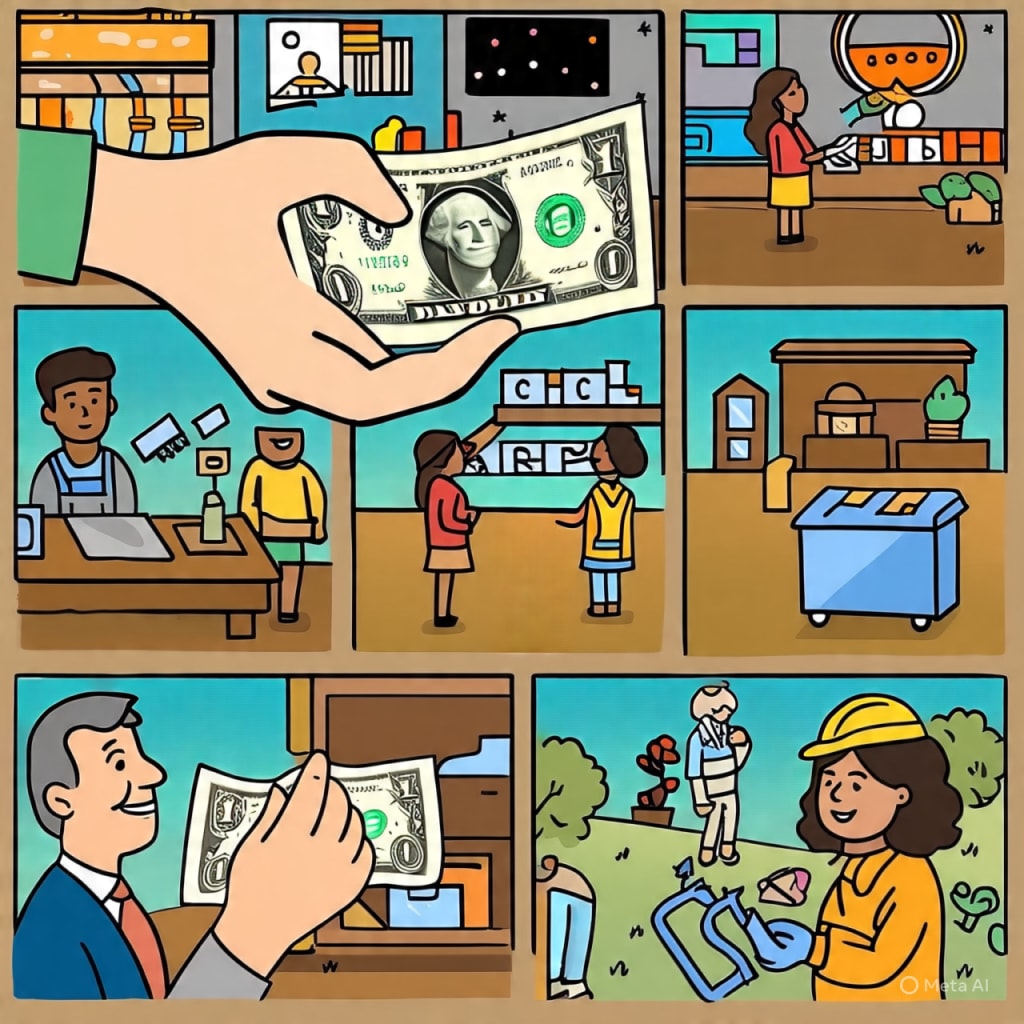
Most people don’t think much about what happens to their money after they spend it. They swipe a card or hand over a bill, get a receipt, and move on. But if your dollar could talk, it would tell a story more exciting and far-reaching than you'd expect.
Let’s follow one ordinary dollar — call it “Buck” — and see where it goes.
---
Chapter 1: The Coffee Shop
It’s Monday morning. You’re groggy and running late, so you grab your usual $5 latte from the local coffee shop. Part of that money — let’s say Buck — goes straight into the register. The rest? Tips, supplies, and expenses. But Buck? Buck ends up in the hands of the cashier, Sarah, who’s working her way through college.
At the end of her shift, Sarah pockets her tips and heads to the grocery store. Buck is now part of her $20 purchase — apples, pasta, and some cheap granola bars. Just like that, Buck changes hands again, now owned by the supermarket.
---
Chapter 2: The Supply Chain
At the supermarket, Buck is added to the daily cash flow that helps pay for deliveries and electricity. When the store buys more stock from its wholesaler, Buck becomes part of a larger transaction that supports truck drivers, warehouse staff, and suppliers across the country.
Eventually, Buck trickles down to a farmer in California, who grows the apples you love. That dollar may help him fix a broken irrigation pipe or buy seeds for the next planting season. It’s no longer just “your dollar” — it’s fuel for an entire network.
---
Chapter 3: The Bank
Not all money moves physically. Often, it rests — temporarily — in banks.
Let’s rewind. When you got paid last week, your paycheck was direct-deposited into your account. That money didn’t just sit there. Your bank lent it out — to someone applying for a mortgage, to a small business needing startup capital, or even to fund government bonds.
Every dollar you save becomes part of the financial system that drives investment and growth. Buck, in the form of electronic digits, may have helped someone buy their first home or fund a medical clinic in a developing country.
That’s the hidden power of saving — your money can work for you and others, even when you’re not spending it.
---
Chapter 4: The Dark Side
But not every journey is bright.
Sometimes, Buck finds itself in less noble places: fueling fast fashion made in sweatshops, supporting companies that exploit workers or damage the environment, or lost to high-interest debt that keeps families struggling for years.
Where you spend and how you invest can unintentionally support practices that don’t align with your values.
For example, using a credit card irresponsibly can bury someone in interest payments — $1 spent turns into $3 repaid over time. That’s not just expensive. It’s dangerous.
Buck becomes a burden when it’s not treated with respect.
---
Chapter 5: The Bigger Picture
Now let’s zoom out.
If millions of people spend and invest consciously — choosing local businesses, ethical companies, sustainable products — the ripple effect can be massive. A dollar might help a small café survive a recession. Another could support clean energy. Another could educate a girl halfway across the globe.
When you save, you create security for yourself. When you spend thoughtfully, you influence the world. Money is not just a tool; it’s a vote for the kind of future you want.
And it all starts with Buck — and all his little friends.
---
Epilogue: The Choice Is Yours
Most people see money as either a source of stress or freedom. In truth, it’s both — depending on how you use it.
So next time you reach into your wallet, take a second to ask yourself: Where will my dollar go next? What kind of story will it tell?
Because every Buck has a journey. And you are its guide.
---
Key Takeaways:
Every dollar you spend has a ripple effect. Your money supports jobs, businesses, and industries — for better or worse.
Saving and investing wisely can help others. Banks and institutions use your money to fund loans and growth.
Your financial choices shape your life and the world. Being intentional can align your spending with your values.
Even small amounts add up. Don’t underestimate the power of just one dollar.
About the Creator
Keep reading
More stories from Muhammad Saad and writers in Earth and other communities.
Earth: The Home We Share
Long before humans walked its lands or gazed up at the stars, Earth spun silently in the blackness of space. A pale blue sphere cloaked in clouds, it was already teeming with life — from the tiniest microbes deep in the ocean to towering trees that stretched toward the sky.
By Muhammad Saad 7 months ago in Earth
Workers Recover 15,000 Crabs After Lorry Crashes Into Field
An extraordinary scene unfolded when a lorry carrying an estimated 15,000 live crabs crashed into a field, spilling its cargo across farmland and prompting a large-scale recovery effort. The unusual accident quickly drew attention from local residents, emergency services, and animal welfare groups, as workers scrambled to rescue as many crabs as possible before they succumbed to exposure.
By Aarif Lashari3 days ago in Earth
US Balks as UK and France Pledge Troops to Postwar Ukraine
As the war in Ukraine grinds on with no clear end in sight, the debate over what comes after the fighting has taken a sharper turn. The United States has signalled reluctance about committing troops to Ukraine once the war ends, even as the United Kingdom and France openly pledge to consider deploying forces in a postwar security role. The divergence has exposed differing strategic priorities among Western allies and raised new questions about how Ukraine’s future security will be guaranteed. While all three nations remain united in their support for Kyiv during the war, the emerging split over postwar troop commitments highlights the complexity of planning for peace in a conflict that continues to reshape Europe’s security landscape. What the UK and France Are Proposing British and French leaders have increasingly spoken about the need for long-term security arrangements for Ukraine once active hostilities end. Their position reflects a growing concern that any ceasefire or peace agreement could be fragile, leaving Ukraine vulnerable to renewed aggression. The idea under discussion is not a combat deployment in an active war zone, but rather a stabilisation or reassurance force. Such troops could help train Ukrainian forces, protect critical infrastructure, and serve as a visible deterrent against future attacks. Supporters argue that a limited but credible international presence would help ensure that any peace settlement is respected. For London and Paris, this approach fits within a broader European push to take more responsibility for continental security. Both governments see Ukraine not only as a partner but as a frontline state whose stability directly affects Europe as a whole. Why Washington Is Hesitant The United States, while remaining Ukraine’s most significant military backer during the war, has taken a more cautious stance on postwar troop deployments. American officials have stressed that there are no plans to send US forces into Ukraine, even after a potential peace agreement. This hesitation is rooted in several factors. First, Washington remains wary of any move that could risk a direct confrontation with Russia. Even in a postwar scenario, the presence of US troops on Ukrainian soil could be portrayed by Moscow as a provocation, escalating tensions rather than reducing them. Second, domestic considerations play a major role. After years of overseas military engagements, there is limited appetite among the American public and political class for new long-term deployments abroad, particularly in a region where risks remain high and outcomes uncertain. Finally, US strategy has increasingly emphasised supporting allies through funding, training, and equipment rather than large-scale troop commitments. From Washington’s perspective, enabling Ukraine to defend itself may be preferable to stationing American forces on the ground. A Question of Deterrence At the heart of the debate lies a fundamental question: what will actually deter future aggression against Ukraine? The UK and France appear to believe that a physical presence, however limited, would send a powerful signal of commitment. Troops on the ground would demonstrate that Ukraine’s security is directly tied to that of major European powers, raising the cost of any future attack. The US, by contrast, seems to place greater faith in alternative mechanisms such as long-term military aid, security guarantees, and sanctions frameworks. American officials argue that deterrence does not necessarily require boots on the ground, especially if Ukraine emerges from the war better armed and more integrated with Western institutions. This difference reflects broader strategic cultures. European powers, facing the immediate proximity of the conflict, may feel a stronger need for visible reassurance measures, while the US assesses risks from a more global perspective. Implications for NATO Unity Although Ukraine is not a NATO member, the discussion has clear implications for the alliance. Any deployment of UK or French troops would be closely scrutinised for what it means for NATO’s role and credibility. NATO operates on consensus, and the absence of US support for a postwar troop presence could complicate coordination. Even if London and Paris act independently or as part of a smaller coalition, questions would remain about command structures, rules of engagement, and the political backing required for such a mission. At the same time, the situation underscores a broader shift within NATO, with European members increasingly expected to shoulder more responsibility. If the UK and France proceed with their plans, it could mark a significant step toward a more autonomous European security posture. Ukraine’s Perspective For Kyiv, the debate is both encouraging and frustrating. On one hand, the willingness of major European powers to consider troop deployments signals long-term commitment and recognition of Ukraine’s security concerns. On the other hand, uncertainty from the US—Ukraine’s most powerful ally—adds another layer of unpredictability. Ukrainian leaders have consistently argued that security guarantees must be concrete, not symbolic. From their perspective, any postwar arrangement must ensure that Russia cannot simply regroup and strike again. Whether this is achieved through foreign troops, binding treaties, or accelerated integration with Western institutions remains an open question. What is clear is that Ukraine wants assurances that go beyond promises and declarations. The Risk of Mixed Signals One potential danger of the current divergence is the message it sends to Moscow. Differing positions among Western allies could be interpreted as hesitation or lack of unity, potentially weakening deterrence rather than strengthening it. At the same time, open debate is not necessarily a sign of weakness. Allies often disagree on tactics while remaining aligned on broader goals. The challenge will be ensuring that these differences do not undermine the core objective of securing a stable and sovereign Ukraine. Diplomats on both sides of the Atlantic are likely to continue working behind the scenes to narrow the gap, even if public statements suggest a clear divide. Looking Ahead The question of postwar Ukraine remains largely theoretical while fighting continues. Yet the discussion itself reveals how seriously Western governments are taking the long-term consequences of the conflict. The UK and France’s willingness to pledge troops reflects a belief that peace must be actively protected. The US reluctance highlights concerns about escalation, sustainability, and domestic support. Reconciling these approaches will be one of the most important diplomatic challenges once the guns eventually fall silent. For now, the disagreement does not signal a breakdown in alliance unity, but it does expose the difficult choices ahead. As the war continues, planning for peace is proving almost as complex—and politically sensitive—as managing the conflict itself.
By Muhammad Hassan7 days ago in Earth



Comments
There are no comments for this story
Be the first to respond and start the conversation.