
The Future of Agriculture: Feeding the World Through Innovation and Sustainability
Addressing Challenges, Harnessing Technology, and Cultivating a Resilient Global Food System

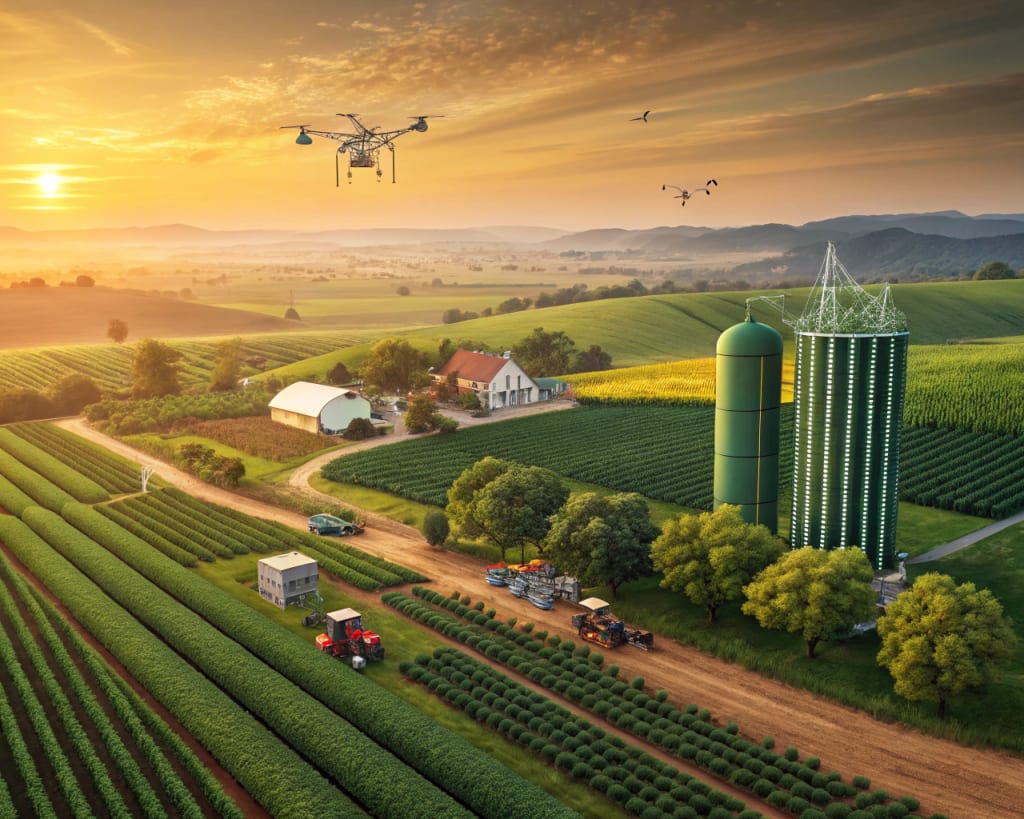
Agriculture, the backbone of human civilization, faces unprecedented challenges in feeding a global population projected to reach 9.7 billion by 2050. As climate change, resource scarcity, and urbanization reshape the landscape, innovative solutions and sustainable practices are transforming the sector. From precision farming to regenerative techniques, agriculture is poised for a revolution. Let’s explore the challenges, impacts, and visionary strategies driving the future of global food production.
Challenges Facing Agriculture
The agricultural sector grapples with multifaceted hurdles. Climate change disrupts yields, with the Intergovernmental Panel on Climate Change (IPCC) estimating a 10-25% decline in crop production by 2050 due to rising temperatures and erratic rainfall. Soil degradation affects 33% of global land, reducing arable land by 1.5 million hectares annually. Water scarcity, with agriculture consuming 70% of freshwater, exacerbates challenges, particularly in regions like Sub-Saharan Africa, where 60% of farmers lack reliable irrigation.
Smallholder farmers, who produce 50% of the world’s food, face financial constraints, with only 15% accessing formal credit, per the World Bank. Pest and disease outbreaks, like locust swarms in East Africa, destroy 20-40% of crops yearly. Food waste is rampant, with 1.3 billion tons—one-third of global production—lost annually. Labor shortages, driven by urban migration, and reliance on outdated practices further strain productivity, especially in developing nations.
Impacts on Society and Environment
The consequences are profound. Food insecurity affects 2.4 billion people, with 828 million facing hunger daily, according to the UN. Malnutrition, linked to poor agricultural diversity, impacts 3 billion who cannot afford healthy diets. Economically, agriculture employs 27% of the global workforce, yet low yields and market access barriers trap farmers in poverty, costing developing economies $1 trillion yearly in lost productivity.
Environmentally, agriculture contributes 24% of global greenhouse gas emissions, with livestock alone accounting for 14.5%. Deforestation for farmland destroys 10 million hectares annually, threatening biodiversity. Pesticide overuse contaminates 20% of global waterways, harming ecosystems and human health. These impacts underscore the urgent need for sustainable practices to balance food security with environmental preservation.
Innovative Solutions and Progress
Agriculture is undergoing a transformation through technology and policy. Precision farming, using drones and IoT sensors, boosts yields by 15-20% while reducing water and pesticide use by 30%, per a 2023 FAO study. Vertical farming, adopted in urban hubs like Singapore, produces 10 times more per hectare than traditional methods. Gene-editing technologies, like CRISPR, have developed drought-resistant crops, with 40% higher yields in trials across Africa.
Regenerative agriculture, emphasizing soil health through crop rotation and cover crops, sequesters 2-4 tons of carbon per hectare annually. Digital platforms, like India’s eNAM, connect 150 million farmers to markets, increasing incomes by 20%. Investments in irrigation, with $1 billion from the African Development Bank, have expanded access for 10 million farmers. Alternative proteins, such as plant-based and lab-grown meat, are projected to capture 10% of the $1.4 trillion meat market by 2030, reducing environmental strain.
A Call to Action
The future of agriculture demands collective action. Governments must invest 1% of GDP in agricultural R&D, as recommended by the FAO, to scale innovations. Subsidies for sustainable practices, like organic farming, can reduce chemical use by 50% by 2030. Public-private partnerships, such as Syngenta’s collaborations with smallholders, can enhance seed access. Training programs for 100 million farmers in digital tools and climate-smart techniques are critical.
Consumers must support local, sustainable produce to reduce food miles, which contribute 19% of food system emissions. Global cooperation, through initiatives like the UN’s Decade of Action on Nutrition, can align policies. Agriculture’s potential to feed the world sustainably lies in innovation, equity, and resilience. By embracing technology, restoring ecosystems, and empowering farmers, we can ensure a nourished planet for generations. The time to act is now—our food, our future, depends on it.
About the Creator
Arjun. S. Gaikwad
Truth Writing unveils reality beyond illusion, power, and propaganda words that awaken conscience and challenge comfort. Fearless, honest, and thought-provoking, it explores politics, humanity, and spirit to inspire awareness and change.
Keep reading
More stories from Arjun. S. Gaikwad and writers in Earth and other communities.
China’s Health Care Evolution: Pioneering a Sustainable and Equitable Future
China’s health care system, serving 1.4 billion people, stands as a global benchmark for scale and ambition. With near-universal insurance coverage and cutting-edge innovations, China is reshaping health care delivery. Yet, challenges like an aging population and regional disparities persist. Through bold reforms and technological advancements, China is forging a path toward equitable, efficient, and sustainable health care. Let’s explore the challenges, impacts, and transformative solutions driving this revolution.
By Arjun. S. Gaikwad6 months ago in Earth
Mother of Elon Musk’s Child Sues xAI Over Grok Deepfakes
Imagine waking up one day to find realistic, sexually explicit images of yourself circulating online—and you never agreed to them. For Ashley St. Clair, the mother of one of Elon Musk’s children, this nightmare became reality. She is now suing xAI, Elon Musk’s AI company, alleging that its chatbot Grok generated harmful deepfake images of her, including depictions of her as a minor and in sexualized contexts.
By Aarif Lashari2 days ago in Earth
Smart phones, Humans and Aliens.
WARNING. I will be tapping into one of your favorite creative tensions: The absurdity of humans worshipping their glowing rectangles as if they were tiny oracles. There’s something deliciously poetic about that contradiction, and it lends itself beautifully to an instructive proviso.
By Novel Allen5 days ago in Poets




Comments
There are no comments for this story
Be the first to respond and start the conversation.