
The Flower That Only Blooms in the Coldest Temperatures
It’s not made of petals — it’s made of ice.

Some flowers bloom in the sun. Others bloom at night.
But a few, incredibly rare, bloom in the coldest hours — when everything else is frozen still.
And they’re not even real flowers.
Meet the mysterious frost flower — a delicate formation of ribbons of ice, so thin and fine that they look like petals crafted by fairies. These “flowers” grow not from seeds or bulbs, but from cracks in the stems of certain plants, and they appear only under the perfect freezing conditions.
They’re not alive.
They don’t last.
But for a few magical hours each winter morning, they bloom.
What Is a Frost Flower?
A frost flower isn’t a flower in the botanical sense. It’s a natural phenomenon caused by water and ice.
It happens when the ground is still warm, but the air temperature drops below freezing, usually during late autumn or early winter. Certain herbaceous plants — especially those with hollow or cracked stems — still draw water up from their roots during this time.
As the water rises through the stem and reaches the cold air outside, it freezes instantly upon contact with the surface.
But water keeps rising.
And as it pushes out through microscopic cracks in the plant’s stem, it freezes in delicate layers, curling and spiraling into thin sheets — forming what looks like a flower made entirely of silk-like ice.
These are frost flowers.
Beautiful. Fragile. And gone as soon as the sun rises.
Where Can You See Them?
Frost flowers are most often found in North America, particularly in the Midwestern and Southern United States, though they’ve also been reported in parts of Europe and Asia.
They appear on cold mornings where:
- The air temperature is below freezing
- The soil is not yet frozen
- There is no snow cover
- Humidity is high
- And the plant stems are the right species
Common host plants include:
- White crownbeard (Verbesina virginica)
- Dittany (Cunila origanoides)
- Hylotelephium (formerly Sedum)
- And other native perennials with porous or cracked stems
These plants don’t make the frost flower intentionally. It’s just physics and timing. But the result is something most people never get to see.
How Do They Form?
Frost flowers are created through a process called ice segregation.
Here’s how it works:
1. The plant’s roots are still active, pulling water from the soil.
2. Water moves up the stem by capillary action.
3. When it reaches a crack in the stem and touches the freezing air, it begins to freeze and expand.
4. As more water follows behind, it pushes the ice outward.
5. The ice extrudes slowly, curling as it grows — forming delicate, ribbon-like patterns.
Unlike frost that forms on windows, this ice grows outward from the plant, creating structures that resemble roses, feathers, or scrolls.
Each one is unique and only lasts for a short time — they begin to melt the moment sunlight hits them.
Why Don’t We See Them More Often?
Because the conditions needed are incredibly specific:
- The ground must be warm enough for water to rise
- The air must be cold enough for freezing
- There must be no wind, or the ice structure will break
- The plant must have the right type of stem — cracked but still active
Even in areas where they do form, frost flowers only appear for a few mornings each year. Many people who live in these regions their whole lives have never seen one.
They are nature’s early morning secret, visible only to those who rise early, step softly, and look closely.
Not Just Beautiful — But Scientific
While frost flowers are often seen as a poetic mystery, they’re also fascinating from a scientific perspective.
They demonstrate:
- Capillary action — how water moves through narrow spaces
- Phase change — how liquid turns to solid under specific conditions
- Thermal conductivity — why the plant must stay warm enough to keep water flowing while the air is cold
Some botanists and physicists study frost flowers to understand how living and non-living systems interact in marginal environments.
It’s an intersection of biology, physics, and art — all on a forest floor before breakfast.
A Flower You Can’t Pick
You can’t collect frost flowers.
You can’t plant them.
You can’t take them home in a vase.
They’re far too delicate — the moment you touch one, it breaks.
And as soon as the sun rises, they vanish into vapor.
That’s what makes them special.
They are a reminder that not all beauty is meant to last — some things exist only for a moment, in silence, in stillness, and then are gone.
Nature’s Quietest Miracle
In a world that often rewards boldness and loudness, the frost flower is a quiet miracle. It doesn’t make noise, it doesn’t bloom for days, and it doesn’t demand attention.
But for those who are lucky enough to witness it — usually just hikers, photographers, and curious early risers — it leaves a deep impression.
It’s a flower made not of cells, but of ice and breath, blooming not with sunlight, but with cold and stillness.
And it proves that sometimes, the coldest places still know how to bloom.
About the Creator
Day Will Turn to Night: Astronomers Officially Confirm the Date of the Longest Solar Eclipse of the Century
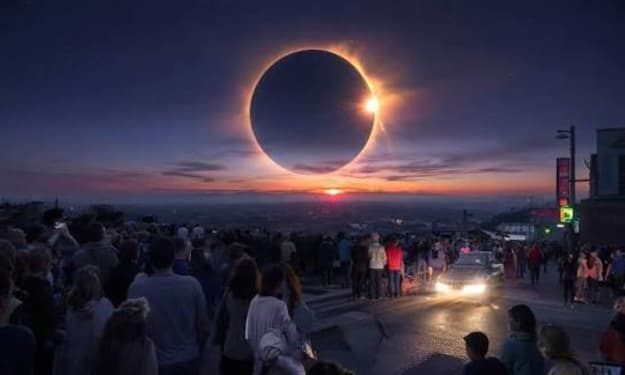
For stargazers, astronomers, and casual skywatchers alike, 2026 promises an astronomical event that will be remembered for a lifetime. Scientists have officially confirmed the date of the longest solar eclipse of the 21st century, a celestial phenomenon that will turn day into night for several minutes across parts of the globe. The announcement has sent excitement rippling through the scientific community and among enthusiasts who have long awaited a solar spectacle of this magnitude. The Science Behind the Eclipse A solar eclipse occurs when the Moon passes between the Earth and the Sun, casting a shadow on our planet and temporarily blocking the Sun’s light. While solar eclipses happen somewhere on Earth approximately every 18 months, total eclipses—where the Sun is completely obscured by the Moon—are far less common. What sets the 2026 eclipse apart is its duration. Astronomers predict that the eclipse will last for over six minutes in its longest phase, making it the longest total solar eclipse of the century. The phenomenon is a result of the precise alignment of the Sun, Moon, and Earth, as well as the Moon’s elliptical orbit, which causes slight variations in apparent size. Dr. Elena Morales, an astrophysicist at the European Southern Observatory, explains: "This eclipse is remarkable not just for its length but for its visibility. For several regions, the Sun will disappear completely, creating a surreal twilight in the middle of the day. It's an excellent opportunity to study the Sun’s corona, which is usually obscured by its brightness." Where and When to Watch The path of totality—the narrow band where the eclipse will be fully visible—stretches across several countries, including parts of the Arctic, Greenland, Iceland, and Spain. Millions of people living along this corridor will experience the full majesty of the eclipse, while a partial eclipse will be visible across much of Europe, northern Africa, and North America. Astronomers recommend planning travel in advance, as areas within the path of totality are expected to see a significant influx of visitors. Hotels, camping grounds, and viewing points are already reporting high demand, as enthusiasts from around the world seek to witness the once-in-a-lifetime event. Safety First: Protecting Your Eyes Viewing a solar eclipse can be dangerous if proper precautions are not taken. Staring directly at the Sun without specialized glasses can cause permanent eye damage. Experts emphasize the use of ISO-certified eclipse glasses or solar viewers for safe observation. Pinhole projectors, telescopes equipped with solar filters, and projection methods can also provide safe and magnified views of the eclipse. Many educational institutions and astronomical societies are planning public viewing events, combining safety with expert commentary to enhance the experience for attendees. Cultural and Scientific Significance Throughout history, solar eclipses have held deep cultural significance. Ancient civilizations often interpreted eclipses as omens or messages from the gods. Today, eclipses continue to captivate human imagination, blending scientific intrigue with awe-inspiring natural beauty. From a scientific perspective, total solar eclipses offer rare opportunities to study the Sun’s outer atmosphere, the corona, which is invisible during regular daylight. Researchers can observe solar flares, prominences, and other phenomena, gaining insights that contribute to our understanding of solar physics, space weather, and even the impact of solar activity on Earth’s climate and satellite communications. Preparing for the Experience For those planning to witness the eclipse, preparation is key. Many enthusiasts are setting up travel plans, packing eclipse glasses, cameras, and telescopes, and coordinating with local astronomy clubs for guided viewing. Timing is crucial—the totality phase, though extended in 2026, still lasts just a few minutes, making precise observation essential for both enjoyment and scientific study. Communities along the path of totality are also preparing for the influx of visitors. Local authorities are coordinating traffic management, accommodation, and public safety measures to ensure that the event remains enjoyable and safe for everyone involved. A Rare and Awe-Inspiring Event The 2026 solar eclipse is more than just a scientific event; it is a once-in-a-generation experience that reminds humanity of the vastness and beauty of the cosmos. For a brief moment, day will turn to night, and millions of people across the globe will share in the wonder of the universe’s intricate dance. Whether you are a professional astronomer or a curious skywatcher, this eclipse offers an unforgettable spectacle. It’s a moment to pause, look up, and marvel at the universe—a reminder that even in our modern, digital age, the natural world continues to inspire awe and wonder. Prepare your glasses, mark your calendars, and get ready for the longest solar eclipse of the century. For those lucky enough to witness it, it will be a memory etched in time, a celestial marvel that will be talked about for decades to come.
By Fiaz Ahmed Brohi7 days ago in Earth
“Are You Dead?”: A New App Reflects the Loneliness of Young Chinese Living Alone
In China’s rapidly changing cities, living alone is no longer unusual—especially among young adults pursuing education, careers, and independence. But as solo living increases, so do concerns about isolation, safety, and what happens when no one is around to check in. Against this backdrop, a new app with a blunt, unsettling question—“Are you dead?”—has captured public attention and ignited debate. Despite its shocking name, the app is not designed to provoke fear. Instead, it aims to address a practical and emotional gap in modern urban life: how to ensure the well-being of people who live alone, and how technology is stepping in where traditional community networks have weakened. The Rise of Solo Living in China China has witnessed a dramatic shift in household structures over the past two decades. Urbanization, delayed marriage, rising housing costs, and changing cultural values have contributed to a growing number of single-person households, particularly among people in their 20s and 30s. For many young Chinese professionals, living alone represents freedom and self-reliance. It allows flexibility, privacy, and independence from family expectations. Yet this independence often comes with trade-offs: fewer daily social interactions, weaker neighborhood ties, and limited support in emergencies. In megacities like Beijing, Shanghai, and Shenzhen, it is increasingly common for neighbors not to know each other at all. In this environment, concerns about what happens if someone becomes ill, injured, or simply disappears from daily routines have become more pronounced. What the App Actually Does Despite its provocative name, the app’s purpose is surprisingly simple. It functions as a digital check-in system. Users set regular times to confirm they are okay—by tapping a notification or completing a brief check-in. If the user fails to respond after a certain period, the app automatically alerts designated contacts, such as friends, family members, or emergency responders. The stark question, “Are you dead?”, is intentionally designed to grab attention and prompt action. Developers argue that softer language is often ignored, while blunt phrasing cuts through digital noise and encourages consistent use. In essence, the app acts as a safety net, especially for people who live alone and may not have daily contact with others. Why Young People Are Downloading It The app’s popularity reflects deeper anxieties among young adults navigating modern life. Many users say they downloaded it not because they fear the worst every day, but because it provides peace of mind—both for themselves and for loved ones. For parents living far from their children, the app offers reassurance without constant phone calls. For users, it creates a sense of being quietly watched over, without sacrificing independence. Some users have also described the app as a form of emotional comfort. Even a routine notification can feel like a reminder that someone, somewhere, would notice if they vanished from daily life. A Name That Sparked Debate The app’s name has been its most controversial feature. Critics argue that the phrase “Are you dead?” is unnecessarily harsh and reflects a growing desensitization in digital culture. Others worry that such language could amplify anxiety rather than reduce it. Supporters, however, see the name as a reflection of reality rather than a provocation. In densely populated cities where people can go unnoticed for days or weeks, the question is uncomfortable—but relevant. They argue that avoiding blunt language does not eliminate the underlying problem of isolation. The debate highlights a broader tension in tech design: Should apps prioritize emotional sensitivity, or practical effectiveness—even if it makes people uncomfortable? Technology Filling a Social Gap The rise of this app points to a larger issue: technology increasingly compensates for weakened social structures. In the past, extended families, close-knit neighborhoods, and workplace communities naturally checked in on individuals. Today, those informal safety nets are often absent. Apps like this one are not just tools; they are symptoms of a society where digital solutions are replacing human presence. While convenient, this raises questions about whether technology is addressing the root causes of loneliness—or simply managing its consequences. Still, for many users, the app is not a replacement for relationships, but a supplement to modern life realities. Living Alone Does Not Mean Wanting to Be Alone An important takeaway from the app’s success is that living alone is not the same as wanting isolation. Many young Chinese adults value independence but still crave connection, security, and acknowledgment. The app’s routine check-ins, though minimal, provide a structured moment of contact. In a fast-paced, high-pressure environment, even small gestures of recognition can matter. This trend also reflects changing attitudes toward mental well-being and personal safety. Younger generations are more open to discussing vulnerability and using tools that previous generations might have dismissed. What This Says About Modern Urban Life The popularity of an app that asks such a stark question speaks volumes about the realities of contemporary urban living—not just in China, but globally. As cities grow larger and lives become more individualized, people are searching for new ways to ensure they are seen, remembered, and protected. The app’s success suggests that people are willing to engage with uncomfortable ideas if they address real needs. It also underscores the importance of designing technology that is honest about modern challenges, rather than masking them with euphemisms. Conclusion: A Wake-Up Call, Not a Warning While the phrase “Are you dead?” may sound alarming, the app behind it is less about fear and more about care. It reflects a generation navigating independence in a world where traditional support systems no longer function as they once did. Rather than signaling a morbid obsession, the app serves as a quiet reminder of something deeply human: the need to be noticed. In that sense, its blunt question is not about death at all—but about presence, connection, and the reassurance that someone would check if you were gone. As solo living continues to rise, tools like this app may become less shocking and more commonplace—symbols of how society adapts to changing ways of life in the digital age.
By Muhammad Hassan3 days ago in Earth
Miss Persephone's Manual to a Seemingly Ordinary Life
Miss Persephone was found at the dining table, her blue eyes swollen, her tears arriving and retreating like the tides of the ocean. Earlier that day, her family had visited her in the retirement home where she had lived for eight years. It was her eightieth birthday.
By Imola Tóth3 days ago in Fiction



Comments
There are no comments for this story
Be the first to respond and start the conversation.