
"The Flame in the River"
When Fire Refused to Drown


In the quiet village of Harthmere, nestled between fog-wrapped mountains and the whispering Wyrndale River, people spoke in hushed tones of a strange legend—the Flame in the River. It was not a tale for children nor something the elders told lightly. It was a story carried by the current itself, flowing through generations like the water it spoke of. And no one, not even the bravest, dared to disturb the river after dusk.
That is, until Elara.
Elara was seventeen and restless, the kind of soul born with questions too big for a village too small. Her father, a fisherman who had spent his life taming the river’s temperamental tides, warned her often: “You can read the sky, child, and you can read the stars. But you’ll never read the river. It keeps its secrets deep.”
But Elara wasn’t afraid of secrets. She was fascinated by them.
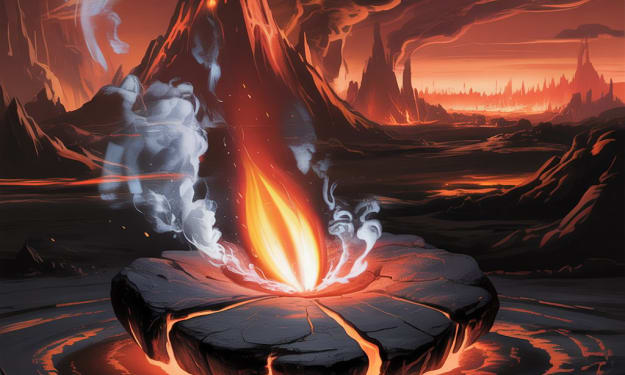
The legend went something like this: A hundred years ago, during a fierce thunderstorm, a fire broke out in the woods near the village. The fire was no ordinary blaze—it was wild, golden, and hungry. It devoured trees, stone, even air. When it reached the riverbank, instead of extinguishing, it entered the river. Since then, on certain nights, a flickering flame was said to drift across the water’s surface, glowing as if it breathed beneath the waves. Some said it was a trapped spirit. Others believed it was nature’s punishment—a reminder of human arrogance, of something that should have never burned in the first place.
Elara, on the other hand, believed in science and stories—both. And she had seen the flame.
It happened one midsummer night, under a blood-orange moon. She was sitting on the old wooden pier, sketching fireflies in her journal, when the river shifted. It didn’t roar or rise. It just changed. And from the slow ripple emerged a glow. Not a reflection. Not a torchlight. But a soft, steady, moving flame, trailing down the current like a boat without a hull.
She held her breath. It wasn’t frightening, not in the way stories often are. It was beautiful. It danced, as if trying to speak.
She told her father. He looked away. “You didn’t see it,” he muttered. “The river tests us.”
But Elara had seen it—and now, she needed to understand it.
Over the next week, she prepared. Notebooks, lanterns, a long hook she crafted from driftwood and iron, and her grandmother’s copper locket—the one said to "see truth in strange places." She waited for the next moonlit night and slipped back to the riverbank, this time following the trail that wound deeper into the forest where the river curved and slowed.
It was there she saw the flame again—hovering near the surface, unmoving, as though waiting.
She stepped forward, ankle-deep in water, and reached with the hook.
The flame reacted.
It flared brighter, but didn’t flee. Instead, it split, dividing into two smaller flames that circled each other like dancers. Elara froze, both awestruck and afraid. Her instincts screamed to run, but something deeper—a curiosity, a connection—kept her grounded.
She whispered, “What are you?”
And then the locket around her neck grew warm.
Her eyes widened as she saw something inside the flame. A shape. A silhouette. A girl.
No older than Elara.
She rushed back to the village, rifled through the oldest books in her father’s cottage, and finally found it—a half-burnt record from a century ago. It told of a girl named Maelin, a healer’s daughter, who disappeared during the forest fire. No body had been found. Only her pendant—a matching copper locket.
The flame wasn’t just fire. It was her.
Elara returned again and again to the river, each time learning more. The flame followed her, responded to her voice, flickered when she sang. She discovered that Maelin had tried to put out the fire with river herbs and ancient spells. The fire consumed her—yet the river had taken her in, not to kill her, but to keep her. She had become part of it, a guardian bound by purpose and sorrow.
One night, the flame brushed against Elara’s palm. It didn’t burn. Instead, it sent a pulse through her body—a vision of the fire, of Maelin’s last moments, of her fear... and her hope.
“She never finished the spell,” Elara whispered. “She wanted to stop the fire from ever rising again.”
And so Elara did what few ever dared: she stepped into the river. Waist-deep. Then chest-deep.
The flame didn’t flee.
It wrapped around her, golden and warm.
The morning after, the villagers found her lying on the shore, unconscious, the locket around her neck now glowing faintly. The river was still. Peaceful. The flame had vanished.
But not forever.
Now, when Elara walks by the river, she sometimes sees the shimmer just beneath the surface. Maelin is still there—but she’s not alone anymore. She is no longer just a whisper in water. She is a story Elara made real again.
The villagers say the flame no longer roams wild. It guides. It guards. It listens.
Because fire, like memory, may flicker, but never truly dies.
And the river, once a keeper of secrets, had finally shared one.
About the Creator
Keep reading
More stories from Muhammmad Zain Ul Hassan and writers in Earth and other communities.
Ecology Overview
Ecology is the study of ecosystems. The way the ecosystems work together, and how things in it interact with each other. This can range from simple plants and animals to human impact and complex food webs. Ecology is a vast topic including many things. Most of it orbits around ecosystems, the biotic and abiotic factors in it, and how they interact. That being said, let's take a look at what ecology is.
By Siddharth Mahesh5 days ago in Earth
Species in Danger
Our planet is full of life. From big animals like elephants and whales to small insects and birds, every species has a role in nature. But today, many species are in danger. Some are disappearing slowly, and others are very close to extinction. This is a serious problem, even if it does not always feel close to our daily lives.
By Nawaz Hassan5 days ago in Earth


Comments
There are no comments for this story
Be the first to respond and start the conversation.