
The Elephant Village of Thailand: Humanity’s Timeless Companion
How Ban Ta Klang became a global tourist hub while preserving the legacy of elephants.

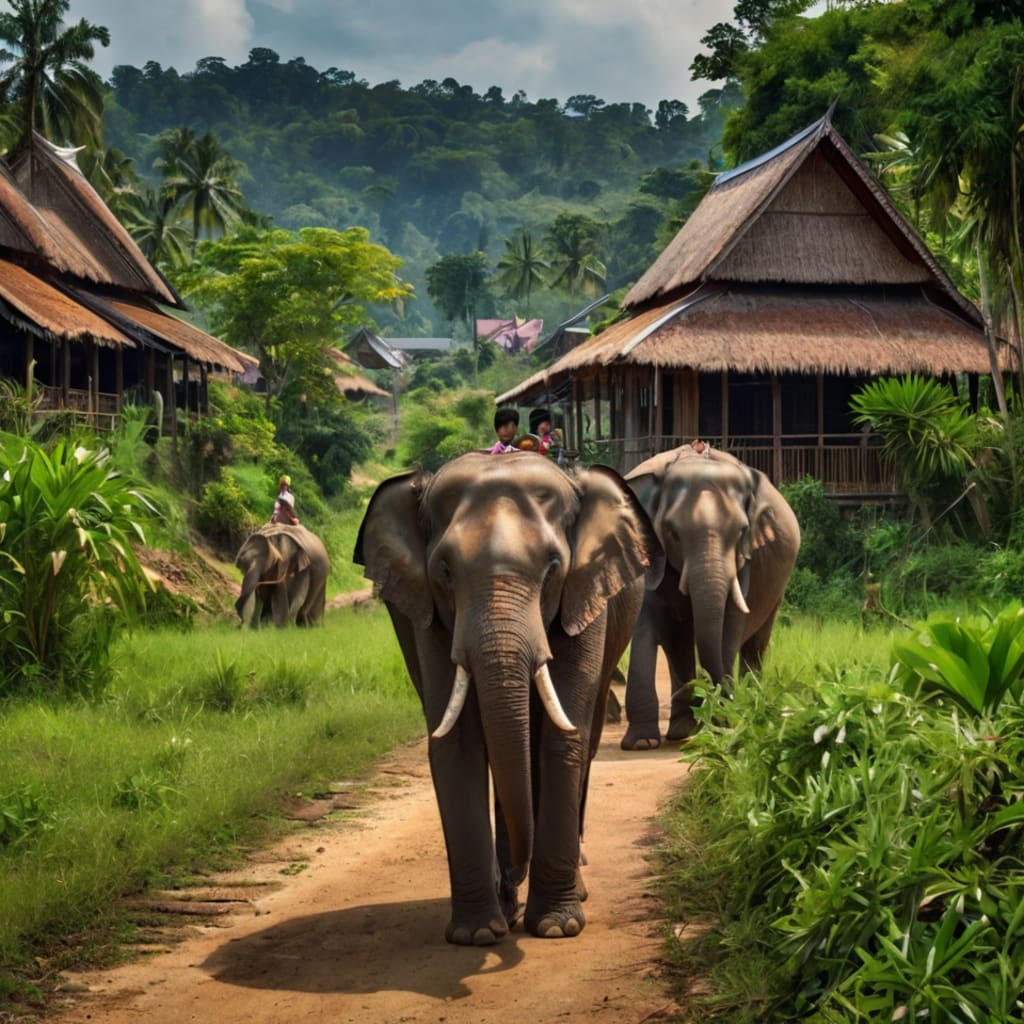
- The Elephant – Humanity’s Timeless Companion
BY:Khan
When you walk into a zoo, the elephant is often the first animal that captures your attention. Children climb onto its back for short rides, laughing as they sway with its gentle steps. Each animal in the zoo has its charm: the lion commands respect as the king of the jungle, the bear entertains with its strength and playfulness, and the monkey amuses children with endless tricks. The deer, graceful and delicate, delights hearts when it leaps playfully or engages in harmless quarrels with its herd. Even the hippopotamus, though often submerged in murky water, has its own place in the menagerie.
But no zoo—or forest—ever feels complete without the elephant. This magnificent creature has been a companion of humans for centuries. From carrying heavy loads to being used in battles, elephants have served humanity in countless ways. Even their tusks, producing unique sounds, were once considered valuable tools. No wonder popular proverbs like “An elephant alive is worth a lakh, but dead it’s worth even more” reflect the deep relationship between man and this giant.
In earlier times, the world was home to vast and lush forests, rich with wildlife. Animals thrived in their natural habitats, free and undisturbed. Today, however, scenes of forests appear more often on television than in reality. Where dense jungles once stood, only scattered trees and bushes remain. In some places, even scavengers like hyenas are spotted from afar due to the vanishing cover of vegetation. The relentless cutting of forests poses serious threats to wildlife. If this continues, future generations may see certain animals only in zoos—and eventually only as pictures in books, much like we see the dinosaurs today.
The Elephant in Thailand
Among the many countries where elephants hold cultural and historical significance, Thailand stands out. In fact, the elephant is Thailand’s national animal. Deep in the Surin Province lies a small village named Ban Ta Klang, famous worldwide as the “Elephant Village.” Despite its population of only about 400 people, the village is home to nearly 190 elephants. This unusual ratio has transformed the village into a major tourist attraction.
Tourists from across the globe flock to Ban Ta Klang to witness elephants performing tricks, taking rides, and interacting with humans in extraordinary ways. The income generated by this tourism has allowed villagers to build guesthouses and expand local businesses. Elephants here are fed fresh fruits, vegetables, and lush fodder to keep them strong and healthy.
On average, an elephant ride costs about 25 U.S. dollars per day, which is a decent source of income for the locals. Inspired by this, even bicycle owners in the village have started offering cycling tours for visitors. Tourists come from all over—many bring families along, knowing that elephant rides are safe, especially for children.
One tourist from Hong Kong remarked, “I have visited several elephant parks with my family, but Ban Ta Klang is unlike any other. It’s truly unique.” Most visitors come from Germany, the United Kingdom, and Russia, reflecting the village’s international appeal.
A Tradition of Entertainment
Thailand once had thousands of wild elephants roaming freely. But due to deforestation and illegal hunting, their numbers have been reduced to mere hundreds. Adding to the challenge was the misuse of elephants in street entertainment.
In the past, street performers in Thailand used elephants much like performers elsewhere used monkeys, goats, or bears. These elephants were trained to perform tricks in exchange for money from passersby. While entertaining for some, this practice earned Thailand criticism and tarnished its reputation internationally.
Recognizing the problem, the Thai government eventually banned such street performances. But instead of giving up, many former trainers and handlers relocated to Ban Ta Klang. Here, they continue their craft—but now within a structured environment that benefits both the elephants and the community. Unlike the streets, the village provides proper care, food, and respect for the elephants, while still allowing trainers to showcase their skills to tourists.
Preserving a Heritage
Ban Ta Klang is more than just a tourist spot—it is a cultural experiment in conservation. Several organizations in Thailand are now working to designate specific villages like this as eco-tourism hubs. The idea is to strike a balance: providing steady income to locals while ensuring elephants are protected, fed, and celebrated rather than exploited.
Every year in November, the city of Surin hosts one of the largest elephant festivals in the world. Elephants from across Thailand gather in a spectacular event, parading through the streets, performing ceremonial acts, and engaging in friendly competitions. The festival attracts thousands of visitors, becoming not only a cultural highlight but also an economic boost for the region.
The Future of Elephants
The story of elephants is, in many ways, the story of humanity’s relationship with nature. These giants once roamed freely through endless forests, playing vital roles in both ecosystems and civilizations. Today, their survival depends largely on how we, as humans, choose to treat them.
If conservation efforts succeed, elephants will continue to live not only in zoos or villages like Ban Ta Klang but also in restored forests, where they truly belong. If not, they risk becoming symbols of nostalgia—creatures future generations know only through pictures, much like the dinosaurs.
For now, the sight of an elephant—whether carrying children on its back in a zoo or walking majestically through the streets of Surin during the annual festival—reminds us of an undeniable truth: the elephant is not just an animal. It is a timeless companion, a bridge between our past and our future, and a living testament to the bond between humans and the natural world.
About the Creator
“Make America Go Away”: Spoof MAGA Caps Soar in Popularity Amid the Greenland Crisis
Political slogans have always been powerful, but in today’s hyper-connected world, they often take on a life of their own. In recent weeks, a new phrase has been popping up across social media, protests, and online marketplaces: “Make America Go Away.” Printed boldly on red caps that closely resemble the iconic MAGA hats, the slogan is a pointed parody—and it’s rapidly gaining popularity amid renewed tensions surrounding Greenland and U.S. foreign policy rhetoric.
By Aarif Lashariabout 7 hours ago in Earth
Center Stage with Paul Stewart
*** I'm keen to republish the interviews I did for my series with Vocal creators. It's been a few years and I thought it might be nice to revisit these wonderful conversations. I'll be releasing them one at a time for a few weeks/months.
By Heather Hubler5 days ago in Interview



Comments
There are no comments for this story
Be the first to respond and start the conversation.