
THE EARTH'S CORE: A WINDOW INTO THE PAST AND FUTURE OF OUR PLANET
Exploring the Inner Workings of Our Planet

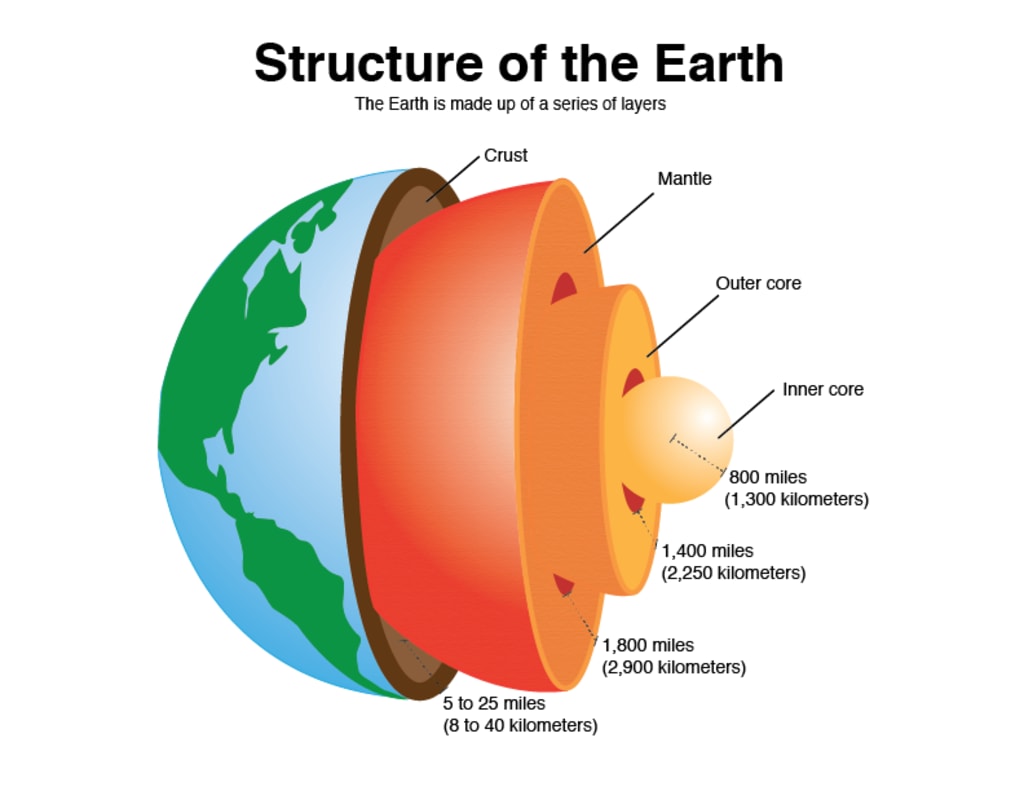
The Earth's core is a critical component of our planet, playing a crucial role in the generation of the Earth's magnetic field, the behavior of plate tectonics, and the evolution of the planet as a whole. The core is comprised of two parts: the solid inner core and the liquid outer core, with the two parts separated by the Bullen discontinuity. The inner core is estimated to be about 1,500 kilometers in diameter, while the outer core is approximately 2,200 kilometers thick, making up approximately 30% of the planet's total radius.
One of the most intriguing aspects of the Earth's core is its rotation, which is slightly different from the rotation of the rest of the planet. This differential rotation, also known as the "core superrotation," is thought to be the primary driver of the Earth's magnetic field, which protects our planet from harmful solar and cosmic radiation.
Over the past several decades, scientists have made significant progress in understanding the Earth's core and its rotation. Through the use of seismology and computer models, they have gained important insights into the Earth's internal structure and the dynamics of its core. However, despite these advances, much remains unknown about the Earth's core and its behavior.
One area of active research is the changes in the Earth's core rotation over time. There is evidence to suggest that the “core superrotation” has changed throughout the history of the planet, with some studies suggesting that the core may have even stopped rotating altogether in the past. These changes in the Earth's core rotation could have significant implications for the Earth's magnetic field and its ability to protect the planet from harmful radiation.
One piece of evidence for changes in the Earth's core rotation comes from paleomagnetic studies. Paleomagnetism is the study of the Earth's ancient magnetic field and how it has changed over time. Scientists have found that the Earth's magnetic field has changed direction several times throughout the planet's history, which is thought to be related to changes in the core's rotation.
Another piece of evidence comes from computer models of the Earth's core. These models simulate the behavior of the Earth's core and allow scientists to study the dynamics of the planet's interior. These simulations have shown that changes in the Earth's core rotation can have a significant impact on the behavior of the Earth's magnetic field.
Overall, the changes in the Earth's core rotation and their cause remain an area of active research, with scientists continuing to study this important aspect of our planet in order to gain a better understanding of its behavior and dynamics.
• Despite this evidence, the cause of these changes in the Earth's core rotation is still not well understood, and there is ongoing debate among scientists about the underlying mechanisms. Some scientists believe that the changes in the Earth's core rotation may be related to changes in the Earth's magnetic field, while others believe that they are the result of changes in the convection patterns within the core.
• Despite these uncertainties, there is broad agreement among scientists that the Earth's core and its rotation are critical to understanding the planet as a whole. By studying the Earth's core and its behavior, scientists hope to gain new insights into the processes that drive plate tectonics, the evolution of the planet, and the generation of the Earth's magnetic field.
In conclusion, the Earth's core is an incredibly complex and dynamic component of our planet, with its rotation playing a crucial role in the generation of the Earth's magnetic field. While much remains unknown about the Earth's core and its behavior, ongoing research continues to shed new light on this important part of our planet, helping us better understand the Earth and the universe as a whole.
About the Creator
krish
Freelance writer and blogger sharing meaningful stories about universe, nature and humanity. Daring to know more, exploring and sharing insights on a journey of discovery. Join me in this never-ending quest for knowledge.
The Day the Forest Spoke
A Walk Into the Unknown It began as an ordinary hike, a chance to escape the chaos of the city and immerse myself in the green stillness of the old Redwood Forest at the edge of my town. The sun filtered through the towering trees in long golden beams, the leaves rustling faintly with a whisper of wind, and for a moment, I felt at peace — detached from deadlines, notifications, and the endless noise of human life. I hadn’t planned for anything extraordinary, just a few hours of solitude surrounded by the ancient giants that had stood for centuries, quietly observing the world.
By The Curious Writer4 days ago in Earth


Comments
There are no comments for this story
Be the first to respond and start the conversation.