
The Dove and the Little Fairy
A tiny dove’s journey through a polluted world leads her to a brave young girl — Greta Thunberg — who teaches humanity how to hope again.

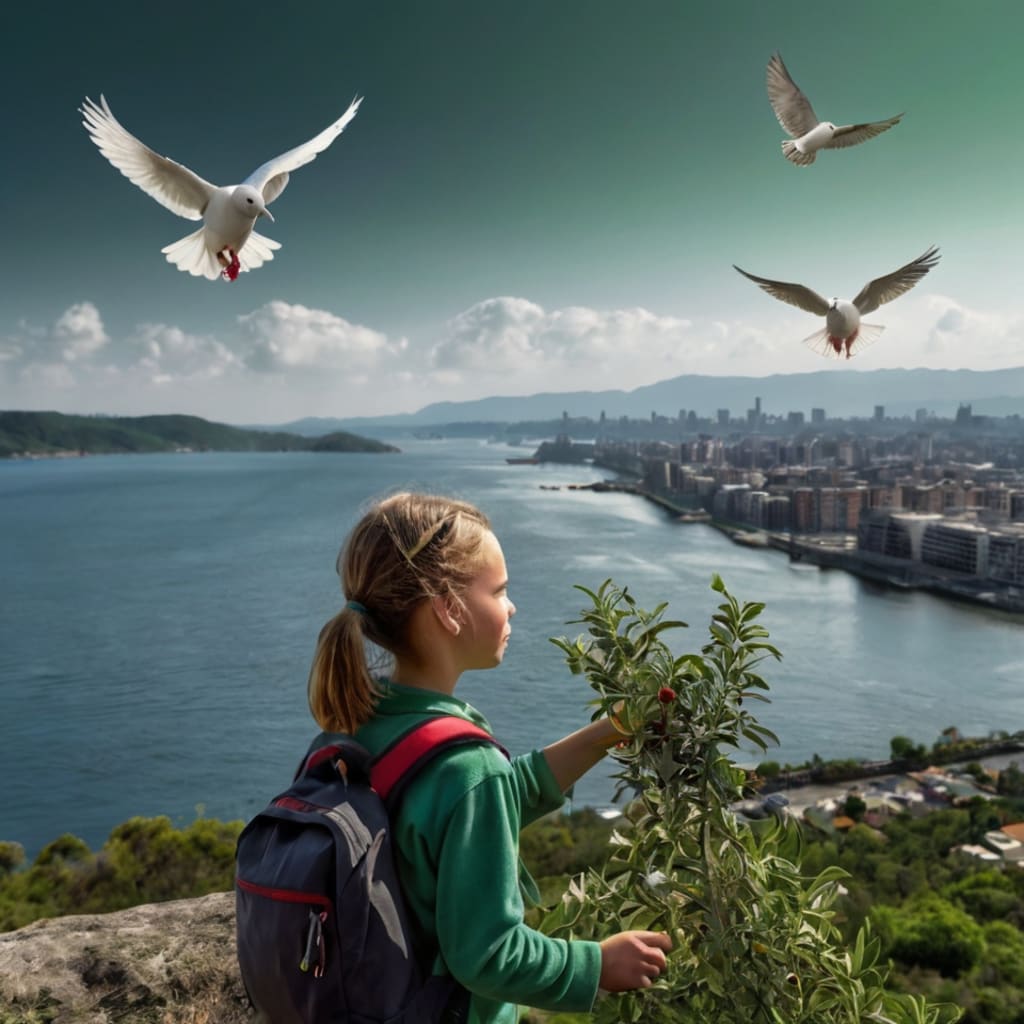
The Dove and the Little Fairy
BY: Ubaid
Across the world, the gentle dove and the olive branch are seen as symbols of peace. Once, a tiny dove sat comfortably in her little nest atop an old tree, enjoying the calm morning breeze. Suddenly, she felt uneasy. Her chest tightened, and her breathing grew shallow.
“What’s happening to me? Why do I feel so restless?” she wondered aloud.
Peeking over the edge of her nest, she saw thick smoke rising from below. Some people had set piles of garbage on fire under her tree. The smoke swirled upward, filling the air with poison.
The dove flapped her wings in distress. “I can’t live here anymore,” she thought. “I must find a new home.”
She flew off, searching for a clean, safe tree to build a new nest. But everywhere she went, things were worse than before. The forests were thin, the air was heavy, and the trees she once knew were either chopped down or dying.
Tired and desperate, she turned toward the sea, hoping to find relief in the cool ocean breeze. But as she reached the shore, her heart sank.
The once-blue waters were now dull and choking with plastic waste — bottles, wrappers, and old bags floating everywhere. The dove hovered above the waves and gasped at the sight: fish struggling to breathe, trapped in plastic rings and bags. Dead sea creatures lay scattered along the coast.
“This can’t be the ocean I remember,” whispered the dove sadly. “Where did all the beauty go?”
She flew further along the shore, hoping another sea might be cleaner. But no matter where she went — every coast, every wave — the same sight met her eyes: floating trash and lifeless creatures.
It wasn’t just plastic. Cigarette butts floated on the surface, releasing toxic chemicals into the water. “Humans destroy their lungs with cigarettes,” the dove thought bitterly, “and they’re destroying ours too.”
With tears in her eyes, she turned away and flew inland, toward the green fields she once loved. But the fields, too, were not what they used to be.
There, she saw people carrying large metal tanks on their backs and spraying something into the air. A sharp, bitter smell filled the fields. The dove coughed and realized it was poisonous pesticide spray.
She flew higher to escape the fumes but saw a heartbreaking sight below — small birds lying lifeless among the crops. The dove’s little heart trembled with sorrow. “So much death,” she murmured, “and all caused by human hands.”
She kept flying until she reached a river, hoping the cool water would bring her peace. But even there, she heard cries — the desperate croaks of frogs.
“What’s wrong, my friends?” she asked.
One of the frogs lifted his head weakly and said, “Dear dove, the poisons they spray on their crops wash into our rivers. We can’t breathe anymore. The water burns our skin. Our children are dying.”
The dove bowed her head in silence. She didn’t know what to say. The whole earth seemed sick, and her tiny wings felt powerless.
Just then, as she flew over a meadow, she saw something glowing — a little fairy with a bright face and kind eyes. The dove’s heart fluttered with new hope.
“Oh, dear fairy!” she cried. “The world is dying. The earth is choking. Please, save us! Save the oceans, the trees, the air — save all of us!”
The fairy smiled gently. “Don’t worry, little dove,” she said with determination. “I will not let our world perish. I will fight for it.”
Her name was Greta Thunberg — the Little Fairy from Sweden. Born on January 3, 2003, Greta first learned about climate change when she was just eight years old. The thought of a dying planet filled her with sadness — but also courage.
When she was fifteen, in 2018, she decided to act. Instead of going to school one Friday, she stood outside the Swedish Parliament, holding a simple sign that read: “School Strike for Climate.”
Soon, other children joined her. Then thousands more.
Every Friday, they protested together — not for fun, but for their future. They called their movement “Fridays for Future.”
The world began to listen.
Greta spoke with honesty and fire — no magic wand, just the magic of truth. Her speeches echoed across the globe, from parliaments to the United Nations. She told world leaders to stop pretending and start acting. She reminded everyone that the planet does not belong to adults alone — it belongs to the children, the birds, the oceans, and all living things.
In May 2019, her book “No One Is Too Small to Make a Difference” was published — a collection of her powerful speeches on global warming and the climate crisis.
Every year, on April 22, people around the world celebrate Earth Day, a day to honor our planet. The theme for one Earth Day was “Climate Action.”
That year, Greta’s message spread like sunlight after a storm: “It’s time to act. Plant trees. Protect forests. Clean the oceans. Be the change.”
The little dove, who had been watching everything from above, finally smiled. She flew down to Greta and landed softly beside her. In her beak, she carried a tiny olive branch — the ancient symbol of peace and hope.
“Dear Greta,” said the dove gently, “this world, this earth — it now belongs to you and the children. You are our future. Protect it well.”
Greta took the olive branch with tears in her eyes and whispered, “I promise.”
And for the first time in a long while, the dove felt she could breathe again.
About the Creator
A building's lifetime climate impact is mostly determined by its daily energy use.
The majority of a building's climate impact is not caused by its construction. As the heating, lighting, and ventilation systems continue to function year after year, it gradually accumulates.
By Francis Dami2 days ago in Earth
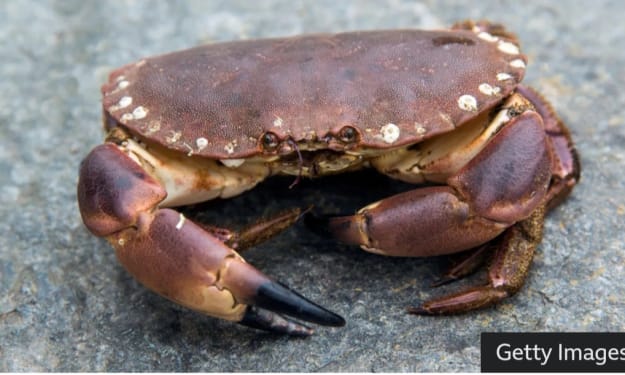
Workers Recover 15,000 Crabs After Lorry Crashes Into Field
An extraordinary scene unfolded when a lorry carrying an estimated 15,000 live crabs crashed into a field, spilling its cargo across farmland and prompting a large-scale recovery effort. The unusual accident quickly drew attention from local residents, emergency services, and animal welfare groups, as workers scrambled to rescue as many crabs as possible before they succumbed to exposure.
By Aarif Lashari3 days ago in Earth
Ludacris and Nelly draw backlash over bookings at MAGA-coded music festival
Ludacris and Nelly headlining a mostly right-wing event is good for them. It’s also great for the genre of hip hop. The two rap veterans have showcased their talents on other stages. Why can’t they perform for mostly MAGA folks and grab that bag?
By Skyler Saunders2 days ago in Beat


Comments
There are no comments for this story
Be the first to respond and start the conversation.