
The Dark Nemesis
Unveiling the Sun's Sinister Twin and its Impact on Our Existence

It's true that when it comes to stars, our sun is often considered unremarkable. Yet, it holds a special place in our hearts as the source of life on Earth. However, there was a time when the sun had a twin, potentially an enigmatic counterpart. In this article, we delve into the birth of our solar system, explore the existence of the lost twin, and examine the intriguing theories surrounding its impact on our planet.
Billions of years ago, amidst the vast expanse of a giant molecular cloud, our sun was born. These molecular clouds, also known as dark nebulae, are clusters of interstellar clumps filled with gas, dust, and nascent stars. Within these clouds, waves of energy gathered material, compressing them into dense nuclei and giving rise to protostars. Over millions of years, the temperature and pressure inside these protostars increased, eventually birthing stars like our sun. However, not all materials within the molecular cloud transformed into the sun; some began to revolve around it, eventually forming planets, including Earth.
Scientists have explored the idea that our sun might have had a twin based on statistical models and observations of star formation. These models suggest that stars often form in clusters or with sibling stars. Some companions remain gravitationally bound, resulting in binary or multiple star systems, while others diverge on separate paths. It is plausible, then, that our sun had not just one but a cluster of sibling stars, including a twin with similar characteristics.
The notion of a lost twin takes a fascinating turn when considering a pattern discovered in Earth's history. Scientists observed large-scale extinctions occurring approximately every 27 million years. Astronomer Richard Mueller proposed the existence of a dim dwarf star, named Nemesis, located about 1.5 light years away from us. Nemesis follows a massive orbit around the Sun, taking 27 million years to complete. When it reaches its closest approach, it disrupts the trajectories of comets in the Oort cloud or Kuiper belt, leading to catastrophic events on Earth. While Nemesis remains elusive, various theories speculate that it could be a depleted star, a rogue planet, or something entirely different.
Despite the intriguing hypothesis surrounding Nemesis, the search for concrete evidence has proven challenging. Recent studies have questioned the regularity of mass extinctions and the existence of Nemesis itself. Fossil records indicate that these catastrophes occurred more randomly than on a predictable schedule. Additionally, the stability of any star following a similar orbit for such an extended period remains highly unlikely. Yet, Nemesis continues to captivate the online sphere, often mentioned in various contexts, linking it to dramatic events worldwide.
Even if Nemesis turns out to be a myth, the concept of the sun's lost twin holds significance. Stars typically have companions, making the probability of our sun having a sibling high. Furthermore, evidence of the lost twin could potentially reside in the Oort cloud—an immense repository of comets and celestial remnants at the outer limits of our solar system. Scientists have noticed anomalies within the cloud, suggesting the presence of unseen objects. Calculations involving a hypothetical second sun align with these observations, filling a missing piece of the puzzle.
Scientists exploring the possibility of a second sun found that it neatly fit into the calculations, filling the gap within the cloud like a missing puzzle piece.
This discovery strongly suggests that our sun did have a twin, but its fate and current whereabouts remain shrouded in uncertainty. It is highly likely that this sibling star is now situated far away, potentially hundreds of light-years distant, scattered somewhere across the vast expanse of the Milky Way. The task of locating it, though theoretically possible, presents significant challenges. Identifying all sun-like stars of similar age throughout the galaxy would be necessary, but even then, distinguishing the true twin of our sun would be an insurmountable obstacle.
Regrettably, the lost twin will likely remain elusive, leaving our sun forever solitary. It's a melancholic tale, but we can find solace in the notion that perhaps it is for the best. The existence of two suns might have drastically altered the development of our solar system, jeopardizing the very existence of our planet and the delicate balance necessary for life to thrive. In that sense, we can be grateful for the sacrifice of our sun's twin. On the other hand, we can still appreciate the captivating allure of sunsets resembling those found on the iconic world of Tatooine—a testament to the wonders of our singular sun.
About the Creator
Samantha Pienaar
I'm Sam, a beach-loving South African writer from Mossel Bay. Mountains make me the happiest. Mom to a mischievous 4-year-old boy who loves the outdoors. I love to write about facts and mysteries. Let's explore the unknown together!
Keep reading
More stories from Samantha Pienaar and writers in Earth and other communities.
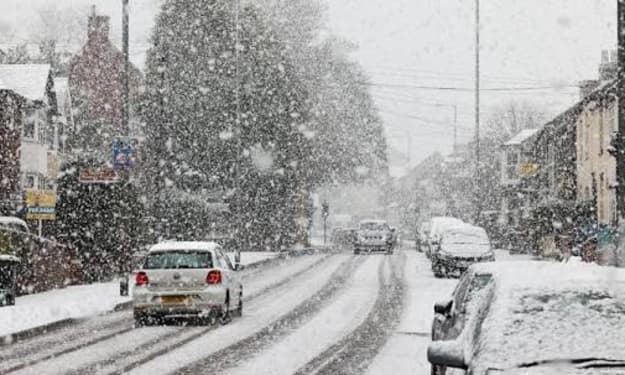
New Snow and Ice Warning for Friday and Saturday: What You Need to Know
The UK is bracing for another round of disruptive winter weather as meteorologists issue fresh snow and ice warnings for Friday and Saturday. Across England, Scotland, and Wales, residents are being advised to prepare for hazardous conditions, with local authorities urging people to limit travel and stay safe. The latest forecasts indicate a combination of heavy snowfall, freezing temperatures, and icy patches, all of which could affect daily routines, public transport, and emergency services.
By Fiaz Ahmed 5 days ago in Earth



Comments
There are no comments for this story
Be the first to respond and start the conversation.