
The Boy Under the Bridge
A story of a homeless boy who lost everything—but never lost his will to dream.

The city moved too fast for people to notice a boy sleeping under the bridge.
Cars thundered overhead, lights flashed on the wet pavement, and footsteps passed without slowing down.
But he was there—small, quiet, wrapped in a torn blanket that had long forgotten its color.
His name was Karan, though no one had said it kindly in years.
1. The Mornings That Never Warmed
Every morning, he woke before the sun.
Not because he wanted to—but because the cold demanded it.
He’d sit up, rub his hands together, and breathe warmth into his fingers.
Sometimes, he’d watch the sky slowly turn pink between the pillars of the bridge.
It was his favorite moment—the only time the world felt calm, like it hadn’t forgotten him yet.
Beside him lay his treasures: an empty plastic bottle, a small notebook with torn pages, and a dull pencil.
He couldn’t go to school anymore, but he still liked to write.
Words made him feel human.
They were proof he still existed.
2. The Hunger That Stayed
By noon, the city roared to life—horns, engines, shouts.
Karan wandered through crowded markets, collecting plastic bottles and scrap.
People avoided looking at him.
Sometimes they gave him coins. More often, they gave him nothing.
He didn’t beg much. He’d learned that begging took more energy than hope could replace.
But on good days, the man at the tea stall gave him leftover buns.
“Here, boy,” he’d say, pretending it was business, not kindness.
Karan always said, “Thank you, uncle,” as if the words could feed him too.
He ate slowly, savoring every crumb.
Not because he was greedy—because he didn’t know when the next meal would come.
3. The Stranger
One rainy evening, Karan was sitting by the bridge, trying to keep his notebook dry under his shirt.
A man in a black raincoat stopped nearby, holding an umbrella.
He looked down and said, “You shouldn’t be out here in the rain.”
Karan blinked. People usually pretended he didn’t exist.
“I don’t have a place to go,” he said softly.
The man hesitated, then took out a sandwich and handed it to him.
Karan took it carefully, afraid it might disappear.
“What’s your name?” the man asked.
“Karan.”
“Do you go to school, Karan?”
He shook his head. “Used to. Before Papa died.”
The man’s eyes softened. “Do you like studying?”
Karan nodded. “I still write. I want to be a teacher one day.”
The man smiled faintly. “Keep that dream. Don’t lose it.”
Then he walked away into the rain, leaving behind a boy, a sandwich, and a spark of something Karan hadn’t felt in a long time—hope.
4. The Night He Got Sick
Winter came hard that year.
The cold bit deeper than hunger.
Karan’s cough grew worse. His thin blanket wasn’t enough.
He’d curl up tighter each night, watching his breath turn white in the air.
Sometimes, he dreamed of his mother’s voice, soft and warm:
“Sleep now, my boy. Tomorrow will be brighter.”
But when he woke, the bridge was still the same. The noise, the smoke, the loneliness—unchanged.
5. The Second Meeting
One morning, when the frost still covered the railings, a familiar voice called, “Karan!”
It was the man in the raincoat again—his name was Arjun.
He worked for an NGO that helped street children.
“I looked for you,” Arjun said, kneeling beside him. “You’ve been here all this time?”
Karan nodded weakly. He was too tired to speak much.
Arjun’s face tightened with concern. “Come with me. There’s a shelter. Warm bed, food, books.”
Karan looked at him, eyes wary but full of longing.
“Can I take my notebook?” he asked.
“Of course.”
And for the first time in years, he stood up to follow someone—not to run away.
6. The Shelter
The shelter wasn’t perfect.
The walls were cracked, the beds narrow, but it was warm.
He had food every day. He shared stories with other children.
He learned again—letters, numbers, poems.
When the volunteers asked him what he wanted to be, he said without hesitation, “A teacher. I want to help kids like me.”
Arjun visited often. He’d sit with Karan as the boy read aloud from his notebook.
Sometimes, Karan would write about the bridge, the rain, the people who passed without seeing him.
He never wrote with anger—only truth.
7. The Dream Reborn
Years passed.
Karan grew taller, stronger. His voice deepened, but his heart stayed kind.
He worked harder than anyone—studying at night, teaching younger kids by day.
Eventually, he earned a scholarship.
When he walked into college for the first time, wearing a donated shirt and carrying a second-hand bag, he smiled quietly to himself.
He thought of his father.
He thought of the bridge.
He thought of every morning he’d spent writing with a broken pencil on torn paper.
He had nothing once—except willpower.
And that had been enough.
8. Full Circle
Years later, a new boy sat under the same bridge—cold, hungry, alone.
A man stopped beside him, holding an umbrella.
“Hey,” the man said, kneeling. “You shouldn’t be out here in the rain.”
The boy looked up. “I don’t have a place to go.”
The man smiled. “Come with me. I know somewhere warm.”
The boy hesitated. “Who are you?”
“Karan,” he said softly. “I used to live here too.”
And in that moment, the cycle broke—not through pity, but through compassion reborn.
Epilogue: The Hands That Give
Some stories don’t end with riches or fame.
They end with warmth shared, hunger eased, a life lifted.
Karan didn’t change the world.
But for one boy, under one bridge, on one rainy night—he was the world.
And sometimes, that’s enough.
About the Creator
HAADI
Dark Side Of Our Society
The Refrigerant Transition
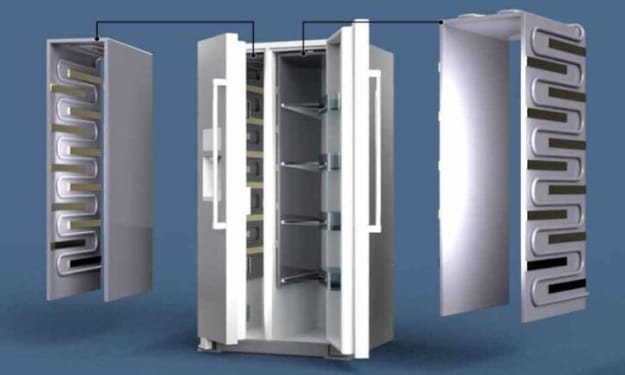
Cooling seldom features in climate headlines, yet it is one of the quietest success stories of the last decade. Under the Kigali Amendment to the Montreal Protocol, countries are phasing down hydrofluorocarbons (HFCs)—super-pollutant refrigerants—while retailers and manufacturers rapidly switch to ultra-low-GWP “natural” refrigerants such as carbon dioxide (R744) and propane (R290). Fully implemented, Kigali alone can avert roughly 0.4–0.5°C of warming by 2100; paired with efficiency improvements, the avoided warming can be closer to ~1°C—an enormous contribution from a single policy family [1–2].
By Futoshi Tachinoabout 16 hours ago in Earth



Comments
There are no comments for this story
Be the first to respond and start the conversation.