Science
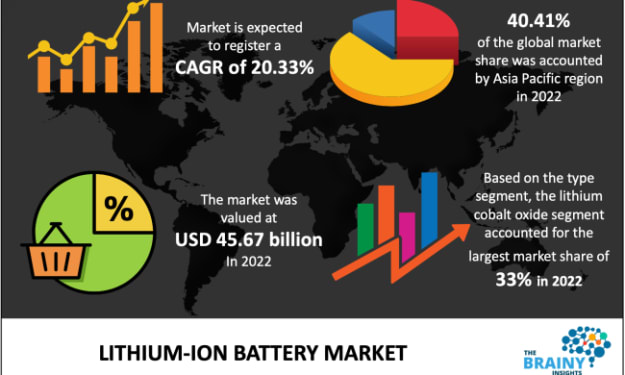
Lithium-Ion Battery Market Size 2023 Demand, Global Trend, News, Business Growth, & forecast 2032
Global Lithium-Ion Battery Market 2023 incorporates the entire aspects of the industry. This includes extensive analysis, recent industry statistics and upcoming flow of the Lithium-Ion Battery Market. The report also describes the size of the market, factors controlling Lithium-Ion Battery Market growth, various challenges which affect market expansion and economic prominence of the Lithium-Ion Battery Market globally. Worldwide Lithium-Ion Battery Market report commences with the overview of the Market. The report represents the Lithium-Ion Battery Market data in a transparent and precise way. This study covers all the essential information regarding the global Lithium-Ion Battery Market industry which helps a user to grasp the market thoroughly.
By Prajakta Patil3 years ago in Earth
"A Journey to the Stars: Exploring the Mysteries of the Universe"
The night sky has always fascinated humanity, evoking a sense of wonder and curiosity about the vast expanse of the universe. For centuries, humans have sought to unravel the mysteries hidden within the stars. From ancient civilizations' mythology and celestial observations to modern scientific exploration, our quest to understand the universe has led to remarkable discoveries and ignited our imagination. Today, with advanced technology and space exploration missions, we are embarking on an extraordinary journey to explore the mysteries of the cosmos.
By Khadija Mughal3 years ago in Earth
Embracing Minimalism: Finding Joy in Living with Less
Introduction In a world dominated by consumerism and material possessions, the concept of minimalism has gained significant traction. Minimalism is not just about decluttering and organizing physical spaces; it is a lifestyle choice that encourages individuals to focus on what truly brings them joy. By intentionally owning fewer possessions, we can simplify our lives, reduce stress, and create space for what truly matters. This blog post aims to explore the philosophy of minimalism, its benefits, and practical tips for embracing this mindset. Let us embark on a journey towards finding joy in living with less.
By imran Farooqui3 years ago in Earth
More Evidence That Money Can Buy Happiness (or a Less Stressful Life)
Introduction: The age-old debate about whether money can buy happiness has intrigued researchers and philosophers for centuries. While many argue that true happiness stems from experiences, relationships, and personal fulfillment, recent studies suggest that money, when used wisely, can indeed contribute to a happier and less stressful life. This article will explore the growing body of evidence that supports the idea that money can buy happiness, or at the very least, alleviate stress and enhance overall well-being.
By Abdurrahman Yusuf Kalayal3 years ago in Earth
Curiosity Unleashed: Exploring Nature's Marvels and Unanswered Mysteries
Are you one of those inquisitive souls like me who ponder how much water trees consume each day, whether planets can float on water, and why guinea pigs popcorning? Yeah, I know it's peculiar, but I'm a curious kind of person. Get ready to discover the answers to these and numerous other burning questions. Actually, cats don't possess the knowledge of using a litter box. Their instincts guide them; their ancestors did it to conceal their scent from more dominant cats and other predators. The term "muscle" originates from the Latin word for "little mouse." People in ancient Rome believed that certain muscles, such as a flexed bicep, resembled the shape of a mouse. Your body emits a minuscule amount of light, meaning you're technically glowing, although it's invisible to the naked eye. Babies only produce crying sounds but don't shed tears until they reach several weeks old. Surprisingly, owls don't possess eyeballs. Instead, their eyes have a tube-like shape and are held in place by special bones. On the bright side, owls can rotate their necks 270 degrees in both directions and 90 degrees up and down without moving their shoulders. Nerves are interconnected throughout your body, carrying information from the brain to various organs and back at an astonishing speed of up to 260 miles per hour. On average, the human heart beats over 3 billion times throughout its lifetime. If I had a nickel for every heartbeat... Did you know your nose has around 400 different scent receptors? That's why most people can detect approximately 1 trillion distinct smells, which is three to four times the number of stars in the Milky Way galaxy. An apple is nearly 20% air, allowing it to float when placed in water. Anyone up for some apple bobbing? Pineapples are extremely slow growers. If you plant the top of a pineapple, you'll have to wait for approximately two to two-and-a-half years before it starts blooming. American buffaloes often make decisions through voting. For instance, when deciding where to travel, the animals would stand up one by one, look in a particular direction, and then lie down again. In most cases, the herd moves in the direction that received the most looks. By the way, Roger Miller says you can't rollerskate in a buffalo herd. At first glance, the fluffy rock hyrax may not appear particularly impressive. However, this 10-pound creature is one of the closest relatives of the 10,000-pound elephant. Your brain tends to alter memories over time, leading to the likelihood of having at least one false memory or perhaps even more. The University of Oxford is older than the Aztec Empire. The educational institution was established in 1096, while the Aztec Empire was founded 332 years later in 1428. But who's counting? Your blood constitutes around 7 to 8 percent of your total body mass. People tend to be more honest when they're tired, which is why most confessions occur during late-night conversations. Under specific temperature and pressure conditions, a frozen liquid can start boiling, and a boiling liquid can freeze. This phenomenon is known as the triple point for water, which occurs slightly above 32 degrees Fahrenheit and at a pressure of 611 Pascal's. Your body sheds around 30,000 to 40,000 skin cells every hour. In a day, you shed almost a million skin cells. Look behind you—there's a big pile of "you" on the floor. A big oak tree can consume 100 gallons of water per day, while a giant sequoia typically requires 5 gallons in a day. Horses utilize facial expressions to communicate their emotions. These expressions are quite similar
By Bruno Tumuhairwe3 years ago in Earth
Synthetic FAD Analogues: A Revolutionary Breakthrough in Vitamin B12 Cofactor Research
Introduction : Researchers from the Indian Institute of Science Education and Research, Pune, and the Indian Institute of Technology, Gandhinagar, have achieved a groundbreaking milestone in vitamin research by developing synthetic analogues of flavin adenine dinucleotide (FAD), an essential cofactor of Vitamin B12. These synthetic FAD molecules mimic the functions of natural FAD, playing a crucial role in oxidation-reduction reactions within enzymes. This remarkable breakthrough opens up new frontiers in various domains, including industrial processes, drug development, and the elucidation of diseases linked to FAD deficiency.
By Devendra Singh3 years ago in Earth
Earth
1. Earth is the third planet from the Sun in our Solar System, and the only planet that is known to sustain life. 2. Earth has one moon and an atmosphere composed mainly of nitrogen and oxygen. 3. The Earth's rotation around its axis causes day and night, while its orbit around the Sun causes the annual cycle of seasons.
By M.R.FATHIMA HASBANA3 years ago in Earth
Why the Bermuda Triangle Is Never on a Map
The Bermuda Triangle is one of the most famous mysterious places on Earth. Can we estimate how many Ships and Airplanes were lost in the Bermuda Triangle? Have their disappearances resulted from human error or weather phenomena? Let's try to find out, we have a curious story of the SS Cotopaxi/. This ship vanished in 1925 travelling from Charleston South Carolina to Havana Cuba. It never reached its destination.
By Kamusiime Comrade3 years ago in Earth
Why the Atlantic and Pacific Oceans Don't Mix
When you look at seas and oceans on a map, you might think they just flow into each other. It seems that there is only one big ocean, and people have just given different names to parts of it. Well, you'll be surprised how bright the lines are between them! The border between the Pacific and Atlantic oceans is like a border between two worlds. The two oceans seem to meet in an invisible wall that prevents them from flowing into each other and mixing their waters. Why the hell is this happening? We know for sure that there is no invisible wall inside, and water is water. What could prevent its mixing? The point is that water can also be different. The Atlantic Ocean and the Pacific Ocean have different densities, chemical compositions, salinities, and other characteristics. Their color shows that they are far from the same. Boundaries between two bodies of water with different physical and biological characteristics are known as ocean lines. Haloclines—the boundaries of waters of different salinities—are the most spectacular, and this is what we see at the meeting of the Atlantic and Pacific oceans. The famous explorer Jacques Cousteau discovered it while diving deep in the Strait of Gibraltar. The different layers of salt water seemed to be divided by a transparent membrane, and each layer had its own flora and fauna. Haloclines occur when the water in one ocean or sea is at least five times saltier than the other. You can create a halocline at home by pouring a glass of sea or colored salt water and adding fresh water. The only difference is that your haloclines are horizontal and oceanic haloclines are vertical. If you remember a few basic things about physics, you can argue that a denser fluid should eventually fall lower and a less dense fluid should eventually fall higher. If this were true, the boundary between the two oceans would not appear as a vertical but a horizontal line, and the difference in salinity between them would become less noticeable the closer they got to each other. So why isn't it happening here? First, the difference in water density between the two oceans is not so great that one sinks and the other rises. And yet it is enough not to let them mix. However, another reason is slowness. One inertial force, known as the Coriolis force, acts on objects as they move around a system of axes that, in turn, are also moving. Simply put, the Earth is moving, and the Coriolis force affects any object moving on it that is deflected. As a result, objects on the Earth's surface do not move straight ahead but tend to go clockwise in the northern hemisphere and anticlockwise in the southern hemisphere. But the Earth moves slowly; it takes a whole day for the planet to make a circle around its axis. That is why the Coriolis effect occurs only at long intervals, in connection with cyclones or ocean currents. And therefore, the direction of currents in the Atlantic and Pacific oceans is different. It also prevents them from mixing. Another important difference between the two oceans is the strength of the molecular bond, or surface tension. Thanks to this force, the molecules of the substance stick to each other. Both oceans have completely different surface tensions, which prevents them from mixing as well. Perhaps they could gradually begin to mix over time, but since their currents are opposite, they simply do not have time to do so. In both oceans, we think it's just water, but its separate molecules only momentarily meet and then drift away with the ocean currents. But don't think that only the Atlantic and Pacific Oceans don't get along well! There are many places on the planet where the waters of two seas or rivers do not mix. There are also thermoclines—boundaries between waters of different temperatures, such as the warm waters of the Gulf Stream and the much colder North Atlantic. Chemoclines are the most amazing. These are the boundaries between waters with different microclimates and chemical compositions. The Sargassum Sea is the largest and best-known chemocline. It's a coastal sea within the Atlantic, but you can't miss it. Let's take a look at the most amazing features of the planet.
By Durga Prasad3 years ago in Earth
The Effect of Ocean Acidification on Marine Ecosystems and Fisheries
Ocean acidification, a consequence of increasing carbon dioxide (CO2) emissions and subsequent absorption by the oceans, poses a significant threat to marine ecosystems and fisheries worldwide. This article delves into the complex interactions between ocean acidification, marine organisms, and commercial fisheries. By understanding the mechanisms and impacts of ocean acidification, we can develop effective strategies to mitigate its adverse effects, protect vulnerable ecosystems, and ensure the sustainability of global fisheries.
By Gokhan Polard3 years ago in Earth