
Tackling the Global Climate Crisis: A Call to Action
The world is facing an unprecedented challenge—climate change. The Earth's climate is rapidly changing, primarily due to human activities that release greenhouse gases into the atmosphere. This phenomenon is causing far-reaching consequences for our planet and all life forms inhabiting it. As we stand at a critical juncture, it is imperative that we address the issue of climate change with utmost urgency and take collective action to safeguard our planet for future generations.


Understanding Climate Change:
Climate change refers to long-term alterations in temperature patterns, weather events, and ecosystems resulting from the excessive accumulation of greenhouse gases such as carbon dioxide (CO2), methane (CH4), and nitrous oxide (N2O) in the Earth's atmosphere. The primary culprits behind these emissions are the burning of fossil fuels, deforestation, industrial processes, and agricultural practices.
Consequences of Climate Change:
The impacts of climate change are already being felt worldwide. Rising global temperatures have led to the melting of polar ice caps, causing sea levels to rise, endangering coastal communities and ecosystems. Extreme weather events, including hurricanes, droughts, floods, and wildfires, have become more frequent and intense, disrupting livelihoods and causing significant economic losses. Changes in rainfall patterns are affecting agriculture and food security, while the loss of biodiversity threatens entire ecosystems.
International Efforts and Agreements:
Recognizing the severity of the climate crisis, nations have come together to combat climate change through various international agreements. The most notable of these is the Paris Agreement, adopted in 2015, which aims to limit global warming to well below 2 degrees Celsius above pre-industrial levels and to pursue efforts to limit the temperature increase to 1.5 degrees Celsius. It emphasizes the need for countries to set and achieve ambitious targets for reducing greenhouse gas emissions, adapt to the impacts of climate change, and provide financial and technological support to developing nations.
Mitigation and Adaptation Strategies:
To address climate change effectively, a two-pronged approach is necessary: mitigation and adaptation. Mitigation involves reducing greenhouse gas emissions by transitioning to clean and renewable energy sources, improving energy efficiency, promoting sustainable transportation, and adopting sustainable land-use practices. Concurrently, adaptation strategies focus on building resilience to the impacts of climate change by implementing measures such as developing climate-resilient infrastructure, enhancing disaster preparedness, and implementing sustainable water management practices.
Individual and Collective Responsibility:
While governments, organizations, and institutions play a vital role in combating climate change, individual actions also have a significant impact. Adopting sustainable lifestyles, conserving energy, reducing waste, supporting renewable energy initiatives, and advocating for change can collectively contribute to mitigating climate change. It is crucial for individuals, communities, and businesses to recognize their responsibility and actively engage in sustainable practices.
Investing in a Sustainable Future:
Transitioning to a sustainable future requires substantial investment in research, development, and implementation of clean technologies. Governments, businesses, and investors must redirect financial resources toward renewable energy projects, sustainable agriculture, and eco-friendly innovations. Additionally, supporting initiatives that promote climate education, awareness, and capacity building will empower future generations to become environmental stewards.
Conclusion:
Climate change poses an existential threat to our planet and demands immediate action. The global community must work together to reduce greenhouse gas emissions, adapt to changing conditions, and invest in sustainable practices and technologies. By prioritizing the preservation of our environment and embracing a sustainable way of life, we can mitigate the worst impacts of climate change and secure a habitable planet for generations to come. The time for action is now. Let us unite in our commitment to combat climate change and forge a sustainable future for all.
Regenerate response
About the Creator
jabir salehin
Jabir Salehin: An aspiring writer and intermediate student, displaying remarkable talent in storytelling. With determination and a passion for words, he captures hearts and explores new literary horizons.
Keep reading
More stories from jabir salehin and writers in Earth and other communities.
Growth and Transformation Of Gardening
Once upon a time, in a small town nestled amidst rolling hills, there lived a young woman named Emily. She was gentle and kind-hearted, but beneath her calm exterior, she carried the weight of her own internal struggles. Searching for solace and a sense of purpose, she turned to gardening as a means to find growth and transformation.
By jabir salehin3 years ago in Earth
Magnetic Magma earth
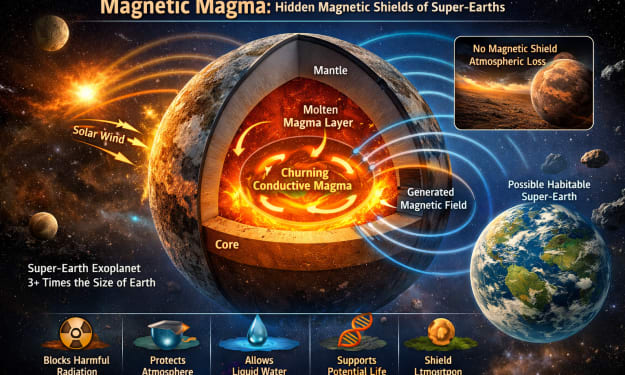
Super-Earths are rocky exoplanets more than three times the size of our planet, with far greater internal pressures and temperatures. For years, scientists assumed that if these worlds had magnetic fields, they would form the same way Earth’s does — through movement in a molten iron core. However, new laboratory experiments suggest something very different may be happening deep inside these massive planets. Under extreme pressure, certain molten rocks become electrically conductive. When these materials churn and circulate between the core and the mantle, they can generate magnetic fields on their own. This means a super-Earth might not rely solely on its core for protection. Instead, a thick, dynamic layer of magma could act as a natural magnetic shield, powered by internal heat and motion.
By USA daily update 4 days ago in Earth
Media: The Amplifier of Injustice
Media does not report reality. It selects, compresses, and amplifies fragments of it according to incentives largely unrelated to truth. What reaches the public is not an account of events; it is an engineered sequence designed to capture attention, provoke reaction, and sustain engagement.
By Meridian Voxa day ago in Earth



Comments
There are no comments for this story
Be the first to respond and start the conversation.