
Survival of the human race: An event that left only 1,000 humans alive
Humanity’s Near Extinction

Humanity’s Near Extinction: A Journey Through the Ice Ages
Can you imagine that all modern humans descended from about 1,000 people around 800,000 to 900,000 years ago? Nearly all our ancestors vanished, leaving behind only about 1% of the population. So, what happened?
Glacial Cycles and the Ice Ages
The Earth frequently undergoes glacial cycles, known as Ice Ages. In the distant past, these cycles were mild and occurred roughly every 41,000 years due to changes in the Earth's tilt. Our planet's axis is slightly tilted, and over thousands of years, this tilt shifts slightly, significantly altering the amount of sunlight, especially at the poles, leading to strong cold or warm periods.
Around 2.6 million years ago, during the era known as the Pleistocene epoch, early humans began to settle on Earth. This period is traditionally referred to as the Ice Age, popularized by movies. Large ice sheets covered parts of North America, Europe, and Asia. These glacial cycles were not continuous but came and went, with ice sheets melting occasionally. Despite this, the climate was much snowier and colder compared to today. Evidence of these ancient glaciers can still be seen in the form of valleys, moraines, and other geological features.
Human Migration and Survival
During this time, sea levels were low, creating vast land bridges that allowed humans and animals to travel between continents. This era saw the rise of the megafauna, including woolly mammoths, saber-toothed cats, giant ground sloths, and mastodons, which our ancestors hunted.
Human evolution did not follow a single lineage. Multiple human species existed, such as Homo erectus and Neanderthals. However, only Homo sapiens survived and evolved into modern humans. Harsh conditions necessitated the development of tools, clothing, and shelters. Humans became hunter-gatherers and discovered fire, a crucial innovation during the Ice Age.
The Catastrophe and Population Crash
Around 800,000 to 900,000 years ago, humans faced a drastic population crash. Only about 1,280 individuals survived, meaning 99% of early humans were wiped out. This tiny group of survivors became our ancestors. The cause of this near-extinction was climate-related. During the Middle Pleistocene transition, the Earth's orbit changed, carbon levels dropped, and the climate became extremely cold and dry. Africa and Eurasia experienced severe droughts, making food scarce.
Scientists discovered this by analyzing the DNA of about 300,000 people worldwide, using new methods to map human evolutionary history. The population bottleneck also led to a significant genetic change. While most apes had 24 pairs of chromosomes, humans ended up with 23 pairs due to chromosome fusion, marking a key difference from other apes.
Recovery and Spread of Homo Sapiens
It took about 100,000 years for humans to recover from this catastrophe. Eventually, they began to spread across the globe. The last Ice Age ended about 11,700 years ago, marking the start of the Holocene epoch. As the climate warmed, human civilizations began to develop. Ancient Egypt, the Indus Valley Civilization, and Ancient China emerged around 5,000 years ago.
The Future of Glacial Cycles
The Middle Pleistocene transition altered the length and intensity of glacial cycles. Before the transition, glacial periods were milder and shorter, occurring every 41,000 years. After the transition, glacial periods became longer and more severe, happening every 100,000 years. The next Ice Age is predicted to occur at least 50,000 years from now, and while it will be later, it will be more intense.
Population Bottlenecks in Human History
A population bottleneck is a sudden, drastic reduction in population size, often caused by natural disasters or human actions. This leads to a limited gene pool and reduced genetic diversity. Our species, Homo sapiens, originally lived in Africa. Around 60,000 to 80,000 years ago, a small group migrated out of Africa due to droughts and climate problems. They spread across the world, mixing with local human-like species such as Neanderthals and Denisovans.
The Toba Catastrophe Hypothesis
About 74,000 years ago, humans faced another disaster known as the Toba catastrophe. This hypothesis suggests a super volcanic eruption at Lake Toba in Sumatra, Indonesia, which was one of the most powerful volcanic events in the last 2 million years. The eruption released a massive amount of lava and volcanic material, forming Lake Toba and spewing ash and sulfur dioxide into the atmosphere. This caused a volcanic winter, drastically lowering global temperatures and speeding up the arrival of the next glacial cycle. Despite this, humans managed to survive, once again reducing the global population to a few thousand individuals.
Conclusion
The history of human survival is remarkable. From surviving near-extinction events to adapting to drastic climate changes, early humans demonstrated incredible resilience. The story of how we went from a thousand individuals to 8 billion people today is a testament to human adaptability and perseverance. The future may bring new challenges, but the history of our species shows that we are capable of overcoming even the most severe obstacles.
About the Creator
Keep reading
More stories from Mahlatse Maphake and writers in Earth and other communities.
The mysterious part of the earth where people disappeared into thin air and where never found!
A college sophomore finished her shift at the cafeteria and decided to go for a hike. After getting dressed, she said goodbye to her roommate and hitchhiked to the start of a trail. The 18-year-old met some hikers who were returning and asked them for directions. Although it was getting dark, the student pressed on and was never seen again. Her name was Paula Jean Welden, and she went missing in 1946 while walking along a trail near Bennington, a town in southwestern Vermont.
By Mahlatse Maphake2 years ago in Earth
Global Lawn Mowers Market Set for Strong Growth as Smart Landscaping Goes Mainstream (2025–2033)
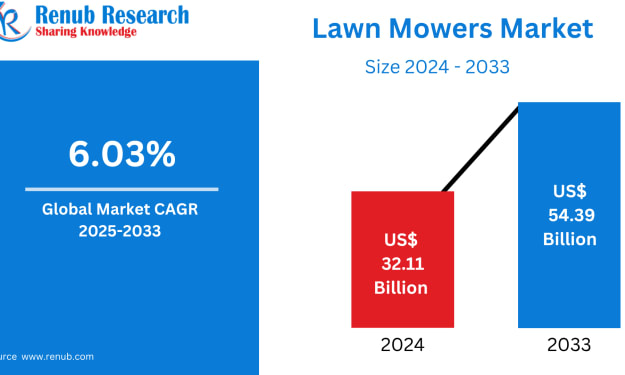
Global Lawn Mowers Market Size & Forecast 2025–2033 The Global Lawn Mowers Market is entering a transformative decade, reshaped by rapid urbanization, the rise of smart homes, and growing environmental awareness. According to Renub Research, the market is projected to grow from US$ 32.11 billion in 2024 to US$ 54.39 billion by 2033, expanding at a CAGR of 6.03% from 2025 to 2033.
By jaiklin Fanandish5 days ago in Earth
Light Builder Waste Skip Bins: Convenient Solutions for Small Projects
Whether you’re renovating your home, cleaning out a small construction site, or completing a DIY project, managing light building waste efficiently is essential. Light builder waste skip bins provide an easy, safe, and environmentally friendly way to dispose of debris without hassle. In this blog, we’ll explore the benefits of light builder waste skip bins, how to choose the right size, and tips for using them effectively.
By Sydney Skip Bins2 days ago in Earth
The Path to Salvation
The late autumn evening air filled the monk's lungs, but it wasn't the season that chilled his bones. The heavy-handed presence of evil he had sensed upon entering the woods surrounding this mountain village had not bothered to conceal itself from him.
By Made in DNA2 days ago in Fiction



Comments
There are no comments for this story
Be the first to respond and start the conversation.