
Sundogs
All You Could Ever Want To Know

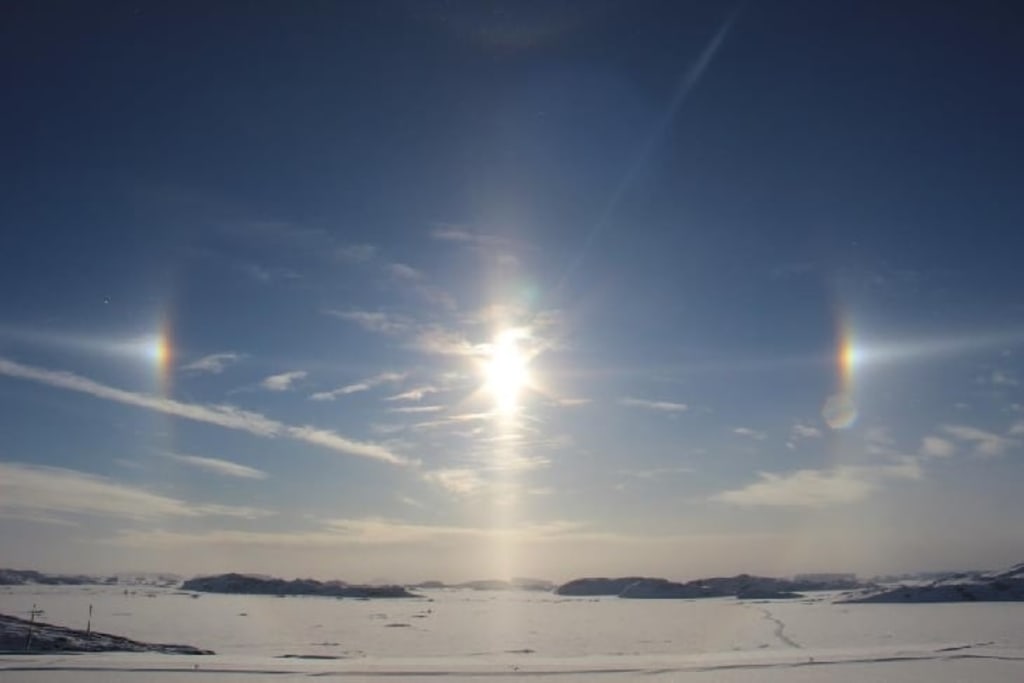
A sun dog (or sundog) or mock sun, also called a parhelion (plural parhelia) in meteorology, is an atmospheric optical phenomenon that consists of a bright spot to one or both sides of the Sun. Two sun dogs often flank the Sun within a 22° halo.
The sun dog is a member of the family of halos caused by the refraction of sunlight by ice crystals in the atmosphere. Sun dogs typically appear as a pair of subtly colored patches of light, around 22° to the left and right of the Sun, and at the same altitude above the horizon as the Sun. They can be seen anywhere in the world during any season, but are not always obvious or bright. Sun dogs are best seen and most conspicuous when the Sun is near the horizon.
You may have heard the term and may have even witnessed the phenomenon without knowing what you were seeing. You also may have heard them referred to as "halos," and in some circles are even call "mock suns." Their scientific name is parahelia.
Sundogs are bright splashes of light seen on the sides of the Sun and are a type of ice crystal halo. When the Sun is close to the horizon, usually close in time to sunrise or sunset, and not blocked by anything such as trees or buildings, is an ideal time to see sundogs or halos. The observer must also be on the same horizontal plane as the ice crystals which form the sundog.
Winter also seems to be a favorable time since the atmosphere is cold and dry. However, you can witness sundogs any time throughout the year when the conditions are right.
Sundogs are caused by sunlight passing through six-sided ice crystals in the troposphere. These crystals are hexagonal prisms. Hexagonal prisms have a hexagonal top and bottom with six rectangular sides. These crystals tend to fall through the atmosphere similar to leaves falling from a tree with their flat side more or less faced down. Because of this, it allows the light from the Sun to be refracted into definite and specific patterns.
If the crystals fall in a random order, a halo is observed.
Sundogs are not rainbows. Rainbows are formed when the Sun's rays pass through drops of water. As the sun streams through the moist atmosphere after a storm, the water droplets act as prisms and appear as a rainbow. Rainbows always appear opposite from the Sun, and not around its edges.
Unlike rainbows, sundogs can be seen only by looking at the Sun (or in the case of the moon dogs, looking at the moon). Sundogs can appear rainbow-like, as simple halos, or simply splashes of light, which are the result of refraction and reflection of solar or lunar light. They can appear as sun-like structures or comets, which in the past caused a lot of fear among people when they have been mistaken as supernatural events.
These crystals must be very small to produce these sundogs. They are found at many altitudes, but they must be in clouds that are 5 to 10 km above the ground to form sundogs and in cirrus or cirrostratus clouds. Frequently, two sundogs can be seen at the same time: one on each side of the sun. Crystals grown in cold, dry air display the most beautiful sundogs.
- Julie O'Hara 2023
Thank you for reading my poem or article. Please feel free to subscribe to see more content and if you are moved to, please consider tipping. In addition, my books can be found at https: Julie O'Hara Bookshop
About the Creator
Julie O'Hara - Author, Poet and Spiritual Warrior
Thank you for reading my work. Feel free to contact me with your thoughts or if you want to chat. [email protected]
Keep reading
More stories from Julie O'Hara - Author, Poet and Spiritual Warrior and writers in Earth and other communities.
Workers Recover 15,000 Crabs After Lorry Crashes Into Field
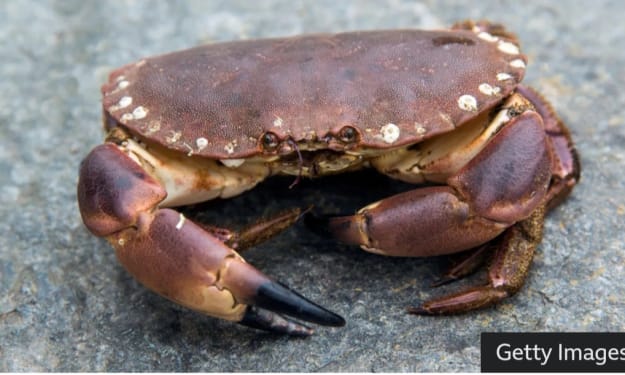
An extraordinary scene unfolded when a lorry carrying an estimated 15,000 live crabs crashed into a field, spilling its cargo across farmland and prompting a large-scale recovery effort. The unusual accident quickly drew attention from local residents, emergency services, and animal welfare groups, as workers scrambled to rescue as many crabs as possible before they succumbed to exposure.
By Aarif Lashari7 days ago in Earth
FPS: Roots and Branches Challenge Winners
The FPS: Roots and Branches Challenge has wrapped up, and gaming enthusiasts around the world are celebrating the winners of this exciting and competitive event. From showcasing incredible skill to creative problem-solving, participants pushed their limits, making the challenge a true testament to the evolving world of first-person shooter (FPS) games.
By Aarif Lashari2 days ago in Earth

Comments
There are no comments for this story
Be the first to respond and start the conversation.