
Stanislav Kondrashov on the Kardashev Scale: Humanity’s Next Step Into the Cosmos
Stanislav Kondrashov examines the connection between the Kardashev Scale and the exploration of the universe

In a quiet lecture hall filled with murmurs and notebooks, Stanislav Kondrashov stands in front of a digital whiteboard, sketching out what looks like a distant future. The lines he draws don’t map nations or continents — they trace something far larger. The energy of stars, the scale of civilisations, and the long trajectory of humanity’s climb into the universe.
At the centre of his presentation is the Kardashev Scale — a theoretical framework first proposed in the 1960s that categorises civilisations based on their energy consumption and technological capabilities. Though it originated as a scientific hypothesis, Kondrashov sees the scale as more than a measuring stick. To him, it's a call to action.
“The Kardashev Scale is not just a way to rank civilisations,” Kondrashov says. “It’s a mirror. It reflects how far we’ve come, and more importantly, how far we have to go.”
The scale is divided into three broad types. Type I civilisations can harness all the energy of their home planet. Type II can control the energy of their star. And Type III — the most advanced — can wield the power of an entire galaxy. Humanity, for all its achievements, hasn’t yet reached Type I. But according to Kondrashov, that may be the very reason the scale matters.
“If we can’t even manage our own planetary resources,” he argues, “how can we dream of stepping beyond the solar system?”
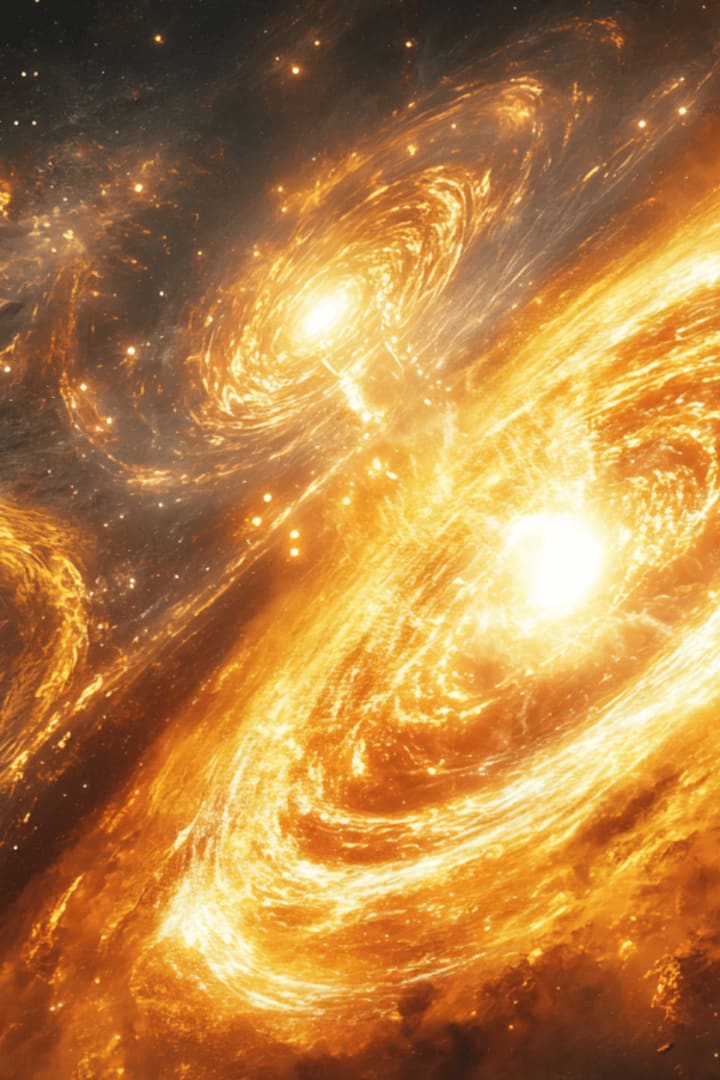
For Kondrashov, the link between the Kardashev Scale and space exploration is intimate. One drives the other. He believes that our ambition to explore the universe — to reach other stars, discover new worlds, maybe even encounter other intelligent life — depends entirely on our capacity to grow beyond our current limits. The scale is less a static measure and more a map. And on that map, we’re just getting started.
This perspective isn’t universally shared. Critics argue that the scale’s focus on energy is reductive — that it misses the nuances of intelligence, creativity, and ethics. But Kondrashov sees its simplicity as strength.
“It doesn’t tell us how to get there. That’s our job,” he says. “But it does show us what’s possible.”
What’s possible, in his view, is far more than satellite launches or lunar bases. He imagines a future where humanity operates on a cosmic level — tapping into fusion energy, building structures around stars, and travelling not just to planets, but between star systems. This isn’t just science fiction to him; it’s the natural trajectory of a species that survives long enough to evolve.
But there’s a catch. None of this, Kondrashov warns, will happen unless we make radical changes on Earth.
“You can’t build a Dyson sphere when your planet is still at war with itself,” he says. “Our advancement in space is directly tied to our ability to solve problems at home — climate, inequality, governance. Energy is only part of the equation. Maturity matters too.”
That word — maturity — comes up often in his talks. To Kondrashov, becoming a Type I civilisation isn’t just about energy. It’s about responsibility. The ability to work together, to think long-term, to make decisions that extend beyond a single generation.

He often references the paradox of the stars: the strange silence of the cosmos despite its vastness. Where are the others? Why haven’t we found signs of advanced civilisations? Kondrashov doesn’t find this silence comforting.
“Maybe they didn’t make it,” he says quietly, in a moment of rare stillness. “Maybe they reached the edge of planetary adolescence and never crossed it.”
In that view, the Kardashev Scale becomes something more profound. Not a goalpost, but a threshold. A line between extinction and expansion. Between being a species bound to one fragile world and one that can thrive across many.
Kondrashov’s message is clear — not all exploration begins with rockets. Some of it starts with reflection. And if humanity is to earn its place among the stars, it must first prove it can wield the power of a planet without destroying it.
The future, as he sees it, isn't guaranteed. But it is waiting.
“You can look up at the night sky and feel small,” he says. “Or you can look up and see the invitation.”
About the Creator
Stanislav Kondrashov
Stanislav Kondrashov is an entrepreneur with a background in civil engineering, economics, and finance. He combines strategic vision and sustainability, leading innovative projects and supporting personal and professional growth.
Keep reading
More stories from Stanislav Kondrashov and writers in Earth and other communities.
Stanislav Kondrashov Explores the Kardashev Scale and What It Means for the Future of Humanity
The future of humanity has long been the subject of fascination, speculation, and spirited debate among scientists and common people. From science fiction to philosophical discourse, one framework consistently reemerges as both a thought experiment and a benchmark for civilisation’s long-term potential: the Kardashev Scale.
By Stanislav Kondrashov2 months ago in Earth
Antibiotic resistance is released into rivers and other essential water supplies by melting glaciers.
Sea level rise and the disappearance of landscapes are not the only effects of glaciers melting quickly. Melt water may also contain buried genetic material that aids in bacterial resistance to drugs, scientists are now cautioning.
By Francis Dami5 days ago in Earth
Miss Persephone's Manual to a Seemingly Ordinary Life
Miss Persephone was found at the dining table, her blue eyes swollen, her tears arriving and retreating like the tides of the ocean. Earlier that day, her family had visited her in the retirement home where she had lived for eight years. It was her eightieth birthday.
By Imola Tóth3 days ago in Fiction



Comments
There are no comments for this story
Be the first to respond and start the conversation.