
Spacecraft touched the Sun but why its not Melting ?
Exploring the Sun's Corona and Solar Wind: Insights from the Parker Solar Probe Mission
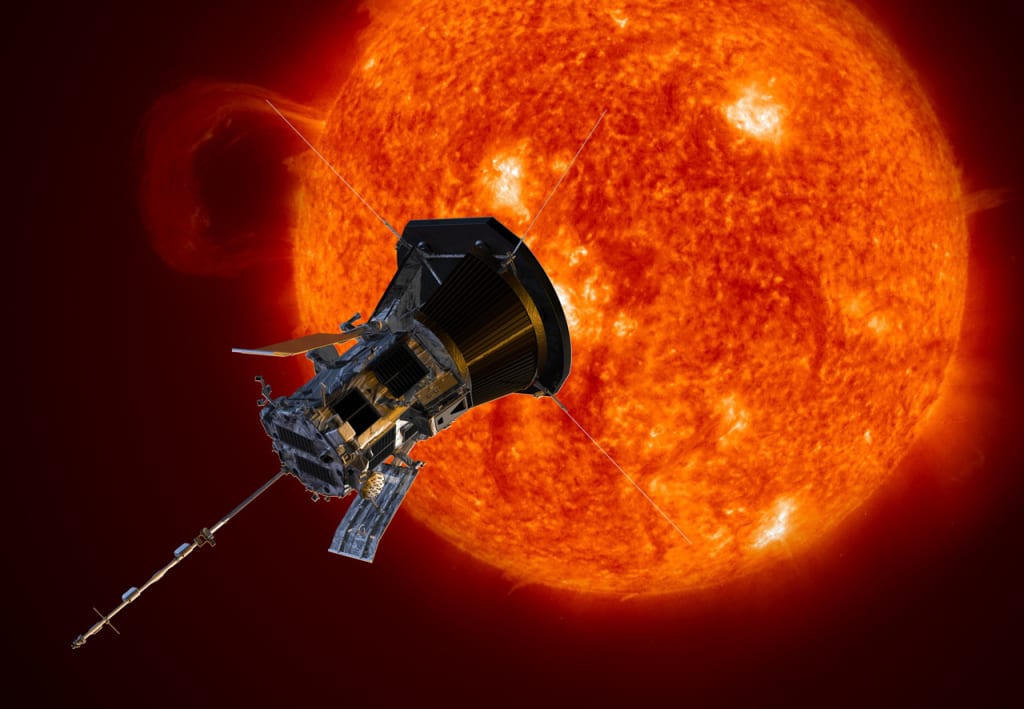
Parker Solar Probe, also known as PSP, is a NASA spacecraft that is designed to study the sun's outer atmosphere, or corona, in unprecedented detail. The spacecraft is named after the American astrophysicist Eugene Parker, who is best known for developing the concept of the solar wind. The Parker Solar Probe was launched on August 12, 2018, and since then it has been on a mission to explore the sun's corona and provide answers to some of the most fundamental questions about our closest star.
The Parker Solar Probe aims to study the solar wind at its source, the sun's corona, to understand how it is generated and how it evolves over time.
Determine the structure and dynamics of the sun's corona: The sun's corona is the outermost layer of its atmosphere and is much hotter than the sun's surface. It is also the region where the solar wind is accelerated to high speeds. The Parker Solar Probe aims to study the corona in detail to understand its structure and dynamics, including the processes that heat it to temperatures of millions of degrees.
Investigate the mechanisms that drive solar energetic particles and flares: Solar flares and energetic particles can have a significant impact on Earth's technology and infrastructure. The Parker Solar Probe aims to study these phenomena to understand how they are generated and how they propagate through the solar system.
Explore the sun's magnetic field and its role in shaping the solar wind and corona: The sun's magnetic field plays a crucial role in the generation and evolution of the solar wind and corona. The Parker Solar Probe aims to study the magnetic field in detail to understand its structure and how it interacts with the plasma in the corona and solar wind.
Design of the Parker Solar Probe:
The Parker Solar Probe is a compact spacecraft with a mass of approximately 685 kg (1,510 lbs) and a length of 3.1 meters (10.1 feet). Its design is optimized for its mission to study the sun's corona up close and withstand the extreme conditions it will encounter.
The spacecraft is powered by two solar arrays, which provide up to 685 watts of power at a distance of 0.25 astronomical units (AU) from the sun. As the spacecraft approaches the sun, it will use a sunshield to protect its instruments from the intense heat and radiation.
The Parker Solar Probe is also equipped with a suite of scientific instruments, which are designed to study the sun's corona and solar wind in detail. These instruments include:
The FIELDS instrument suite, which measures electric and magnetic fields in the solar wind and corona.
The WISPR instrument, which captures images of the solar corona and solar wind.
The SWEAP instrument suite, which measures the properties of the solar wind, including its density, temperature, and velocity.
The ISOIS instrument suite, which measures the composition of energetic particles in the solar wind.
The HIRA instrument, which measures the properties of high-energy particles in the solar wind.
Scientific Discoveries from the Parker Solar Probe Mission:
Since its launch, the Parker Solar Probe has provided unprecedented insights into the sun's corona and solar wind. Some of the most significant scientific discoveries from the mission are:
The sun's corona is much hotter than previously thought: One of the biggest mysteries of the sun's corona is why it is so much hotter than the sun's surface. The Parker Solar Probe has provided new insights into this phenomenon, revealing that the corona is even hotter than previously thought. The spacecraft has measured temperatures of up to 3.6 million degrees Fahrenheit (2 million degrees Celsius) in the corona.
The solar wind is much more variable than previously thought: The Parker Solar Probe has revealed that the solar wind is much more variable than previously thought, with rapid fluctuations in its density, velocity, and temperature. These fluctuations can have a significant impact on Earth's space weather.
The sun's magnetic field is much more complex than previously thought: The Parker Solar Probe has provided new insights into the sun's magnetic field, revealing that it is much more complex than previously thought. The spacecraft has observed "switchbacks" in the magnetic field, where it reverses direction and becomes more turbulent. These switchbacks are thought to be a key driver of the solar wind.
The solar wind is much faster than previously thought: The Parker Solar Probe has measured the speed of the solar wind as it flows away from the sun. The spacecraft has observed speeds of up to 430 miles per second (700 kilometers per second), much faster than previously thought. This high-speed solar wind can have a significant impact on Earth's space weather.
The sun's atmosphere is full of energetic particles: The Parker Solar Probe has detected a wide range of energetic particles in the sun's corona and solar wind. These particles include electrons, protons, and helium ions, some of which are accelerated to speeds close to the speed of light. These energetic particles can have a significant impact on the space environment around the sun.
Implications of the Parker Solar Probe Mission:
The Parker Solar Probe mission is providing new insights into the sun and its impact on Earth's space environment. Some of the implications of these findings are:
Improved space weather forecasting: The Parker Solar Probe's measurements of the solar wind and corona can help improve our ability to forecast space weather, which can have a significant impact on Earth's technology and infrastructure.
Better understanding of the sun's influence on Earth's climate: The sun's activity is known to have a significant influence on Earth's climate. The Parker Solar Probe's measurements of the solar wind and corona can help us better understand this influence and its implications for climate change.
Improved understanding of the origins of the solar system: The sun and the solar system formed from a cloud of gas and dust approximately 4.6 billion years ago. The Parker Solar Probe's measurements of the sun's corona and solar wind can help us better understand the conditions that existed in the early solar system and how it evolved over time.
Conclusion:
The Parker Solar Probe mission is providing unprecedented insights into the sun's corona and solar wind. The spacecraft's measurements are revealing new details about the sun's magnetic field, the properties of the solar wind, and the composition of the sun's atmosphere. These findings are helping us better understand the sun and its impact on Earth's space environment, including its influence on space weather and climate. As the Parker Solar Probe continues its mission, we can expect even more exciting discoveries that will deepen our understanding of our closest star.
About the Creator
Arish Ali
The world is yours!
Top Australian Writers’ Festival Cancelled After Palestinian Author Barred
One of Australia’s most respected literary festivals has been cancelled following a fierce backlash over the decision to bar a Palestinian author from participating. What began as a programming dispute quickly escalated into a national debate about free speech, cultural inclusion, and political pressure in the arts. The cancellation has sent shockwaves through Australia’s literary community, raising urgent questions about whose voices are allowed on public platforms and at what cost.
By Aarif Lashari4 days ago in Earth
The Trans Youth Athletes in the US Fighting for Their Rights: ‘Playing Is an Act of Resistance’
Across the United States, sports have become an unexpected front line in the fight over transgender rights. For many trans youth athletes, simply stepping onto a field, track, or court is no longer just about competition—it is an act of resistance. As state legislatures debate and pass laws restricting transgender participation in school sports, young athletes are finding themselves at the center of a national culture war that reaches far beyond the locker room.
By Aarif Lashari4 days ago in Earth




Comments
There are no comments for this story
Be the first to respond and start the conversation.