
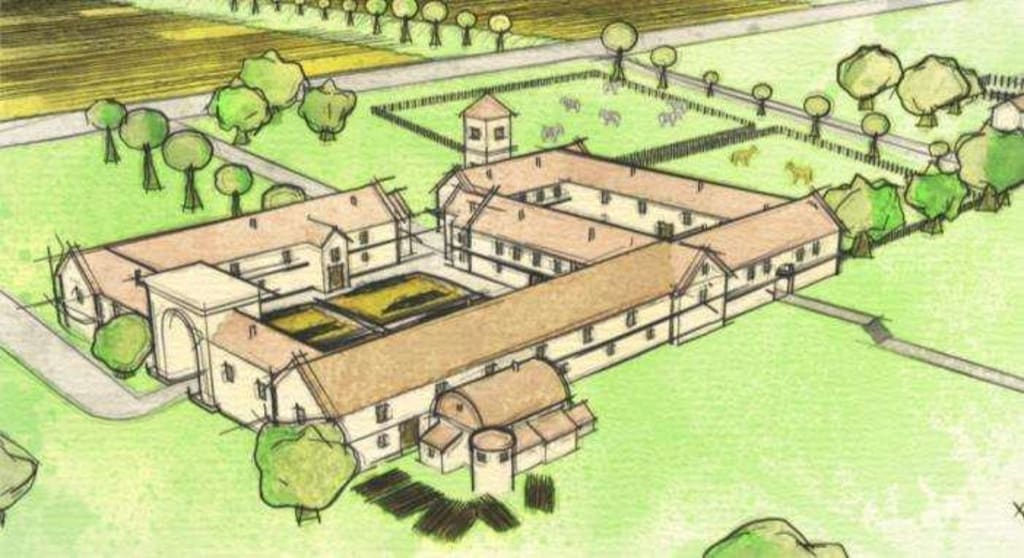
The kinship entered into the villas interior. Around the central garden, five stories opened upward like giant steps of a pyramid, and each held a terrace as the architecture receded before the rising garden. Sweeping backward as the ceiling revealed open sky on each of the four sides, the sight of draped mosses refreshed Echecrates, ever since the days of his youth. The tiered terraces let sunlight in through the clear plexiglass dome above. A dome that would soon open as winter approached its end. For now, layers of additional sheeting extended from each terrace, creating a collage of coloured streaks as the 6 layer bubble kept in pockets of warm air.
All around him, the garden burst forth. Oil plants teemed with life, as water dripped from above in a soothing and melodic rhythm. Droplets splashed down onto rocks and scattered amongst the soil of the plants. It was a pleasant place to sit and play chess, though it was a place of chaos at times, as children would enter the playground and gather to learn in their play.
The panopticon had its value he thought to himself. All around five gardeners or more kept watch at varying times, ensuring the garden maintained its wealth. 250,000 such gardens existed in the commonwealth now. but more than helping ensure the villas self-sufficiency, the gardeners would sometimes take notes on the children. They say that it takes a village to raise a child, and the gardeners often gave parents advice on those proclivities they observed when children thought no one was watching.
"So you see," he said to Crito, "that is what I felt Socrates meant when he spoke of the lyre and cloak. Those things which express the height of an artisan's capacity were never the foundation of our spirit."
"Oh?" Crito replied, "but should I assume the church was right in its commentary?"
Echecrates smiled ruefully. "The church made its attempts, always lost in its own search for the superior man. They had to turn to celibacy as the marker which would render men untouched by so many things which had nothing to do with the sexes. They made a noble attempt but held their gaze turned to the world, without appreciation. "
Overhead an owl hooted in the light of freshly lit lanterns. It swooped down to grab a rarely seen mouse scurrying amongst bowls of fruit. A sleek flash of snow-white, present and then gone among the roosts. The noble animal settled down into its meal, pausing only briefly, to stare at the company below.
Echecrates knife flashed as he deftly plucked a brilliant green apple and cut a wedge out. The fruits juices burst in his mouth as he breathed in the cool evening air. "Still," he continued, "it is Socrates' move towards Phaedo which rings true with me. Just like a lock of hair, a lyre can be cut, or a cloak left as a mere remembrance of its original maker, but these are not the soul that guides the body. Just look around us! Once these sweeping halls, the hanging moss, those owls now so active were broken dreams. It is in the most basic things of Terra that inspiration, care, courage, strength and all the facets of the soul spring forward. All these walls and gardens which glint with the luster of the soul arose from the simplest of things."
The group settled for a moment near a bamboo fountain. The trickling water cascaded down from just above them, caught by crescents of rocky and bells. Its sound was just audible, but it had stood in such sharp contrast to the sharp 'phac!' when the owl had gained its meal.
"Like the lyre, one does not begin with strings, but rhythm and inspiration." Echecrates continued. " That is why Socrates said that Phaedo should not grow long hair again until he proved the soul persists when all its instruments lay torn asunder. The dullness and wreckage of the world do not mean the death of what it means to be alive, not any more than the ghosts which haunt things of grandeur long since passed from this place. We live this moment, just like the first garden villas where a rekindling of a spirit that had never died but lay passively, quiet and meek. If we cannot make such arguments as this place first required, then what good is a lock of hair, or the strings of a lyre? Even the maker of a fine cloak goes to waste when one cannot argue for the soul which dwells in the form and thus creates it. And yet, where that soul resides, the form is only an inevitability."
"I feel like I understand this, what has been said rings a note within my heart," Crito responded after a long pause. Neither felt the need to speak further, but neither did they wish to part, so the sound of cascading water spoke their hearts for them. Above the night owl hooted once more as it looked about attentively, seeing no-thing in particular, but letting the space reveal itself and the most minute movement.
"Ah!" Crito began at long last, "but time pauses for none of us my friend and I must be going. May our interests bring us to meet again sometime soon."
The party shared final words and some stayed for a bite, but the night felt content and few words passed before Echecrates found himself alone. He reclined backwards slightly as his bearded chin fell and his eyes met with the owls. Echecrates held the gaze for a moment and settled in to meditate.
It is a difficult thing to allow imagination to happen, vision. One can gather all their strength and feel little better than a man in a cave hammering the rock of their mind into an image, a kind of imagination. To let go of ones body though. . . That takes years of practice except for a lucky few, almost born with second sight.
Echecrates relaxed his thought, let the sound of the falling water enter him, let his mind wrap around its timid cacophony. Vibration weaves with vibration and his hands soon lost their particular feel, just like when he became lost in carving. The feeling of his rhythmic breathing remained as the water flowed through his mind's eye. Again Echecrates tucked in his chin slightly and turned inwards yet further. His eyes smiled and the vision swam until an owl blinked its great eyes and looked intently at him. A thousand minds swirled amid the owl, friends past and present, enemies, family, colleagues. A voice spoke through the owl, as it beckoned him to follow.
Echecrates envisioned then a great garden, that same one which he was in presently. Only the owl remained the same, its head bobbing once more. Almost as if to say follow me. There was only one way to find out. First though he let himself flow to the owl and his gentlr vibrating hands turned misty and cool. Wings spread forth and the one leaped into the air, followed in harmony by the other, though it was difficult to say who led. Echecrates soon turned to follow the owl beyond his vision of the familiar. As it soared beyond the walls of the gardens 5th story, Echecrates exhaled and opened into the unknown.
About the Creator
Keep reading
More stories from Warren Peidl and writers in Earth and other communities.
Polar Opposition
At the extremes: Stoic -vs-Epicurean Epicurean: One should enjoy life to its fullest by savouring each experience. Stoic: It is good to be happy, but you lose the habit of accentuating each mild pleasure when you pursue only the epitome of pleasure. Old age will come and leave a hollow want, where the statement that you must have been great is only a bitterness. It is better to habituate satisfaction with the moment, letting the cherry on top come as a passing fruit bound to fade.
By Warren Peidl4 years ago in Psyche
Without Democracy, Donald Trump’s Venezuelan Oil Quest Will Fail
Donald Trump’s renewed interest in Venezuelan oil may seem, on the surface, like a hard-nosed geopolitical calculation. Venezuela holds the world’s largest proven oil reserves, and amid global energy uncertainty, access to those resources is undeniably tempting. But history, economics, and politics all point to the same conclusion: without democratic reform in Venezuela, any attempt by a Trump-led US administration to secure reliable Venezuelan oil will ultimately fail.
By Aarif Lashari4 days ago in Earth



Comments
There are no comments for this story
Be the first to respond and start the conversation.